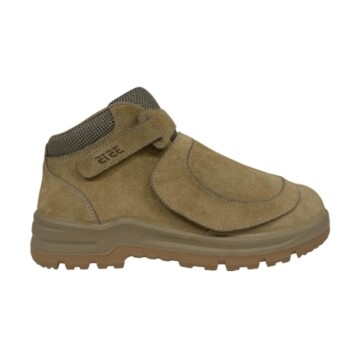
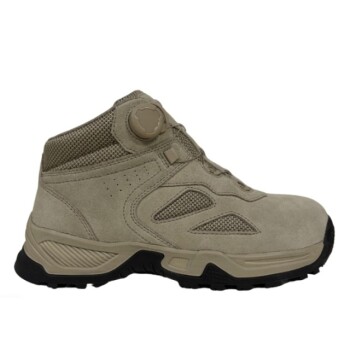
Electrical Hazard (EH) protection is a critical safety requirement for indoor fiber technicians, not because of the fiber cables themselves, but due to the environment in which they are installed. Technicians frequently operate in close proximity to live electrical panels, sockets, and hidden wiring that may suffer from aging or improper grounding. EH-rated tactical boots act as a vital insulator, preventing the body from becoming a pathway to the ground and significantly reducing the risk of fatal shock during accidental contact.
The Core Insight While fiber optics transmit light rather than electricity, the utility closets and server rooms where they terminate are often congested with high-voltage infrastructure. EH-rated boots provide a necessary secondary line of defense by isolating the wearer from the ground, ensuring that an accidental touch of a live wire does not complete an electrical circuit through the technician's body.
The Hidden Risks of Indoor Environments
Proximity to Live Infrastructure
Indoor fiber optic line management rarely happens in isolation. Technicians must route cables near electrical panels and power sockets.
This proximity increases the likelihood of accidental contact with live components. Even a momentary slip or brush against an exposed terminal can be dangerous.
The Threat of "Invisible" Faults
The danger is often concealed within the building's infrastructure. Wiring may be hidden behind walls or within conduits shared with fiber lines.
As noted in industry assessments, these systems often suffer from aging, poor grounding, or improper installation. A technician cannot always visually identify which surfaces or components are electrified.
Preventing Circuit Completion
The fundamental danger of electric shock arises when the body completes a circuit between a live source and the ground.
EH-rated boots interrupt this path. By insulating the feet, they stop the current from flowing through the body to the floor, preventing the shock from becoming fatal.
Technical Capabilities of EH Protection
High-Voltage Resistance
To ensure reliability, EH tactical boots undergo rigorous testing standards.
According to safety specifications, the soles and heels must endure up to 14,000 volts at 60 Hz for 60 seconds. This ensures the boot maintains its integrity even during significant high-voltage events.
Strict Leakage Limits
Withstanding voltage is not enough; the flow of current must also be restricted.
During testing, current leakage is not allowed to exceed 3.0 milliamperes. This strict limit ensures that even if the boot is stressed, the amount of electricity reaching the wearer remains minimal.
Non-Conductive Construction
EH protection relies on the materials used in the boot's manufacturing.
These boots utilize non-metallic parts and specialized insulating compounds. This construction is designed to withstand shocks and voltage for at least one minute, buying the wearer critical time to disengage from the hazard.
Understanding the Trade-offs and Limitations
The "Dry Conditions" Constraint
It is vital to understand that EH ratings are generally valid only in dry conditions.
If the boots become wet or saturated, their insulating properties can be compromised. Water conducts electricity, effectively bypassing the protection the boot materials provide.
Protection vs. Invincibility
EH boots are a secondary source of protection, not a primary shield.
They are designed to protect against accidental contact. They do not enable technicians to intentionally handle live wires or ignore standard lockout/tagout procedures.
Vulnerability to Physical Damage
The sole's integrity is paramount to its safety rating.
If a technician steps on a nail or creates a puncture in the sole, the static discharge and insulation capabilities are ruined. Regular inspection of the soles is just as important as the initial purchase.
Making the Right Choice for Your Safety
Before selecting footwear for a fiber optic project, assess the specific environment and your role.
- If your primary focus is working in older buildings: Prioritize boots with the highest grade of insulation to guard against likely grounding faults or aging wiring.
- If your primary focus is mixed-utility spaces: Ensure your boots are strictly EH-rated and avoid any footwear with conductive metal shanks or eyelets.
- If your primary focus is maintenance: Establish a routine to inspect boot soles for embedded metal or wear that could nullify the electrical resistance.
Treat your footwear as a component of your life-support system, protecting you from the invisible hazards that share space with your fiber lines.
Summary Table:
| Feature | EH Protection Specification | Purpose for Technicians |
|---|---|---|
| Voltage Resistance | 14,000V at 60Hz for 60 seconds | Withstands significant high-voltage contact |
| Leakage Limit | Under 3.0 milliamperes | Minimizes current flow to the body |
| Construction | Non-metallic / Insulating compounds | Eliminates conductive paths to the ground |
| Standard | Secondary line of defense | Guards against accidental contact with live wires |
Secure Your Team with 3515 High-Performance Footwear
As a premier large-scale manufacturer serving distributors and brand owners worldwide, 3515 delivers the specialized safety solutions required for high-risk technical environments. Our flagship Safety Shoes series and EH-rated tactical boots are engineered with advanced non-conductive materials to protect technicians from invisible hazards during fiber optic and utility management.
From work and tactical boots to outdoor and dress shoes, we provide comprehensive production capabilities to meet your bulk requirements with precision and durability. Partner with us to enhance your product lineup and protect your workforce.
Contact us today to discuss your bulk orders and custom specifications!
References
- Mohammad Lathoiful, Hidayat Hidayat. ANALISIS RISIKO KESEHATAN DAN KESELAMATAN KERJA (K3) PADA PROSES PEMASANGAN JARINGAN INTERNET FTTH (FIBER TO THE HOME) DENGAN METODE HIRARC (HAZARD IDENTIFICATION, RISK ASSESSMENT, AND RISK CONTROL) STUDI KASUS DI PT. JINDE GRUP INDONESIA. DOI: 10.55445/jt.v9i01.37
This article is also based on technical information from 3515 Knowledge Base .
Related Products
- Premium Wholesale Tactical Style Safety Shoes Boots with Quick Lacing
- High-Traction Suede Tactical Boots Wholesale & Custom Manufacturing
- Durable Leather Tactical Boots Wholesale & Custom Manufacturing for Brands
- Wholesale Tactical Boots High-Traction & Reflective for Bulk & Brand Orders
- Wholesale Durable Mid-Cut Tactical Boots for Custom & Private Label Brands
People Also Ask
- How are gait analysis research findings applied to the functional design of safety shoes and tactical boots?
- How does anthropomorphic design influence material selection? Enhance Footwear Performance through Biological Alignment
- How do quality certification standards for safety shoes reduce perceived risk? Buy Online with Technical Certainty
- Why is the synchronization of craftsmanship and UX development emphasized for bulk customization of safety shoes?
- How can specialized footwear mitigate safety risks? High-Volume OEM/ODM Solutions since 1951