
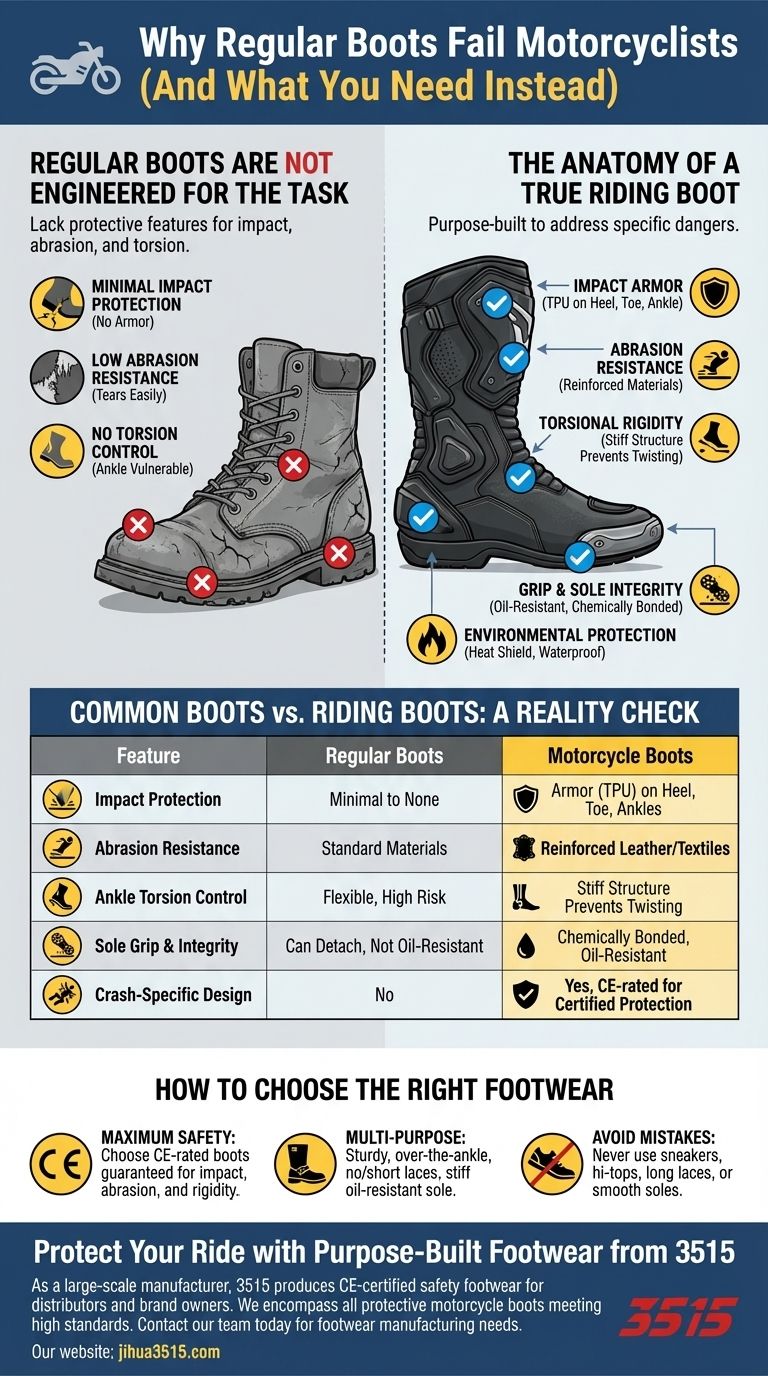
Regular boots are not recommended for motorcycle riding because they are fundamentally not engineered for the task. They lack the specific protective features—such as impact armor, abrasion-resistant materials, and ankle torsion control—designed to mitigate the unique and violent forces involved in a motorcycle accident.
Choosing motorcycle footwear isn't about style; it's about physics. A standard boot fails because it isn't built to protect against the three primary threats of a crash: high-velocity impact, intense abrasion, and severe twisting of the ankle.
The Anatomy of a True Riding Boot
A motorcycle is not a car; you are not surrounded by a protective cage. Your gear is your only defense, and your feet and ankles are exceptionally vulnerable. Purpose-built riding boots address specific dangers that regular boots simply ignore.
Protection Against Impact
A proper motorcycle boot contains integrated armor, often made of thermoplastic polyurethane (TPU), over critical areas. This includes the heel, the toe box, and the ankle bones (malleolus). This armor is designed to absorb and distribute the focused energy of an impact with the pavement or another vehicle.
Resistance to Abrasion
When you fall at speed, you don't just hit the ground—you slide. Standard leather or canvas will be shredded in seconds by asphalt. Motorcycle boots use thick, reinforced leather or advanced abrasion-resistant textiles to keep the boot intact and protect your skin underneath.
Torsional Rigidity
One of the most common and severe riding injuries is a twisted or crushed ankle. Motorcycle boots are built with a stiff structure that prevents the foot from bending or twisting in unnatural directions during a crash. This torsional rigidity is a feature entirely absent in a flexible work boot or sneaker.
Grip and Sole Integrity
The sole of a riding boot is chemically bonded and designed to be oil-resistant and non-slip, ensuring a secure grip on the pegs and on the ground. More importantly, the sole is engineered to remain attached to the boot during the extreme forces of a crash, unlike many regular boots which can be torn apart.
Environmental Protection
Beyond crash safety, riding boots serve other practical functions. They shield your feet from the intense heat radiating from the engine and exhaust pipes. Many are also waterproof and offer features like reflective panels for nighttime visibility, enhancing both comfort and safety.
Common Boots vs. Riding Boots: A Reality Check
Many riders attempt to substitute other types of sturdy footwear, but each comes with critical compromises. Understanding these trade-offs reveals why purpose-built gear is superior.
The Problem with Standard Work Boots
While a sturdy leather work boot is undoubtedly better than a sneaker, it lacks specialized protection. Most work boots have a steel toe for drop protection, not slide and impact protection. Their construction is too flexible to prevent ankle torsion, and their soles are not designed for the specific grip needed for riding.
The Hazard of Loose Laces
Many hiking and combat boots feature long laces. These present a significant snag hazard, with the potential to get caught on a footpeg, shifter, or brake lever at a critical moment. This can prevent you from putting your foot down at a stop or, in the worst case, cause an accident.
The False Security of "Sturdy" Alternatives
Engineer and some combat boots are often considered better alternatives, and they can be. They offer good ankle coverage and often lack laces. However, they still fall short of the dedicated impact armor and torsional stiffness found in a true motorcycle boot. Cowboy boots, with their smooth leather soles, are particularly dangerous as they offer virtually no grip on asphalt.
How to Choose the Right Footwear
Your choice of footwear should be a deliberate calculation of risk and intended use. There is no single "best" boot, only the best boot for your specific needs.
- If your primary focus is maximum safety: Choose a boot that is CE-rated, which certifies it has passed standardized tests for impact, abrasion, and rigidity. This is the only way to guarantee a specific level of protection.
- If your primary focus is a practical, multi-purpose option: Look for sturdy, over-the-ankle leather boots with no laces (like engineer boots) or very short, securely tucked laces. Ensure they have a stiff, oil-resistant sole.
- If your primary focus is simply avoiding critical mistakes: Never ride in sneakers, hi-tops, hiking boots with long laces, or any footwear with a smooth sole like cowboy boots. These offer almost no meaningful protection.
Ultimately, your footwear is a critical piece of safety equipment, not a fashion accessory.
Summary Table:
| Feature | Regular Boots | Motorcycle Boots |
|---|---|---|
| Impact Protection | Minimal to none | Armor (TPU) on heel, toe, and ankles |
| Abrasion Resistance | Standard materials | Reinforced leather/textiles for slides |
| Ankle Torsion Control | Flexible, high risk of injury | Stiff structure prevents twisting |
| Sole Grip & Integrity | Can detach; not oil-resistant | Chemically bonded, oil-resistant, non-slip |
| Crash-Specific Design | No | Yes, CE-rated for certified protection |
Protect Your Ride with Purpose-Built Footwear from 3515
As a large-scale manufacturer, 3515 produces a comprehensive range of CE-certified safety footwear for distributors, brand owners, and bulk clients. Our production capabilities encompass all types of protective motorcycle boots and boots designed to meet the highest standards of impact resistance, abrasion protection, and torsional rigidity.
We help you equip riders with the essential defense they need. Contact our team today to discuss your footwear manufacturing needs and ensure superior protection for your customers.
Visual Guide
Related Products
- Heavy-Duty Waterproof Nubuck Safety Boots Safety Shoes for Bulk Supply
- Durable Goodyear Welt Leather Work Boots for Wholesale & Private Label
- Wholesale Tactical Boots High-Traction & Reflective for Bulk & Brand Orders
- Premium Wholesale Tactical Style Safety Shoes Boots with Quick Lacing
- Wholesale Waterproof Tactical Boots Custom Suede & High-Traction Soles
People Also Ask
- What primary protective functions do professional safety boots provide in urban solid waste recovery and waste picking processes? Discover Dual-Layer Protection.
- How do safety boots reduce cutting hazards? Essential Protection for Your Workforce
- Which organizations develop safety standards for work boots? Ensure Compliance & Worker Safety
- What are the common types of safety boots and their primary uses? A Guide to Industrial Footwear
- Why is ankle and arch support important in safety footwear? Prevent Injury & Fatigue



















