In short, high country hunting boots are necessary for rugged terrain because they are a specialized safety system, not just footwear. Their rigid construction, significant ankle support, and durable materials are specifically engineered to prevent serious injury and provide stability on the steep, uneven, and often treacherous landscapes found at high elevations.
The core issue isn't about comfort, but about physics. Standard boots lack the structural integrity to counteract the immense stress that steep inclines and unstable ground place on your ankles and feet, making a purpose-built high country boot a non-negotiable piece of safety equipment.

The Anatomy of a High Country Boot
To understand their necessity, you must first understand their design. These boots are built with a single purpose in mind: conquering vertical, unforgiving environments.
The Critical Role of Ankle Support
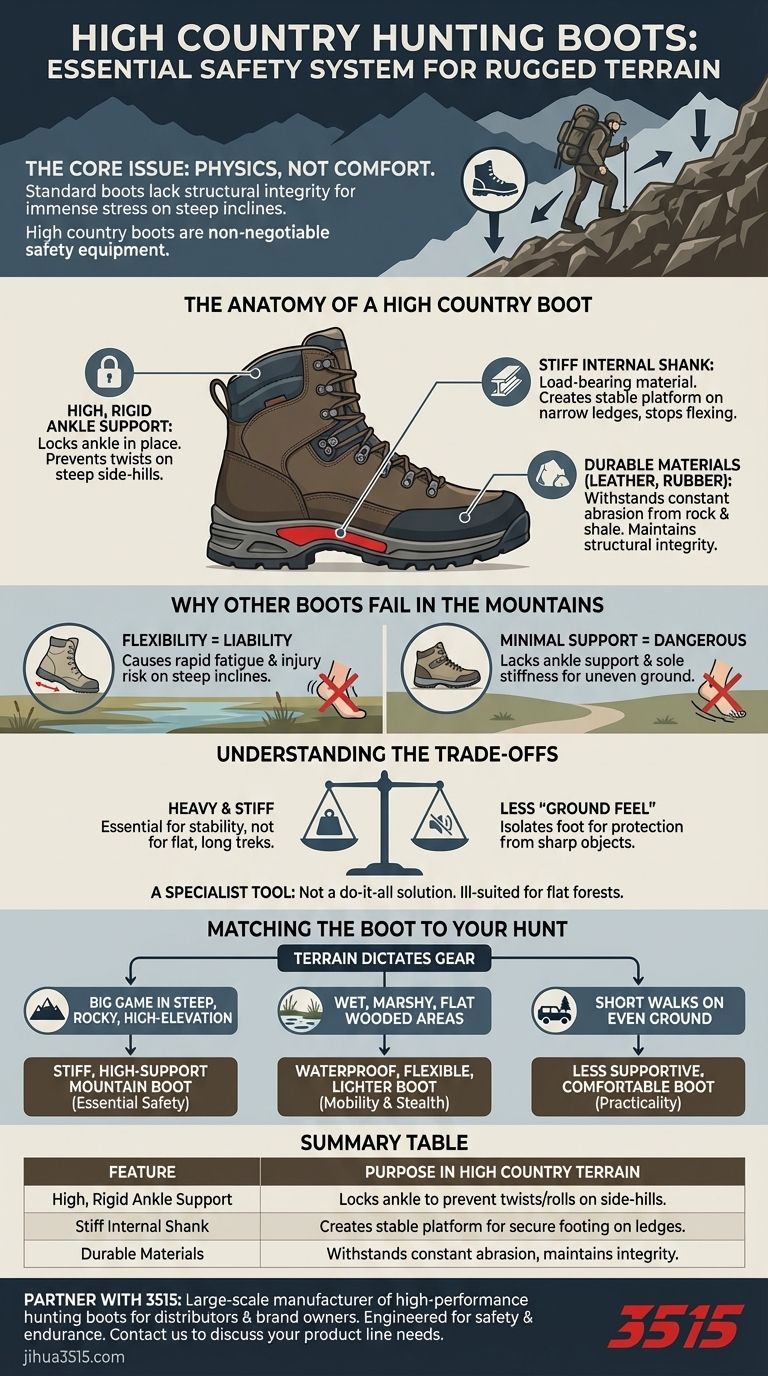
A key feature of a high country boot is its height and rigidity around the ankle. This design is meant to lock your ankle in place, drastically reducing the risk of a debilitating twist or roll when traversing a steep side-hill or navigating loose rock.
This is a fundamental difference from boots designed for flat ground, which prioritize flexibility over rigid support.
Stiffness as a Safety Feature
High country boots feature a thick internal shank, which is a load-bearing piece of material (like stiff nylon or steel) between the insole and outsole. This creates extreme stiffness throughout the boot's sole.
This rigidity allows you to stand securely on narrow ledges or sharp rocks without the boot flexing and compromising your footing. It effectively creates a small, stable platform for your entire foot.
Durability for Abrasive Landscapes
Mountain terrain is relentlessly abrasive. The materials used in high country boots, often including thick leather and rubber rands (protective bumpers), are chosen for their ability to withstand constant scraping against rock and shale, ensuring the boot maintains its structural integrity.
Why Other Boots Fail in the Mountains
The necessity of a specialized boot becomes clearest when you consider the failure points of boots designed for other environments.
The Problem with Flexibility
Boots made for marshlands or flat woods are designed to be lightweight and flexible to enhance mobility and stealth. While perfect for that context, this flexibility becomes a severe liability in the mountains.
On a steep incline, a flexible boot forces the muscles in your feet and arches to work constantly, leading to rapid fatigue and an increased chance of slips and ankle injuries.
When Minimal Support is Dangerous
Many hunters use boots designed for minimal hiking—covering less than a mile from a vehicle to a tree stand. These prioritize comfort for short distances over flat terrain.
Using such a boot in the high country is dangerous. It lacks the ankle support and sole stiffness to protect you, making every step on a steep or uneven surface a significant risk.
Understanding the Trade-offs
As with any specialized tool, the design of a high country boot involves deliberate compromises. Being aware of these is key to understanding their proper application.
The Cost of Stiffness
The rigidity that makes these boots essential in the mountains makes them heavy and often uncomfortable for walking on flat, even ground. They are not ideal for long treks on maintained trails or roads.
A Lack of "Ground Feel"
The thick, stiff sole that protects your foot also isolates it. You lose the ability to feel the fine details of the terrain beneath you, a trade-off made in favor of absolute stability and protection from sharp objects.
Not a Do-It-All Solution
A high country boot is a specialist. Using it for a quiet stalk through a flat hardwood forest would be noisy, clumsy, and uncomfortable. It is overkill and ill-suited for any environment that is not steep and rugged.
Matching the Boot to Your Hunt
The right choice is entirely dependent on the terrain you plan to conquer. Let your environment dictate your gear, not the other way around.
- If your primary focus is big game in steep, rocky, high-elevation terrain: You must choose a stiff, high-support boot designed specifically for the mountains.
- If your primary focus is hunting in wet, marshy, or relatively flat wooded areas: Prioritize a waterproof, flexible, and lighter-weight boot that allows for mobility and stealth.
- If your primary focus is short walks from a vehicle to a stand on even ground: A less supportive, more comfortable boot is sufficient and far more practical for your needs.
Ultimately, selecting the right boot is the first step in building a foundation of safety and endurance for any successful hunt.
Summary Table:
| Feature | Purpose in High Country Terrain |
|---|---|
| High, Rigid Ankle Support | Locks ankle in place to prevent twists and rolls on steep side-hills. |
| Stiff Internal Shank | Creates a stable platform for secure footing on narrow ledges and sharp rocks. |
| Durable Materials (Leather, Rubber) | Withstands constant abrasion from rock and shale to maintain boot integrity. |
Ready to equip yourself with the right foundation for your next high-country hunt?
As a large-scale manufacturer, 3515 produces a comprehensive range of high-performance hunting boots for distributors, brand owners, and bulk clients. Our production capabilities encompass all types of rugged footwear engineered for safety and endurance in the most demanding environments.
Contact us today to discuss how our specialized boots can become a cornerstone of your product line or next hunting expedition.
Visual Guide
Related Products
- Wholesale Lightweight Tactical Boots Custom Manufacturer for Desert & Combat Use
- High-Traction Suede Tactical Boots Wholesale & Custom Manufacturing
- Durable High-Ankle Tactical Boots Wholesale Manufacturer for Custom & Bulk Orders
- Wholesale High-Traction Camo Boots - Custom Manufacturer for Brands
- Durable High-Ankle Tactical Boots for Wholesale & Custom Manufacturing
People Also Ask
- What are the common types of combat boots? Find the Right Boot for Your Mission
- What specialized protections do tactical boots offer? Maximize Endurance with High-Performance Footwear
- How does additive manufacturing equipment reduce environmental risks? Sustainable Tactics for Modern Footwear Production
- What is the role of high-frequency acquisition hardware in technical skill analysis for outdoor and tactical boots?
- What are the different types of tactical boots available? Find the Right Boot for Your Mission