
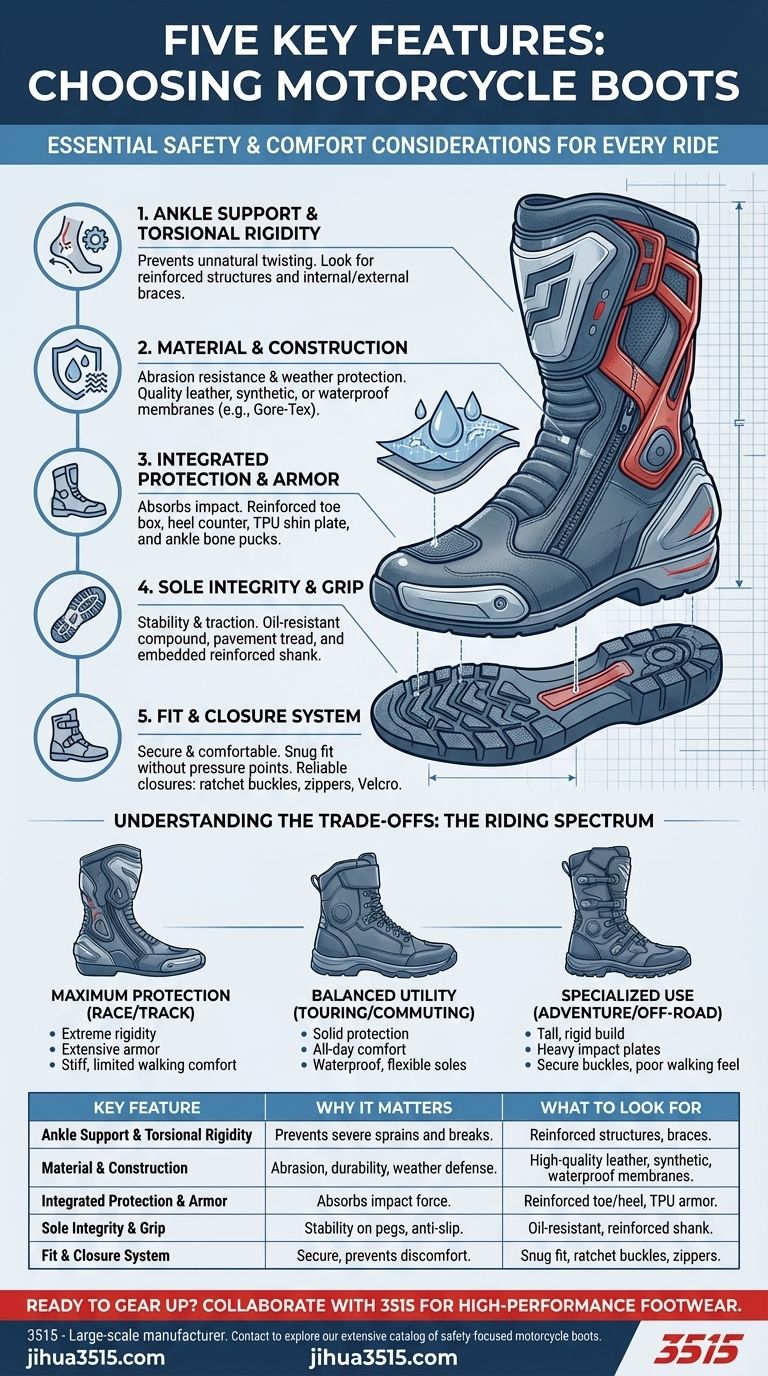
To choose the right motorcycle boots, you must evaluate five key features that directly impact your safety and comfort on the road. The most critical considerations are the boot's level of ankle support and torsional rigidity, the quality and type of construction materials, the integrated armor and protection systems, the integrity and grip of the sole, and the overall fit combined with a secure closure system.
The most common mistake is treating motorcycle boots like casual footwear. They are essential safety equipment, and the right choice is not about style, but about matching the level of protection to the specific hazards of your riding environment.

Deconstructing the Five Pillars of a Motorcycle Boot
Understanding what makes a dedicated motorcycle boot superior to a standard work or hiking boot requires looking at its specific construction. Each feature is designed to mitigate a particular risk associated with riding.
1. Ankle Support & Torsional Rigidity
This is arguably the most important safety feature. Your ankles are extremely vulnerable to twisting forces (torsion) and impact during a crash.
A proper riding boot is engineered to be torsionally stiff, meaning it resists twisting. This prevents your ankle from rotating unnaturally, a common cause of severe sprains and broken bones.
Look for boots with reinforced structures around the ankle. High-end race and touring boots often feature external braces or internal support systems designed specifically to limit dangerous lateral movement while still allowing for necessary forward and backward flex.
2. Material & Construction
The materials determine a boot's ability to resist abrasion, protect from impact, and handle different weather conditions.
Leather remains a top choice for its exceptional abrasion resistance and durability. Synthetic materials like microfiber offer a lighter-weight alternative with similar protective qualities.
For weather protection, look for boots with a waterproof and breathable membrane, such as Gore-Tex. This keeps your feet dry from external rain while allowing internal sweat vapor to escape, which is critical for comfort on long rides.
3. Integrated Protection & Armor
A riding boot is not just a covering; it's a piece of armor for your foot. Standard shoes offer almost no meaningful impact protection.
Key protective elements include a reinforced toe box to prevent crushing injuries and a stiff heel counter to protect from impact and stabilize the foot.
Look for armor covering the ankle bones (often called "pucks" or inserts) and a shin plate on taller boots. These components, typically made of hard TPU (Thermoplastic Polyurethane), are designed to absorb and distribute the force of an impact.
4. Sole Integrity & Grip
The sole of a motorcycle boot serves two distinct purposes: providing grip on the ground and stability on the pegs.
The sole must be made of an oil-resistant compound to ensure you don't slip when putting a foot down on a slick surface at a stop. The tread pattern is designed for grip on pavement, not just dirt.
Furthermore, a good boot has a reinforced shank embedded in the sole. This steel or composite shank adds rigidity, preventing the sole from flexing over the footpeg and protecting your arch from injury.
5. The Critical Importance of Fit & Closure
All the safety features in the world are useless if the boot doesn't fit properly or stay on in a crash. A boot that is too loose can shift or come off entirely, while one that is too tight creates painful pressure points and cuts off circulation.
Always try boots on, preferably at the end of the day when your feet are slightly swollen. Ensure there's no major heel lift and that your toes aren't crammed. Consider the anatomical shape of the boot, as some manufacturers offer gender-specific designs for a more precise fit.
A secure closure system is non-negotiable. Laces can be a snag hazard, so if a boot has them, they must be secured by a retaining strap. Zipper and Velcro combinations are common on touring boots, while ratchet buckles are standard on race and off-road boots for their precise and secure fit.
Understanding the Trade-offs
No single boot is perfect for every type of riding. The primary trade-off is almost always between maximum protection and all-day comfort or walkability.
The Riding Spectrum
Think of boot selection as a spectrum. On one end, you have highly protective but stiff race boots. On the other, you have more flexible but less armored riding shoes. Your ideal boot is somewhere on that spectrum, dictated by how and where you ride.
Maximum Protection (Race & Track Boots)
These boots prioritize safety above all else. They feature extensive external armor, extreme torsional rigidity, and replaceable toe sliders. The trade-off is that they are often stiff, cumbersome for walking, and may have limited waterproofing.
Balanced Utility (Touring & Commuting Boots)
This is the most versatile category. These boots balance solid protection—including ankle support and subtle armor—with features designed for long-term comfort, such as waterproofing and more flexible soles for easier walking during stops.
Specialized Use (Adventure & Off-Road Boots)
Adventure (ADV) and motocross boots offer a different kind of maximum protection. They are tall and extremely rigid, with heavy shin plates and secure buckle systems designed to protect against impacts from rocks, logs, and the bike itself. Their primary trade-off is a near-total lack of walking comfort and feel for the controls.
Making the Right Choice for Your Riding Style
Assess your primary riding environment and choose the equipment that best mitigates its specific risks.
- If your primary focus is daily commuting or urban riding: Opt for a shorter, reinforced riding shoe or boot that offers certified ankle, toe, and heel protection without being too bulky for walking.
- If your primary focus is long-distance touring: Prioritize a waterproof, comfortable boot with good torsional support and subtle armor that you can wear all day in variable weather.
- If your primary focus is aggressive street or track riding: Invest in a dedicated race boot with the highest level of certified protection, torsional rigidity, and impact armor available.
- If your primary focus is adventure or off-road riding: Choose a tall, heavily armored ADV or motocross boot with a stiff sole and multiple buckle closures for maximum security and impact resistance.
Ultimately, your boots are a critical investment in your personal safety, so choose them with the same care you would your helmet.
Summary Table:
| Key Feature | Why It Matters | What to Look For |
|---|---|---|
| Ankle Support & Torsional Rigidity | Prevents severe sprains and breaks by resisting twisting forces. | Reinforced ankle structures, external braces, or internal support systems. |
| Material & Construction | Determines abrasion resistance, durability, and weather protection. | High-quality leather or synthetic materials; waterproof/breathable membranes like Gore-Tex. |
| Integrated Protection & Armor | Absorbs and distributes impact force to protect feet and ankles. | Reinforced toe box, stiff heel counter, TPU armor on ankle bones and shin. |
| Sole Integrity & Grip | Ensures stability on pegs and prevents slipping on slick surfaces. | Oil-resistant compound, reinforced shank, and pavement-specific tread pattern. |
| Fit & Closure System | Keeps boots secure in a crash and prevents discomfort or circulation issues. | Snug fit with no heel lift; secure closures like ratchet buckles or zipper/Velcro combos. |
Ready to Gear Up with the Right Motorcycle Boots?
As a large-scale manufacturer, 3515 produces a comprehensive range of high-performance footwear for distributors, brand owners, and bulk clients. Our production capabilities encompass all types of safety-focused motorcycle boots and shoes, designed to meet the demands of commuters, tourers, racers, and off-road riders. We combine durable materials, advanced protection systems, and ergonomic fits to ensure your customers ride with confidence.
Let’s collaborate to equip riders with boots that prioritize safety without compromising comfort. Contact us today to discuss your specific needs and explore our extensive catalog!
Visual Guide
Related Products
- Wholesale Tactical Boots High-Traction & Reflective for Bulk & Brand Orders
- High Performance Fire-Retardant Waterproof Safety Boots
- Durable Goodyear Welt Leather Work Boots for Wholesale & Private Label
- Wholesale High-Traction Camo Boots - Custom Manufacturer for Brands
- Heavy-Duty Waterproof Nubuck Safety Boots Safety Shoes for Bulk Supply
People Also Ask
- How do tactical boots protect against injuries? Discover the Integrated Safety System
- What are the consequences of wearing ill-fitting tactical boots? Avoid Injury and Boost Performance
- What role does repairable design play in tactical boots? Extend Lifespan & Cut Total Ownership Costs
- What features should law enforcement officers look for in tactical boots? Essential Guide for Safety & Performance
- What features enhance breathability and comfort in tactical boots? A Guide to Superior Footwear Performance



















