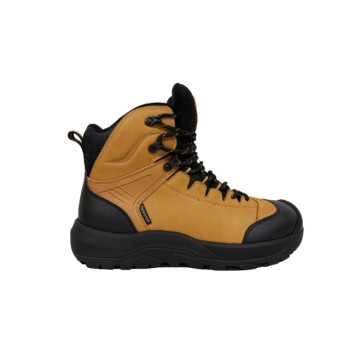
To create a uniform internal electrode. Conductive materials, such as metal balls, are poured into insulating shoes to physically conform to the irregular shape of the shoe's interior. This ensures that high-voltage current is distributed evenly across the entire inner surface of the cavity, allowing for an accurate test of the shoe's insulation capabilities.
The Core Objective: By filling the shoe with conductive material, you transform the empty air void into a solid electrical conductor. This guarantees that the voltage stresses every millimeter of the insulation, preventing structural weaknesses in the sole or upper from escaping detection.
The Mechanics of the Internal Electrode
Creating a Continuous Conductor
The primary purpose of the conductive filling is to act as an internal electrode. A standard rigid electrode cannot fit perfectly inside the complex, organic curves of a shoe.
By using flowable conductive materials like metal balls, the electrode takes the exact shape of the footwear. This eliminates air gaps that could otherwise insulate the material from the test voltage.
Ensuring Comprehensive Surface Contact
For a dielectric strength test to be valid, the current must seek out the path of least resistance.
The conductive filling ensures the high-voltage current fully contacts the inner surface of the shoe cavity. This comprehensive coverage forces the current to test the insulation at every point, rather than just where a probe might touch.
Evaluating Material Integrity
Testing Dielectric Strength
The configuration allows the applied voltage to rigorously evaluate the dielectric strength of the materials used.
By sandwiching the shoe's insulation between the internal conductive filling and an external electrode (usually water or a metal plate), the test creates a uniform electrical field. This setup measures exactly how much voltage the insulation can withstand before breaking down.
Verifying Structural Integrity
Beyond just the material properties, this method tests the overall structural integrity of the shoe.
The filling distributes voltage across seams, joints between the sole and upper, and varying thicknesses of material. This ensures that the finished product functions as a cohesive safety barrier, not just a collection of insulating parts.
Critical Dependencies and Pitfalls
The Necessity of Standardization
The primary reference emphasizes the use of standardized conductive materials.
If the filling material is inconsistent or not sufficiently conductive, the "internal electrode" will have uneven resistance. This can lead to false positives, where the shoe passes the test simply because the current didn't reach a weak spot.
The Risk of Incomplete Filling
The accuracy of the test relies entirely on the material forming a complete interface with the inner surface.
If the shoe is not filled adequately, or if air pockets remain trapped near the toe or heel, those areas remain untested. The test results would only reflect the integrity of the areas that were successfully contacted by the filling.
Making the Right Choice for Your Goal
To ensure your testing yields reliable safety data, consider the following based on your specific objectives:
- If your primary focus is Certification: Ensure the conductive material used is strictly standardized to guarantee the internal electrode provides uniform voltage distribution.
- If your primary focus is R&D: verifying the structural integrity of new designs requires that the filling fully contacts complex geometries, such as new sole-to-upper bonding techniques.
This method is the industry standard because it effectively turns the shoe's complex geometry into a reliable, testable electrical component.
Summary Table:
| Feature | Purpose in Testing |
|---|---|
| Material Used | Conductive metal balls or flowable media |
| Core Function | Creates a uniform internal electrode following shoe contours |
| Key Benefit | Eliminates air gaps to prevent untested weak spots |
| Test Objective | Verifies dielectric strength and structural insulation integrity |
| Critical Factor | Comprehensive filling and standardized material conductivity |
Partner with 3515 for Certified Safety Footwear Excellence
As a premier large-scale manufacturer serving global distributors and brand owners, 3515 leverages rigorous testing standards to ensure every pair of shoes meets the highest safety benchmarks. Our comprehensive production capabilities cover all footwear types, anchored by our flagship Safety Shoes series.
Whether you need work and tactical boots, outdoor shoes, training sneakers, or high-end Dress & Formal shoes, we provide the bulk manufacturing expertise and quality assurance your brand deserves. Contact us today to discuss your production requirements and discover how our technical precision can add value to your product line.
References
- Juan Ramírez, Alex Valenzuela. Estimation of the Current Uncertainty in the Dielectric Shoe Test According to the ISO/IEC 17025 Standard in the High Voltage Laboratory LABAV of the Escuela Politécnica Nacional. DOI: 10.3390/engproc2024077021
This article is also based on technical information from 3515 Knowledge Base .
Related Products
- Premium Insulated Safety Boots and Shoes for Wholesale & Bulk Orders
- Custom Manufactured Air Cushion Leather Business Shoes for Wholesale
- Premium Suede Sport Safety Shoes for Wholesale & Bulk Orders
- Wholesale Durable & Breathable Training Shoes for Custom Brands
- Wholesale Modern Comfort Shoes with Dial Closure for Private Label & Bulk Orders
People Also Ask
- What are the recommended insulation ratings for mild winter conditions? A Guide for Active & Stationary Workers
- How does insulation thickness correlate with temperature ranges? A Guide to Choosing the Right Warmth
- What insulation level is needed for severe cold and stationary work? 1200g or Higher is Essential
- What safety advantages do insulated boots offer beyond warmth? Dielectric Protection & Superior Grip
- How does fleece lining contribute to the warmth of insulated boots? Trapping Air for Superior Cold Protection