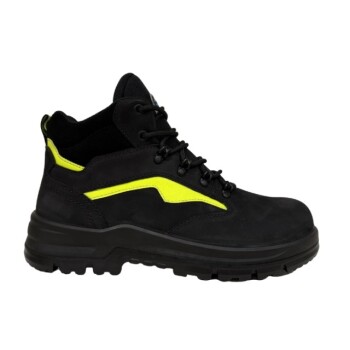
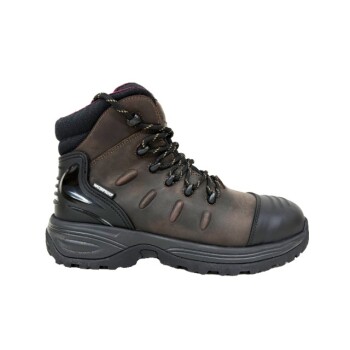
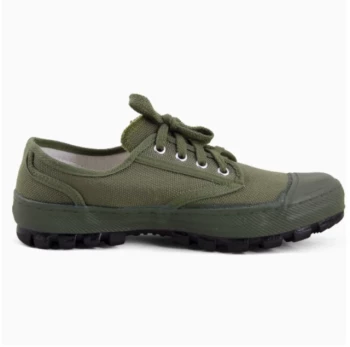
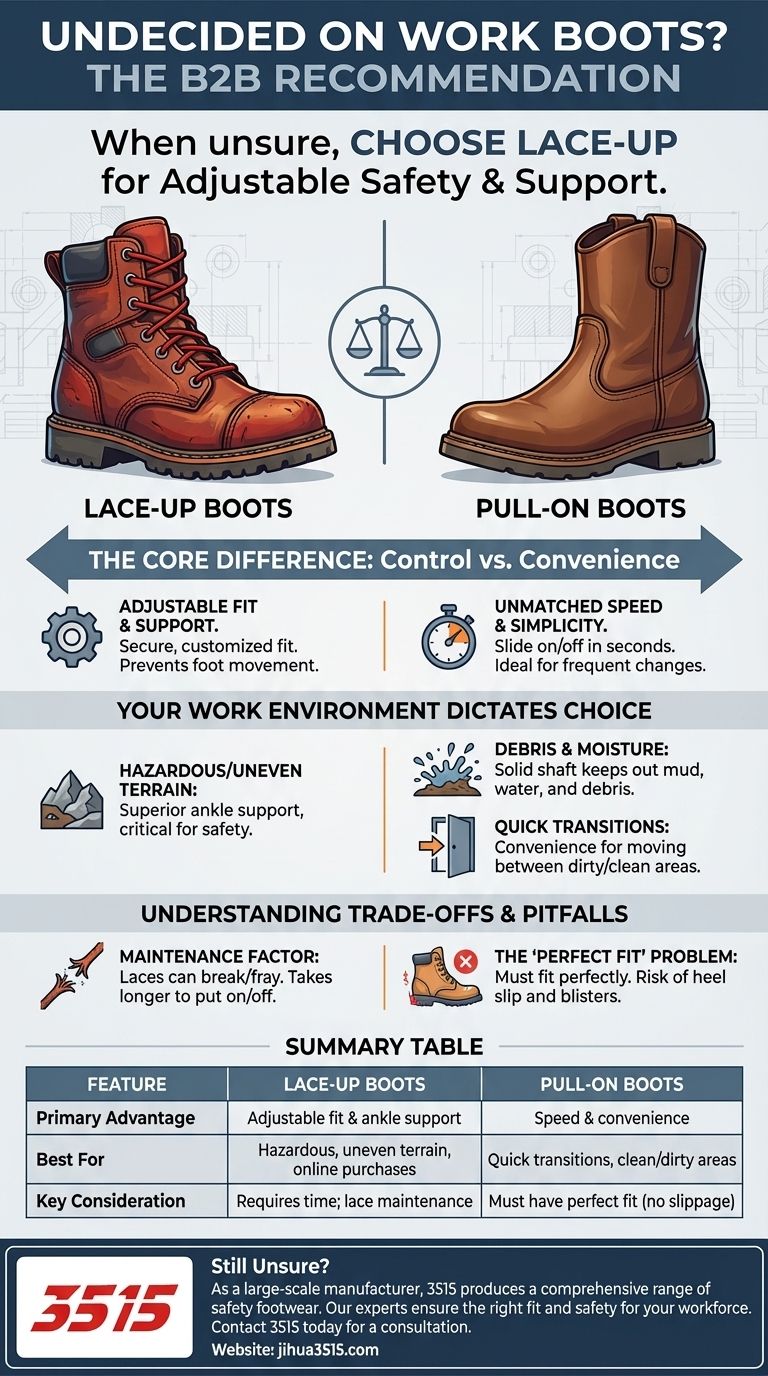
When you're undecided between lace-up and pull-on work boots, the most reliable recommendation is to choose lace-up boots. They offer a fundamentally more adjustable fit and superior ankle support, which are critical safety and comfort factors that accommodate a wider variety of foot shapes and demanding work environments.
The choice isn't about which boot is universally "better," but which one aligns with your core priorities. Lace-up boots prioritize customizable support and safety, while pull-on boots prioritize unmatched convenience and speed.
The Core Difference: Control vs. Convenience
The fundamental distinction between these two boot styles comes down to a single trade-off: a highly controlled, secure fit versus the ease of getting the boot on and off.
Lace-Up Boots: The Standard for Fit and Support
Lace-up boots use a lacing system that allows you to tighten or loosen the fit across your instep and around your ankle.
This adjustability is not a minor feature; it is the primary reason they are recommended for those who are unsure. It provides a more secure, customized fit that prevents your foot from moving inside the boot, reducing friction and increasing stability.
Pull-On Boots: Unmatched Speed and Simplicity
Pull-on boots, often called Wellingtons or cowboy-style work boots, are designed for pure convenience.
Their main advantage is the ability to slide them on and off in seconds without fussing with laces. This is ideal for workers who frequently need to remove their footwear when moving between outdoor and indoor environments.
How Your Work Environment Dictates Your Choice
Your daily tasks and the terrain you navigate should be the most significant factors in your decision. Each boot style excels in different conditions.
For Hazardous or Uneven Terrain
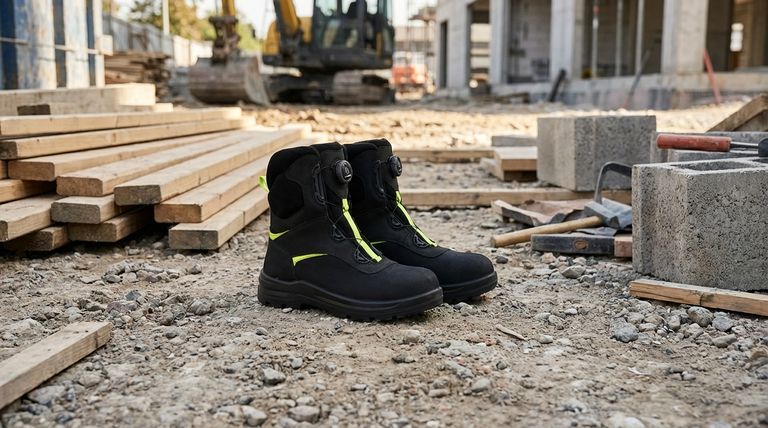
Lace-up boots provide far better ankle support. If you work on construction sites, rough landscapes, or any environment where a twisted ankle is a real risk, the secure fit of a lace-up is a critical safety feature.
For Jobs with Debris or Moisture
Pull-on boots often have a solid, uninterrupted shaft. This design can be more effective at keeping out mud, water, and debris compared to the tongue and eyelets of a lace-up boot.
For Agility and Quick Transitions
If your role requires moving quickly between a dirty work area and a clean office or vehicle, the convenience of a pull-on boot is a significant quality-of-life improvement.
Understanding the Trade-offs and Pitfalls
Trust comes from understanding the downsides. No boot is perfect, and being aware of the potential issues is key to making an informed choice.
The Pull-On "Perfect Fit" Problem
The biggest risk with pull-on boots is the fit. Because they are not adjustable, they must fit your foot and ankle perfectly right out of the box to provide adequate support.
An ill-fitting pull-on boot can lead to your heel slipping, causing blisters and instability. This is why trying them on in person is almost mandatory before purchasing.
The Lace-Up Maintenance Factor
Lace-up boots have their own minor inconveniences. Laces can get caked with mud, fray over time, or break, requiring replacement.
They also take significantly longer to put on and take off properly. While this seems trivial, it can become a daily annoyance depending on your workflow.
Making the Right Choice for Your Needs
To move past indecision, anchor your choice to your single most important requirement.
- If your primary focus is safety and support: Choose lace-up boots. Their adjustable fit and superior ankle protection are non-negotiable for demanding or unpredictable work environments.
- If your primary focus is convenience: Choose pull-on boots, but only after trying them on in person to guarantee a snug, non-slipping fit that feels secure.
- If you are buying online without trying them on: Default to lace-up boots. Their adjustability provides a much higher probability of achieving a safe and comfortable fit.
By prioritizing the demands of your job over style or simple preference, you can confidently select the work boot that will serve you best.
Summary Table:
| Feature | Lace-Up Boots | Pull-On Boots |
|---|---|---|
| Primary Advantage | Adjustable fit & ankle support | Speed & convenience |
| Best For | Hazardous, uneven terrain, or online purchases | Quick transitions, clean/dirty areas |
| Key Consideration | Requires time to put on/take off; laces need maintenance | Must have a perfect fit to prevent heel slippage |
Still Unsure Which Work Boot is Right for Your Team?
As a large-scale manufacturer, 3515 produces a comprehensive range of footwear for distributors, brand owners, and bulk clients. Our production capabilities encompass all types of safety shoes and boots, including both lace-up and pull-on styles designed for maximum safety, comfort, and durability.
Let our experts help you select the perfect boot for your specific work environment and requirements. We ensure the right fit, safety features, and performance for your workforce.
Contact 3515 today for a consultation and discover how our manufacturing solutions can meet your needs.
Visual Guide
Related Products
- Durable Leather Work Boots for Wholesale & Custom Manufacturing
- Durable Leather Work Boots for Wholesale & Custom OEM Manufacturing
- Durable Leather Work Boots Wholesale Manufacturer & Custom Factory
- Durable Leather Moc Toe Work Boots for Wholesale & Custom Manufacturing
- Wholesale Durable 6-Inch Work Boots | Custom & Private Label Manufacturer
People Also Ask
- What is the difference between full-grain and top-grain leather? Premium Material Guide for Boot Manufacturers
- What are the common workplace hazards that can be mitigated with the right work boots? Protect Your Workforce
- What are the common foot issues workers face due to uncomfortable work boots? Prevent Pain & Deformities
- What are the advantages of leather versus synthetic work boots? A Guide to Choosing the Right Material
- What are the key components of modern work boots? Engineered for Ultimate Durability and Comfort