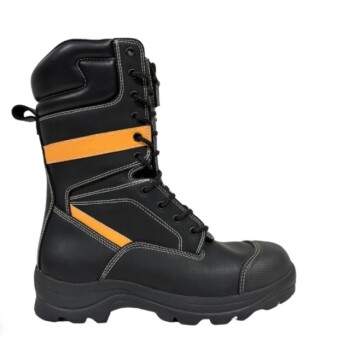
Compliance with rigorous safety standards is the baseline for professional firefighting footwear. To operate in the global market, boots must primarily meet NFPA 1971 (North America) or EN ISO 15090 (Europe and International), alongside regional requirements like ASTM F2413 and OSHA 1910.136. These certifications ensure protection against extreme thermal hazards, liquid penetration, and mechanical impacts.
Professional firefighting footwear must satisfy a hierarchy of international certifications to guarantee life-saving performance. For brand owners and distributors, adhering to these standards is not only a safety mandate but a prerequisite for legal market entry and risk mitigation in high-stakes environments.
The Global Benchmarks: NFPA and EN ISO
NFPA 1971: The Standard for Structural Firefighting
The NFPA 1971 standard is the most critical requirement for structural and proximity firefighting in the North American market. It mandates that footwear pass exhaustive tests for radiant and conductive heat resistance, ensuring the boot remains a barrier against extreme temperatures.
Beyond thermal protection, these boots are evaluated for thermal insulation and liquid penetration resistance to protect against chemicals and bloodborne pathogens. Our heritage in manufacturing since 1951 ensures that these complex layers are integrated without compromising the boot’s structural integrity.
EN ISO 15090 and 20345: The European Foundation
For the European and international B2B markets, EN ISO 15090 is the specialized standard for firefighting footwear, often built upon the EN ISO 20345 safety shoe framework. It requires a protective toecap capable of withstanding 200 joules of impact and a compression test of 15 KN.
These standards also categorize boots by their protection levels (such as S1, S2, or S3), covering slip resistance, durability, and antistatic properties. Professional distributors rely on these ratings to ensure the footwear can withstand the rigorous industrial-grade environments their clients face.
Technical Performance and Testing Requirements
Mechanical and Electrical Integrity (ASTM F2413)
The ASTM F2413 standard defines the minimum requirements for design and performance, specifically focusing on puncture-resistant soles and electrical insulation. This protects firefighters from "hidden" hazards like energized wires or debris in collapsed structures.
Our state-of-the-art production facilities utilize advanced testing equipment to verify that every batch meets these classifications. This consistent high-volume delivery is supported by a robust supply chain that minimizes variability in safety performance.
Resistance to Corrosion and Chemical Exposure
Firefighting environments are often acidic or contaminated with hazardous fluids. Supplementary standards, such as PN EN ISO 20347, ensure that materials—including metal eyelets or internal shanks—are resistant to corrosion and chemical degradation.
Using premium materials like treated leather, Kevlar, and specialized rubber, we maintain a balance between durability and ease of use. This focus on material science is what allows our OEM/ODM partners to scale their brands with confidence in their product’s longevity.
Understanding the Trade-offs and Pitfalls
The Cost of Multi-Regional Certification
Maintaining compliance across NFPA, EN, and ASTM simultaneously involves significant R&D and certification costs. While this increases the initial price point, it is the only way to ensure universal market access and protect against the catastrophic legal liabilities of equipment failure.
Balancing Protection with Weight and Ergonomics
A common pitfall in firefighting footwear design is "over-engineering" for safety at the expense of mobility. A boot that meets all thermal standards but is too heavy can lead to firefighter fatigue and increased risk of injury.
Achieving a high safety-to-weight ratio requires advanced manufacturing equipment and decades of design heritage. We focus on lightweight, puncture-resistant composites and ergonomic cushioning to ensure that safety does not hinder operational speed.
Making the Right Choice for Your Goal
How to Apply This to Your Project
Selecting the right manufacturing partner depends on your specific market focus and volume requirements. A manufacturer with a long-standing history provides the stability needed for large-scale B2B distribution.
- If your primary focus is the North American Municipal Market: Prioritize footwear that is fully certified to the latest edition of NFPA 1971 and meets OSHA 1910.136 regulations.
- If your primary focus is Global B2B or Industrial Reselling: Ensure your inventory complies with EN ISO 15090 and EN ISO 20345 to meet international safety shoe mandates.
- If your primary focus is Premium Brand Development (OEM/ODM): Seek a partner with heritage-driven expertise and the ability to combine multi-standard compliance with custom comfort features.
Choosing footwear backed by comprehensive international certifications ensures that your brand provides the ultimate protection in the world’s most hazardous conditions.
Summary Table:
| Standard | Primary Region | Core Protection Features |
|---|---|---|
| NFPA 1971 | North America | Structural firefighting, radiant/conductive heat resistance, liquid penetration. |
| EN ISO 15090 | Europe/Global | Specialized firefighting footwear; 200J impact protection, slip resistance. |
| ASTM F2413 | USA / International | Puncture-resistant soles, electrical insulation, and mechanical integrity. |
| OSHA 1910.136 | USA | General workplace safety compliance for hazardous environments. |
| EN ISO 20345 | Europe/Global | Basic safety shoe framework; compression resistance and anti-static properties. |
Scale Your Brand with Certified Manufacturing Excellence
Elevate your product lineup with a manufacturing partner that combines 70+ years of heritage with high-tech precision. As a large-scale manufacturer serving distributors and brand owners since 1951, 3515 offers comprehensive production capabilities for all footwear types, anchored by our flagship Safety Shoes series.
For B2B resellers and wholesalers, we address your core concerns by providing:
- Massive Production Scale: Robust supply chain stability for consistent, large-volume delivery.
- Universal Compliance: Expertise in NFPA, EN ISO, and ASTM standards to ensure legal market entry.
- Premium OEM/ODM Capabilities: Tailored designs that balance rigorous safety with ergonomic comfort to boost your profit margins.
- Heritage & Quality: State-of-the-art equipment backed by decades of technical expertise.
From tactical boots and sneakers to professional firefighting footwear, 3515 is your trusted partner for high-stakes performance.
Contact 3515 Today to Discuss Your Bulk Requirements
Related Products
- Premium Flame-Retardant Waterproof Safety Boots and Shoes
- High Performance Fire-Retardant Waterproof Safety Boots
- Wholesale Lightweight Tactical Boots Custom Manufacturer for Desert & Combat Use
- Durable Military Combat Boots with Water Drainage for Wholesale & OEM
- Durable Leather Tactical Boots Wholesale & Custom Manufacturing for Brands
People Also Ask
- Why are waterproof safety boots recommended for certain work environments? Essential Protection for Wet & Hazardous Jobs
- What materials are commonly used in waterproof boots? The Complete Guide to Durable, Breathable Protection
- How does boot construction affect waterproofing? The Science Behind Truly Dry Feet
- What should you look for to ensure boots are fully waterproof? The Essential 2-Part System
- What is the advantage of one-piece construction in waterproof boots? Unbeatable Seamless Protection