
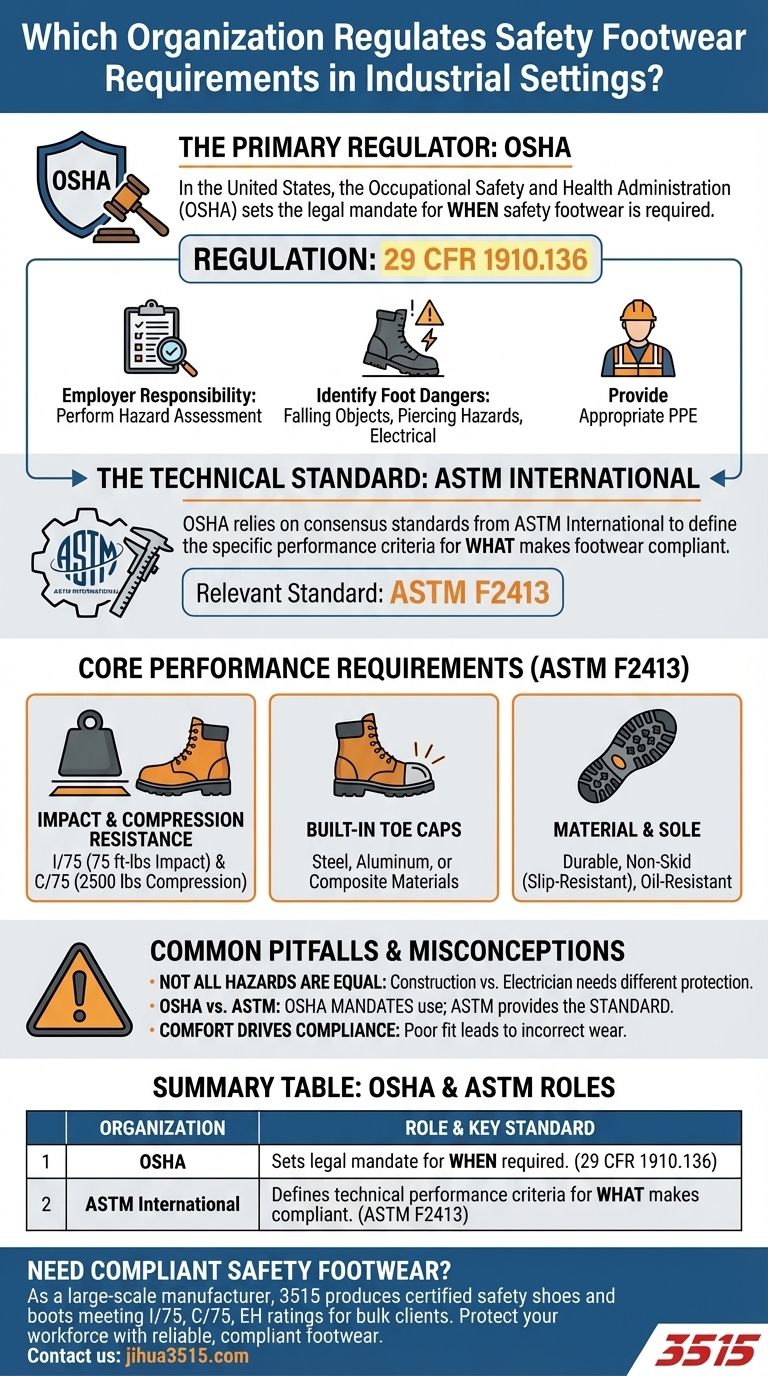
In the United States, the primary organization that regulates safety footwear requirements for industrial settings is the Occupational Safety and Health Administration (OSHA). Through its federal regulation 29 CFR 1910.136, OSHA mandates that employers must ensure their employees use protective footwear when working in areas with a danger of foot injuries.
While OSHA sets the legal mandate for when safety footwear is required, it relies on consensus standards from organizations like ASTM International to define the specific performance criteria and testing methods for what makes footwear compliant.
The Role of OSHA: Setting the Mandate
OSHA's primary goal is to ensure safe and healthful working conditions. It achieves this by setting and enforcing standards, and its regulations on Personal Protective Equipment (PPE) are a cornerstone of this mission.
The Foundation: 29 CFR 1910.136
This specific regulation is the legal foundation for foot protection in the workplace. It requires protective footwear for employees facing risks from falling or rolling objects, objects that could pierce the sole, or electrical hazards.
The Employer's Responsibility
Under this standard, the employer holds the ultimate responsibility. They must perform a hazard assessment of the workplace to identify specific foot dangers and then select and provide the appropriate footwear to protect their workers.
Defining "Appropriate": The ASTM Connection
OSHA tells you that you need protection, but it doesn't manufacture or certify the boots themselves. For the technical specifications, OSHA defers to standards-developing organizations.
What is ASTM International?
ASTM International (formerly the American Society for Testing and Materials) is the organization that develops the technical standards for safety footwear performance. The most relevant standard is ASTM F2413.
Core Performance Requirements
Footwear that complies with ASTM standards is tested and rated for specific protections, which are often printed on a label inside the shoe.
- Impact and Compression Resistance: This is the most fundamental requirement. Safety toes must protect against impacts (I/75) and compression (C/75), indicating they can withstand 75 foot-pounds of impact and 2,500 pounds of compression.
- Built-in Toe Caps: All OSHA-compliant safety footwear must have a built-in toe cap, which is typically made of steel, aluminum, or composite materials.
- Material and Sole: The standards also address general construction. Compliant footwear often features durable leather uppers and non-skid (slip-resistant) soles suitable for the work environment. Oil resistance is another common and critical feature.
Understanding the Common Pitfalls
Simply buying a "steel-toed boot" is not enough to guarantee compliance or safety. The specific hazards of the job must dictate the choice of footwear.
Not All Hazards Are Equal
A construction worker facing risks from falling objects and sharp nails needs different protection than an electrician working near live circuits. The first needs impact and puncture resistance, while the second requires a boot with an Electrical Hazard (EH) rating.
The OSHA vs. ASTM Distinction
A common point of confusion is thinking OSHA "approves" specific brands or models of boots. This is incorrect. OSHA mandates the use of protective footwear, while ASTM provides the standard to which the boot must be manufactured and tested.
Comfort Drives Compliance
An often-overlooked factor is user adoption. If the provided footwear is a poor fit or excessively uncomfortable, workers may be less likely to wear it correctly, defeating its purpose. Proper sizing and selection are critical for effective safety programs.
Making the Right Choice for Your Goal
Ensuring compliance is about matching the certified protection of the footwear to the specific, identified hazards of the workplace.
- If your primary focus is hazard assessment: As an employer, you must analyze the workplace for risks like falling objects (impact), heavy machinery (compression), sharp debris (puncture), and live electricity (EH).
- If your primary focus is purchasing footwear: Look for boots explicitly labeled as compliant with "ASTM F2413" and verify the specific ratings (e.g., I/75, C/75, EH, PR) match your hazard assessment.
- If your primary focus is daily use: Ensure the footwear fits correctly and is appropriate for your specific tasks, as proper use is just as important as the boot's technical specifications.
Selecting the right safety footwear is a critical step in creating a truly safe work environment.
Summary Table:
| Organization | Role in Safety Footwear | Key Standard / Regulation |
|---|---|---|
| OSHA | Sets legal mandate for when protective footwear is required | 29 CFR 1910.136 |
| ASTM International | Defines technical performance criteria for what makes footwear compliant | ASTM F2413 |
Need compliant safety footwear that meets OSHA and ASTM standards?
As a large-scale manufacturer, 3515 produces a comprehensive range of certified safety shoes and boots for distributors, brand owners, and bulk clients. We ensure every pair meets the required impact (I/75), compression (C/75), and electrical hazard (EH) ratings for your specific industrial needs.
Let us help you protect your workforce with reliable, comfortable, and fully compliant footwear. Contact our experts today for a quote to discuss your requirements.
Visual Guide
Related Products
- Premium Suede Sport Safety Shoes for Wholesale & Bulk Orders
- Premium Lightweight Safety Shoes for Wholesale & Bulk Orders
- Wholesale Anti-Smash & Puncture-Proof Safety Shoes Custom Manufacturing for Brands
- Premium KPU Injection Athletic Style Safety Shoes
- Premium Safety Shoes with Rotating Buckle Safety Sneakers
People Also Ask
- What industries have specific OSHA footwear requirements? Ensure Compliance & Protect Your Workforce
- What are the primary functions of professional safety shoes? Maximize Safety in Water Supply Confined Spaces
- What role do specialized safety shoes play in preventing falls? Engineering Stability in Industrial Environments
- Why wear protective masks, gloves, and safety shoes in 5S Shine? Elevate Safety and Discipline
- What are the main components of safety shoes? A Guide to Protective Footwear Design



















