The definitive answer is that neither boot is universally "better." The superior choice depends entirely on your specific job hazards and daily environment. Steel toe boots offer the absolute highest level of protection against crushing and impact, while composite toe boots provide significant advantages in weight, electrical resistance, and comfort in extreme temperatures.
Your decision is a direct trade-off. You must choose between the maximum impact protection of steel and the specialized, lightweight advantages of composite materials for electrical safety, temperature comfort, and convenience.
The Core Difference: Material and Protection
The fundamental distinction between these two safety boots lies in the material used for the protective toe cap, which dictates their primary strengths and weaknesses.
Steel Toe: The Gold Standard for Impact
A steel toe cap is the traditional choice, made from heavy-duty steel. It has a long-standing reputation for providing the highest possible resistance to impact and compression.
Under extreme force, a steel toe is more likely to bend rather than shatter. This makes it the preferred option in environments with a high risk of extremely heavy falling or rolling objects, such as heavy construction or logging.
Composite Toe: The Modern, Lightweight Alternative
Composite toe caps are made from non-metallic materials like carbon fiber, plastic, or Kevlar. These materials are engineered to be significantly lighter than steel.
While they meet the same ASTM safety standards for most common workplace impacts, they may offer less ultimate protection against extreme crushing forces. Under a load that would bend a steel toe, a composite toe has a higher chance of cracking or breaking.
Environmental and Electrical Considerations
Beyond pure impact resistance, the material properties of the toe cap have significant implications for different work environments.
Extreme Temperatures
Steel is a conductor of thermal energy. In very cold weather, the steel cap can become extremely cold, drawing heat from your feet. Conversely, in high-heat environments, it can become uncomfortably warm.
Composite materials do not conduct heat or cold, providing superior insulation. This makes composite toe boots far more comfortable for anyone working outdoors or in temperature-controlled environments like freezers or foundries.
Electrical Hazards
This is a critical, non-negotiable distinction. Steel is a conductor of electricity, making steel toe boots entirely unsuitable for electricians or anyone working near live circuits.
Composite toes are non-conductive, a vital safety feature that earns them an EH (Electrical Hazard) rating. If your job involves a risk of electrocution, composite toe boots are the only appropriate choice.
Metal Detectors
Because they are non-metallic, composite toe boots will not set off metal detectors. This is a major quality-of-life benefit for personnel at airports, nuclear power plants, and high-security facilities who must pass through security checkpoints frequently.
Understanding the Trade-offs
Choosing the right boot requires an honest assessment of your daily risks and comfort needs.
Protection vs. Weight
This is the central trade-off. Steel offers a higher ceiling of protection but at the cost of significant weight, which can lead to fatigue over a long shift.
Composite materials provide certified protection for most scenarios in a much lighter package, measurably reducing foot fatigue and increasing all-day comfort and mobility.
Durability Under Extreme Stress
While both are durable for daily wear, their failure points differ. For the vast majority of workplace incidents, both perform equally well.
However, in a catastrophic crushing event, steel's tendency to bend may be preferable to a composite's potential to crack. Evaluate the absolute worst-case scenario in your workplace.
All-Day Comfort and Flexibility
Weight is a primary driver of comfort, giving a clear advantage to composite boots. Furthermore, composite materials often allow for a slightly less bulky toe box and greater overall flexibility of the boot.
Making the Right Choice for Your Role
Use your primary daily task and most significant risk factor as your guide.
- If your primary focus is maximum impact protection: Choose steel toe boots, especially if you work in heavy construction, manufacturing, or with machinery where crushing is the greatest risk.
- If your primary focus is electrical hazard safety: You must choose composite toe boots for their essential non-conductive properties.
- If your primary focus is all-day comfort and mobility: Choose composite toe boots for their lighter weight, temperature insulation, and convenience if you frequently pass through metal detectors.
Ultimately, choosing the right boot is about matching its specific strengths to the unique demands of your workday.
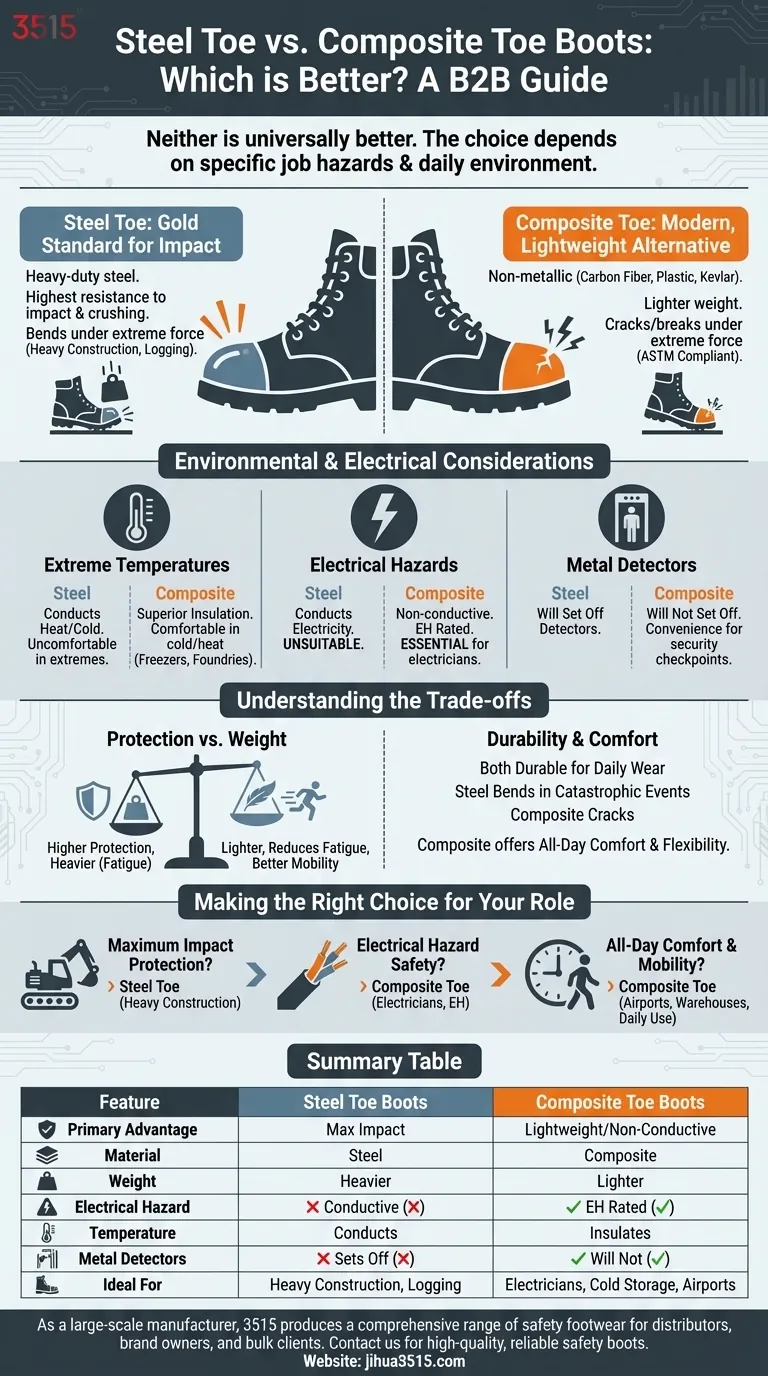
Summary Table:
| Feature | Steel Toe Boots | Composite Toe Boots |
|---|---|---|
| Primary Advantage | Maximum impact/crush protection | Lightweight, non-conductive, temperature neutral |
| Material | Heavy-duty steel | Carbon fiber, plastic, or Kevlar |
| Weight | Heavier | Lighter (reduces fatigue) |
| Electrical Hazard | Not suitable (conductive) | EH Rated (non-conductive) |
| Temperature Conductivity | Conducts heat/cold | Insulates against temperature |
| Metal Detectors | Will set off detectors | Will not set off detectors |
| Ideal For | Heavy construction, logging, high-impact risk | Electricians, cold storage, airports, all-day comfort |
As a large-scale manufacturer, 3515 produces a comprehensive range of safety footwear for distributors, brand owners, and bulk clients. Whether your workforce requires the ultimate protection of steel toe boots or the specialized advantages of composite toe boots, we have the production capability and expertise to meet your needs. Contact us today to discuss your specific requirements and get a quote for high-quality, reliable safety boots.
Visual Guide
Related Products
- Durable Steel Toe Safety Boots Wholesale & Custom Manufacturing
- Wholesale Durable Breathable Safety Boots Custom OEM Manufacturer
- Wholesale Durable 6-Inch Work Boots | Custom & Private Label Manufacturer
- Puncture-Resistant Velcro Safety Boots for Wholesale & Custom Manufacturing
- Premium Sport Style Safety Boots for Bulk Orders
People Also Ask
- Why are industrial safety boots with steel toes necessary for machine operators? Essential Foot Protection for Safety
- Why is it mandatory to wear safety shoes with steel toe protection during metal loading? Prevent Crushing Injuries
- What are the main materials used in steel toe safety shoes? A Guide to Protective Footwear Construction
- What are the characteristics of steel toe safety boots? Maximum Protection, Key Trade-offs
- Is it true that steel toes can cause toes to get cut off? Debunking the Dangerous Myth