
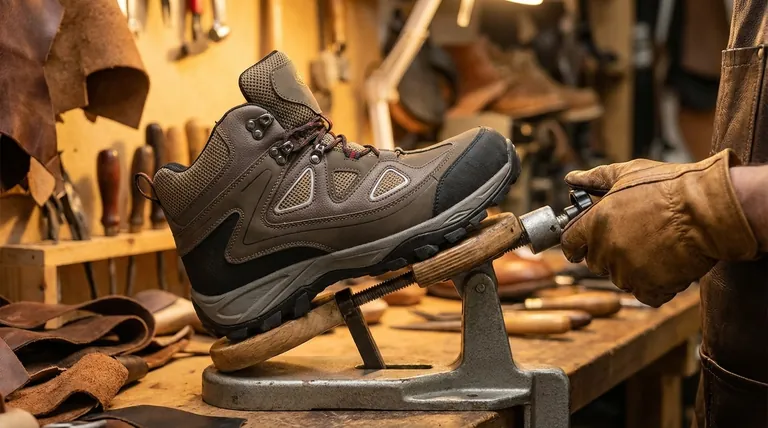
Boot stretching is a targeted solution for footwear that is fundamentally the right size but causes discomfort in specific areas. It becomes necessary when a boot is slightly too narrow, pinches across the instep, or creates a pressure point, especially after you've determined it cannot be returned or exchanged. The process works best on natural materials like leather, which have fibers that can be permanently reshaped.
The core principle is this: stretching can create incremental space to relieve specific pressure points, but it cannot change a boot's length or correct a fundamentally poor fit. Success depends entirely on the boot's material and the precise nature of the discomfort.
Identifying When Stretching is a Viable Solution
Before deciding to stretch your boots, you must accurately diagnose the fit issue. Stretching is a precision tool for a narrow set of problems, not a cure-all for a bad purchase.
The Golden Rule: For Boots That Are Slightly Too Small
Stretching is designed for marginal gains—typically adding a quarter to a half size in width. It is the perfect solution for a boot that feels just a bit too snug across the ball of your foot or cramps your pinky toe.
If the boot is a full size too small or causes pain throughout your foot, stretching will not resolve the issue.
Material is Key: Natural vs. Synthetic Fibers
The effectiveness of stretching is dictated by the boot's material. Natural leathers (full-grain, suede, nubuck) are ideal because their fibrous structure can be relaxed and permanently reformed to a new shape.
Synthetic materials like polyurethane ("pleather") and most textiles have very little to no capacity to stretch. Attempting to do so can crack the material's finish or damage its integrity.
The Length Limitation: A Critical Boundary
This is the most important constraint to understand: you cannot stretch a boot for length. A boot's length is determined by the rigid sole and the reinforced toe box.
If your toes are pressing firmly against the front of the boot, it is the wrong size. No amount of stretching will fix this fundamental problem.
Post-Stretching Adjustments
After a successful stretch, you may need to reconsider your insoles or sock thickness. A boot that has been widened might feel looser overall, and a thinner sock or different insole might be needed to dial in the perfect fit.
Common Scenarios Where Stretching is Effective
Stretching is most often used to solve one of four common fit problems. A professional cobbler will have specialized machinery for each scenario.
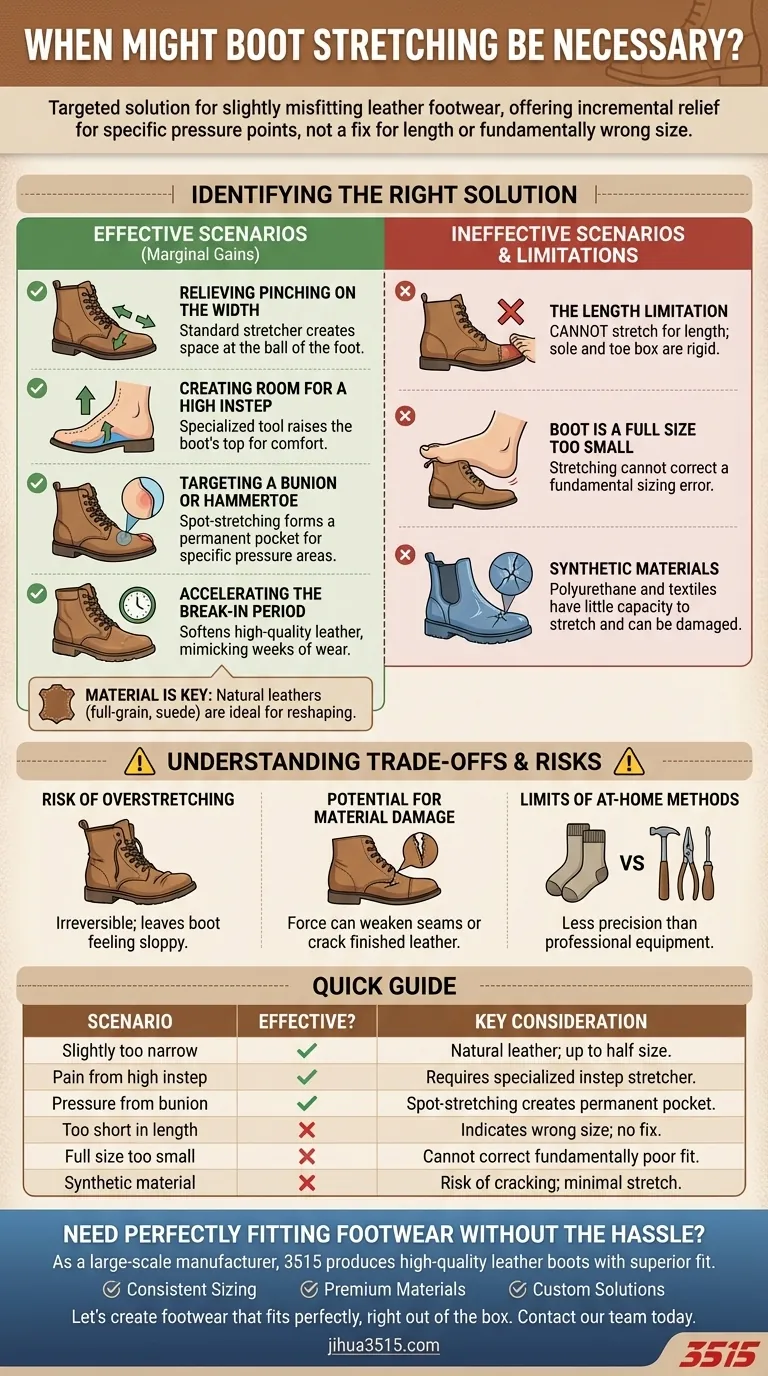
Relieving Pinching on the Width
This is the most frequent reason for stretching. If the boot's length is correct but it feels painfully tight across the widest part of your foot (the ball), a standard boot stretcher can provide significant relief.
Creating Room for a High Instep
For individuals with a high arch or instep, the top of the boot can press down, causing pain and restricting circulation. A specialized instep stretcher can raise this area, alleviating the pressure.
Targeting a Bunion or Hammertoe
A cobbler can use a device that spot-stretches a very small, specific area. This creates a permanent bubble or pocket in the leather to accommodate a bunion or hammertoe without altering the fit of the rest of the boot.
Accelerating the Break-in Period
For very stiff, high-quality footwear like work boots or hiking boots, professional stretching can mimic the initial weeks of wear. It helps soften the leather and shape it to a more foot-friendly form, easing a difficult break-in process.
Understanding the Trade-offs and Risks
While effective, stretching is an irreversible process. Understanding the potential downsides is critical to making an informed decision.
The Risk of Overstretching
Once leather fibers are stretched, they cannot be shrunk back to their original position. An overly aggressive stretch can leave the boot feeling loose and sloppy, ruining the fit permanently. This is why incremental adjustments are key.
Potential for Material Damage
Applying force incorrectly can cause significant harm. Seams can be weakened or torn, and finished leathers (like patent leather) can crack under pressure. This risk is much higher with DIY methods than with a professional.
The Limits of At-Home Methods
While home remedies like wearing thick socks or using stretching sprays exist, they offer less control and precision than professional equipment. A cobbler’s tools apply even, consistent pressure over time, which is safer and more effective for the boot's materials.
Making the Right Choice for Your Boots
To decide if stretching is the correct path, identify your primary goal and match it to the capabilities of the process.
- If your primary focus is relieving a specific pressure point (like width or a bunion): Professional stretching is an excellent and highly effective solution.
- If your primary focus is fixing a boot that is too short in length: Do not attempt to stretch it; the boot is the wrong size and this will not solve the core problem.
- If your primary focus is simply breaking in a stiff new pair of leather boots: Stretching can help, but first try wearing them with thick, damp socks around the house as a less aggressive alternative.
Ultimately, understanding the precise limits of stretching empowers you to salvage a good pair of boots without risking their structural integrity.
Summary Table:
| Scenario | Is Stretching Effective? | Key Consideration |
|---|---|---|
| Boot is slightly too narrow | Yes | Ideal for natural leathers; adds up to half a size in width. |
| Pain from a high instep | Yes | Requires a specialized instep stretcher for targeted relief. |
| Pressure from a bunion/hammertoe | Yes | Spot-stretching can create a permanent pocket for the area. |
| Boot is too short in length | No | Cannot change boot length; indicates the wrong size. |
| Boot is a full size too small | No | Stretching cannot correct a fundamentally poor fit. |
| Boot is made of synthetic material | No | Risk of cracking or damage; little to no capacity to stretch. |
Need perfectly fitting footwear without the hassle?
As a large-scale manufacturer, 3515 produces a comprehensive range of high-quality leather boots and shoes for distributors, brand owners, and bulk clients. Our expertise ensures a superior fit from the start, minimizing the need for post-purchase adjustments.
We can help you provide your customers with:
- Consistent Sizing: Precision manufacturing for reliable, true-to-size footwear.
- Premium Materials: High-quality, supple leathers that offer comfort and durability.
- Custom Solutions: Tailored production to meet your specific design and fit requirements.
Let's create footwear that fits perfectly, right out of the box.
Contact our team today to discuss your manufacturing needs and how we can bring value to your business.
Visual Guide
Related Products
- Premium Wholesale Tactical Style Safety Shoes Boots with Quick Lacing
- High Performance Fire-Retardant Waterproof Safety Boots
- Premium Waterproof High-Cut Industrial Safety Boots for Wholesale and Bulk Orders
- Durable Leather Work Boots for Wholesale & Custom Manufacturing
- Durable Leather Work Boots for Wholesale & Custom OEM Manufacturing
People Also Ask
- How are gait analysis research findings applied to the functional design of safety shoes and tactical boots?
- How can specialized footwear mitigate safety risks? High-Volume OEM/ODM Solutions since 1951
- Why is the synchronization of craftsmanship and UX development emphasized for bulk customization of safety shoes?
- How do quality certification standards for safety shoes reduce perceived risk? Buy Online with Technical Certainty
- How does anthropomorphic design influence material selection? Enhance Footwear Performance through Biological Alignment



















