
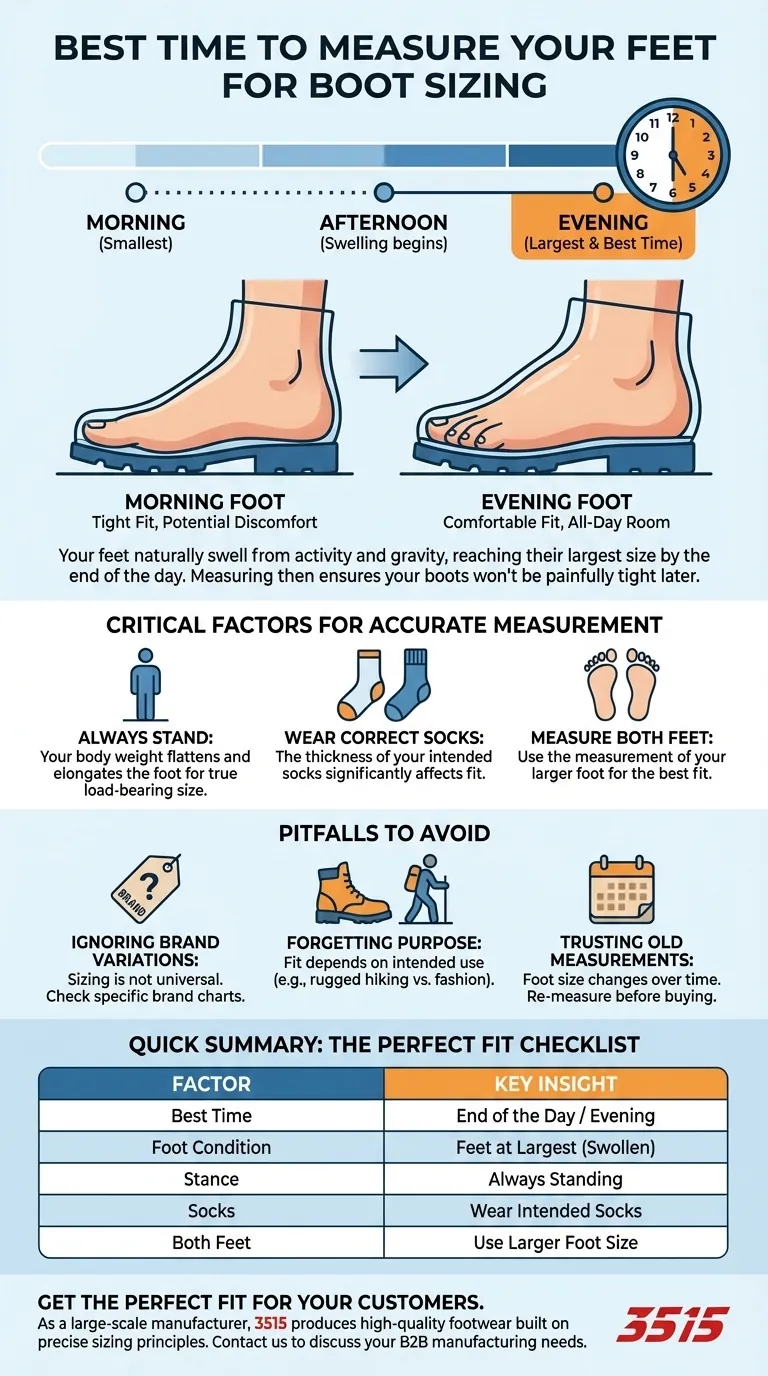
The single best time of day to measure your feet for boots is at the end of the day, preferably in the evening. Your feet naturally swell and expand from the effects of walking and standing, reaching their largest size after a full day of activity. Measuring at this point ensures you purchase a boot that will remain comfortable and not become too tight.
The core principle is simple: measure your feet at their largest to account for the natural swelling that occurs throughout the day. This prevents the common problem of boots feeling fine in the morning but painfully tight by the afternoon.
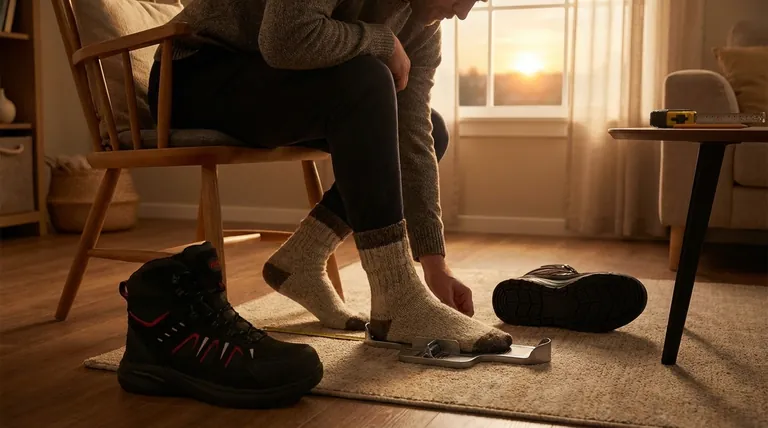
Why Your Foot Size Changes Throughout the Day
Many people assume their shoe size is a fixed number, but the reality is that your feet are dynamic. Their volume and shape change in response to daily activity, which is a critical factor in achieving a proper boot fit.
The Effect of Gravity and Activity
As you stand, walk, and go about your day, gravity causes fluids to settle in your lower extremities. This, combined with the pressure of bearing your body weight, causes your feet to swell slightly.
This expansion affects both the length and width of your foot. It is the primary reason why a measurement taken first thing in the morning is often inaccurate for determining all-day comfort.
How This Impacts Boot Fit
Measuring in the morning captures your foot at its smallest size. If you buy a boot based on this measurement, the arch, width, and length will feel correct at first.
However, as your foot swells to its natural afternoon size, that same boot will become constrictive, leading to pressure points, blisters, and general discomfort.
The Correct Method for an Accurate Measurement
Knowing when to measure is only half the battle. How you measure is equally important to avoid sizing errors.
Always Measure While Standing
Never measure your foot while sitting down. When you stand, your full body weight flattens and elongates your foot, revealing its true "load-bearing" size. This is the measurement that matters.
Wear the Right Socks
The thickness of your sock can significantly alter the fit of a boot. Always wear the type of sock you intend to use with the boots when you measure. A thick wool hiking sock, for instance, requires much more room than a thin dress sock.
Measure Both Feet
Almost everyone has one foot that is slightly larger than the other. You must measure both and use the measurement of the larger foot to determine your size. Sizing to the smaller foot will guarantee discomfort.
Understanding the Pitfalls to Avoid
Even with the correct timing, common mistakes can derail your efforts to find the perfect fit. Being aware of these pitfalls is essential for success.
Ignoring Brand Variations
A size 10 in one brand may fit very differently from a size 10 in another. Never assume your size is universal. Always consult the specific brand's sizing chart and reviews if possible.
Forgetting About the Boot's Purpose
The ideal fit depends on the boot's intended use. A rugged hiking boot requires more room in the toe box for descents than a snug-fitting fashion boot meant for short-term wear.
Trusting Old Measurements
Foot size can change over time due to age, weight fluctuations, and other life factors. Do not rely on a measurement you took years ago. Re-measure your feet every time you prepare to buy a new, high-quality pair of boots.
Making the Right Choice for Your Goal
Use these guidelines to ensure your measurement strategy aligns with your intended use.
- If your primary focus is all-day comfort for work or hiking: Measure in the late afternoon or evening while wearing your thickest intended socks to ensure ample room for swelling.
- If your primary focus is a precise fit for a specialized activity (e.g., climbing): Still measure in the evening, but be sure to use the exact, often thinner, sock you will wear for that specific task.
- If you are buying boots online: Take extra care to measure in the evening, stand while measuring, and cross-reference your findings with that specific brand's sizing guide and customer reviews.
Taking a few minutes to measure correctly at the right time is the most critical step toward ensuring seasons of comfort and performance from your boots.
Summary Table:
| Measurement Factor | Key Insight |
|---|---|
| Best Time | End of the day / Evening |
| Foot Condition | Feet are at their largest due to swelling |
| Stance | Always measure while standing |
| Socks | Wear the socks you'll use with the boots |
| Both Feet | Measure both and use the larger foot's size |
Get the Perfect Fit for Your Customers
As a large-scale manufacturer, 3515 produces a comprehensive range of footwear for distributors, brand owners, and bulk clients. Our production capabilities encompass all types of shoes and boots, ensuring you receive high-quality products built for comfort and durability based on precise sizing principles.
Let us help you provide the best for your market.
Contact our team today to discuss your manufacturing needs and how we can deliver the perfect fit for your customers.
Visual Guide
Related Products
- Wholesale Durable Leather Work Boots | 8-Inch Goodyear Welt Manufacturer
- Wholesale Durable Mid-Cut Tactical Boots for Custom & Private Label Brands
- Durable High-Ankle Tactical Boots for Wholesale & Custom Manufacturing
- Durable Leather High-Ankle Tactical Boots for Wholesale & Custom Manufacturing
- Durable High-Ankle Tactical Boots Wholesale Manufacturer for Custom & Bulk Orders
People Also Ask
- What is the difference between full-grain and top-grain leather? Premium Material Guide for Boot Manufacturers
- What is the complete process for deep cleaning leather work boots? A Step-by-Step Guide to Preserve Your Investment
- Why is it important to waterproof leather work boots? Protect Your Investment and Performance
- What are the advantages of leather as an upper material for work boots? Unmatched Durability & Custom Comfort
- What are the key qualities of leather for work boots? Superior Durability, Breathability & Custom Fit



















