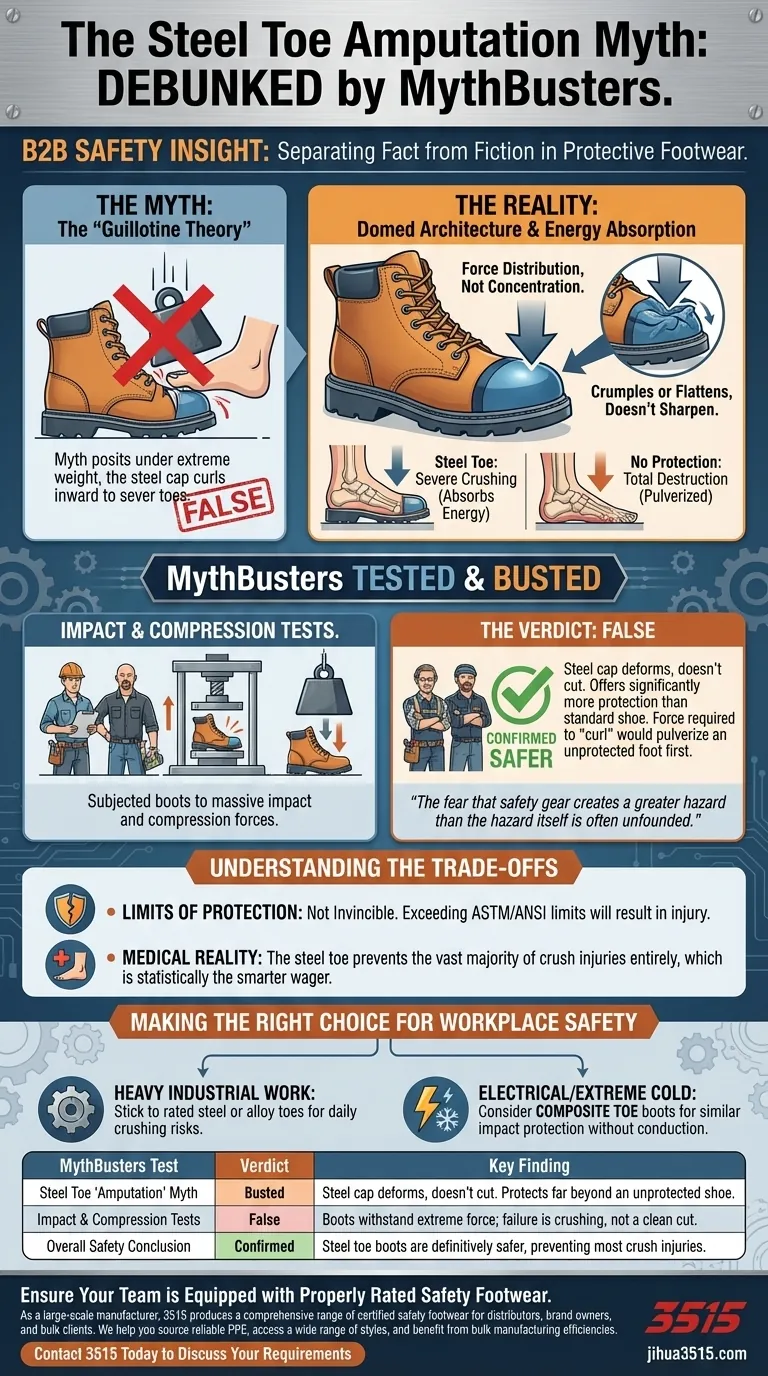
The "Steel Toe Amputation" myth posits that under extreme weight, the protective steel cap in safety boots will curl inward, acting like a guillotine to sever the wearer's toes.
The MythBusters team tested this by subjecting boots to massive impact and compression forces. They concluded the myth is false. The tests demonstrated that while the steel cap can deform under catastrophic weight, it offers significantly more protection than a standard shoe, and the "cutting" scenario is virtually impossible under normal accident conditions.
Core Takeaway The fear that safety gear creates a greater hazard than the hazard itself is often unfounded. In the case of steel toe boots, the force required to "curl" the steel is so great that an unprotected foot would be pulverized long before the boot failed, making the steel toe the definitively safer choice.
The Physics of the "Amputation" Myth
The Guillotine Theory
The myth suggests a specific failure mode: that a falling heavy object hits the edge of the steel cap, forcing the back edge down to slice through the foot.
This assumes the steel is brittle or shaped in a way that promotes shearing. However, safety caps are designed with a domed architecture intended to distribute force, not concentrate it.
The Reality of Failure Modes
When steel toe caps fail, they typically do not snap or sharpen. Instead, they crumple or flatten.
This deformation absorbs a significant amount of kinetic energy. While this clamping action can break bones, it prevents the total destruction of the foot that would occur without the rigid barrier.
The MythBusters Testing Methodology
Impact vs. Compression
The show tested both sudden impact (dropping heavy weights) and slow compression (hydraulic press).
They compared the damage done to a clay foot inside a steel toe boot against a clay foot in a regular shoe. The regular shoe offered zero resistance, resulting in immediate and total "injury."
The Verdict
The steel toe boot withstood thousands of pounds of pressure before failing.
Even when the boot finally failed under extreme load, the steel did not curl into a blade. It simply collapsed. The resulting injury to the analog foot was severe crushing, but this occurred at a threshold far beyond what would have destroyed an unprotected foot.
Understanding the Trade-offs
Limits of Protection
While the amputation myth is false, steel toe boots are not invincible.
Every piece of Personal Protective Equipment (PPE) has a breaking point, usually defined by ASTM or ANSI standards (e.g., resisting 75 lbs of impact or 2,500 lbs of compression). Exceeding these limits will result in injury.
The Medical Reality
There is a grim nuance to the debate: a clean cut is technically easier to surgically reattach than a pulverized "mush" of bone and tissue.
However, relying on this logic is a dangerous error. You are betting on a catastrophic failure mode to save you from a minor one. The steel toe prevents the vast majority of crush injuries entirely, which is statistically the smarter wager.
Making the Right Choice for Workplace Safety
To maximize safety, you must match your gear to your environment's specific risks.
- If your primary focus is heavy industrial work: Stick to rated steel or alloy toes; the risk of "amputation by boot" is a fallacy, while the risk of crushing is a daily reality.
- If your primary focus is electrical hazards or extreme cold: Consider composite toe boots, which offer similar impact protection without conducting electricity or temperature, eliminating the metal variable entirely.
Trust the engineering standards over the anecdotes; the boot is there to save your foot, not sacrifice it.
Summary Table:
| MythBusters Test | Verdict | Key Finding |
|---|---|---|
| Steel Toe 'Amputation' Myth | Busted | Steel cap deforms, doesn't cut. Protects far beyond an unprotected shoe. |
| Impact & Compression Tests | False | Boots withstand extreme force; failure is crushing, not a clean cut. |
| Overall Safety Conclusion | Confirmed | Steel toe boots are definitively safer, preventing most crush injuries. |
Ensure Your Team is Equipped with Properly Rated Safety Footwear
As a large-scale manufacturer, 3515 produces a comprehensive range of certified safety footwear for distributors, brand owners, and bulk clients. Our production capabilities encompass all types of industrial boots, including steel toe and composite toe options designed to meet rigorous safety standards.
We help you:
- Source reliable PPE that protects your workforce from real-world hazards.
- Access a wide range of styles to suit various industrial environments.
- Benefit from bulk manufacturing efficiencies and consistent quality.
Don't let myths compromise safety. Partner with a manufacturer you can trust.
Contact 3515 today to discuss your safety footwear requirements and receive a quote.
Visual Guide
Related Products
- Durable Steel Toe Safety Boots Wholesale & Custom Manufacturing
- Wholesale Durable Breathable Safety Boots Custom OEM Manufacturer
- Wholesale Durable 6-Inch Work Boots | Custom & Private Label Manufacturer
- Puncture-Resistant Velcro Safety Boots for Wholesale & Custom Manufacturing
- Premium Sport Style Safety Boots for Bulk Orders
People Also Ask
- Why are industrial safety boots with steel toes necessary for machine operators? Essential Foot Protection for Safety
- Why is it mandatory to wear safety shoes with steel toe protection during metal loading? Prevent Crushing Injuries
- What are the main materials used in steel toe safety shoes? A Guide to Protective Footwear Construction
- What are the characteristics of steel toe safety boots? Maximum Protection, Key Trade-offs
- Is it true that steel toes can cause toes to get cut off? Debunking the Dangerous Myth