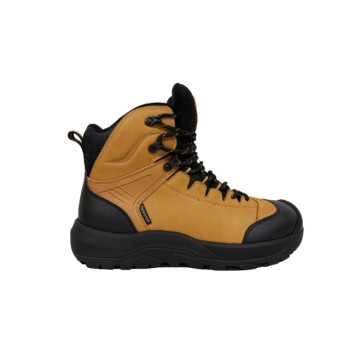
Waterproofing in winter cycling boots is achieved through a multi-layered engineering approach that prioritizes structural integrity and advanced material science. High-performance boots integrate breathable waterproof membranes, precision-sealed seams, and DWR-treated uppers to create an impenetrable barrier against external moisture. By eliminating traditional cooling features like sole vents and incorporating high-cuff designs, manufacturers ensure that feet remain dry even in the most aggressive slush and rain.
Technical waterproofing is a synergy of material innovation and specialized construction techniques. For brand owners and distributors, these features represent the benchmark for professional-grade winter footwear that balances moisture protection with thermal regulation.
Advanced Material Integration
Breathable Waterproof Membranes
The core of modern waterproofing is the integration of a microporous membrane, such as Gore-Tex, between the outer shell and the inner lining. These membranes are engineered to block liquid water droplets while allowing microscopic sweat vapor to escape, maintaining a dry internal microclimate. In premium OEM/ODM manufacturing, these membranes are often applied in a "bootie" construction to ensure 360-degree protection.
Water-Repellent Uppers and Treatments
Professional-grade boots utilize oil-tanned leather or high-performance synthetics treated with Durable Water Repellent (DWR) coatings. These materials cause water to bead and roll off the surface rather than saturating the fabric. Utilizing high-quality raw materials ensures the boot maintains its structural integrity and aesthetic appeal over long-term exposure to road salt and grit.
Structural Design and Sealing Techniques
Precision Seam Sealing and Zippers
Every point of entry is a potential failure site, which is why top-tier manufacturers utilize taped seams to prevent water from wicking through stitch holes. Water-resistant YKK zippers and gusseted tongues are standard features that provide a continuous shield across the bridge of the foot. These components require state-of-the-art bonding equipment to ensure they withstand the repetitive stresses of cycling.
Sole Architecture and Vent Management
Unlike summer road shoes that prioritize airflow, winter-specific designs completely eliminate sole vents. This design choice prevents water from entering through the bottom of the shoe when riding through puddles or standing in snow. Advanced stitchdown construction is often favored over traditional methods, as it creates a more robust barrier against moisture ingress at the sole-to-upper interface.
High-Cuff and Ankle Interface
To address water entry from the top of the boot, manufacturers employ high-cuff designs featuring neoprene or elasticized closures. These cuffs are designed to overlap seamlessly with winter tights, creating a "shingle effect" that directs water away from the ankle. This technical detail is critical for maintaining dryness during prolonged efforts in heavy rain.
Understanding the Trade-offs
Breathability vs. Absolute Waterproofing
While a boot can be made 100% waterproof using non-porous materials like heavy rubber, this often leads to excessive perspiration buildup inside the shoe. The challenge for large-scale manufacturers is balancing moisture vapor transmission rates (MVTR) with external protection. High-performance boots prioritize this balance, though they may require more specialized maintenance than simpler, less breathable alternatives.
Weight and Power Transfer
Adding waterproof layers and insulation naturally increases the bulk of the footwear compared to lightweight racing shoes. However, professional supply chain stability and modern design allow for the use of carbon-reinforced soles to offset this weight. This ensures that the boot remains efficient for power transfer while providing the necessary protection for enterprise-level winter training.
Strategic Recommendations for Your Product Line
How to Apply This to Your Project
When selecting or developing a winter cycling boot for your inventory, consider the specific environmental needs of your target market and the manufacturing capabilities required to meet them.
- If your primary focus is extreme weather performance: Prioritize boots with integrated membranes and high-cuff neoprene closures to ensure maximum protection against deep snow and heavy rain.
- If your primary focus is high-volume distribution: Look for designs utilizing robust synthetic uppers and taped seams, which offer consistent quality and durability across massive production scales.
- If your primary focus is premium brand positioning: Emphasize technical features like stitchdown construction and heritage-grade materials that highlight a commitment to craftsmanship and long-term reliability.
By leveraging over 70 years of manufacturing heritage and state-of-the-art technical design, you can deliver winter footwear that exceeds the rigorous demands of professional and enthusiast cyclists alike.
Summary Table:
| Technical Feature | Engineering Detail | Performance Benefit |
|---|---|---|
| Breathable Membrane | Microporous layers (e.g., Gore-Tex) | Blocks liquid water while allowing sweat vapor to escape |
| Seam Sealing | Taped seams & gusseted tongues | Prevents moisture entry through stitch holes and zipper tracks |
| Sole Construction | Ventless design & stitchdown build | Eliminates water ingress from puddles and snow at the base |
| High-Cuff System | Neoprene or elasticized closures | Creates a seal with tights to stop water from entering the top |
Partner with 3515 for Enterprise-Scale Footwear Manufacturing
Elevate your product lineup with 70+ years of manufacturing expertise. As a large-scale manufacturer serving distributors and brand owners since 1951, 3515 offers comprehensive production capabilities for all footwear types, anchored by our flagship Safety Shoes series. Our extensive portfolio covers work and tactical boots, outdoor shoes, training shoes, and sneakers, as well as Dress & Formal shoes to meet diverse bulk requirements.
Why Choose 3515?
- Massive Production Scale: Robust supply chain stability for consistent large-volume delivery.
- Premium OEM/ODM Capabilities: Tailored designs with international certifications to meet global standards.
- State-of-the-Art Equipment: Precision engineering for technical features like waterproof membranes and seam sealing.
- Distributor Support: Competitive margins and reliable lead times for B2B resellers and wholesalers.
Ready to scale your inventory with professional-grade footwear? Contact us today to discuss your project!
Related Products
- Premium Insulated Safety Boots and Shoes for Wholesale & Bulk Orders
- Factory Direct Wholesale Rain Boots Durable Waterproof & Fully Customizable
- Durable Waterproof Rain Boots | Custom Manufacturer for Wholesale & Brands
- Heavy-Duty Waterproof Nubuck Safety Boots Safety Shoes for Bulk Supply
- Wholesale Waterproof Tactical Boots Custom Suede & High-Traction Soles
People Also Ask
- What are the recommended insulation ratings for mild winter conditions? A Guide for Active & Stationary Workers
- How does insulation thickness correlate with temperature ranges? A Guide to Choosing the Right Warmth
- What insulation level is needed for severe cold and stationary work? 1200g or Higher is Essential
- What safety advantages do insulated boots offer beyond warmth? Dielectric Protection & Superior Grip
- How does fleece lining contribute to the warmth of insulated boots? Trapping Air for Superior Cold Protection