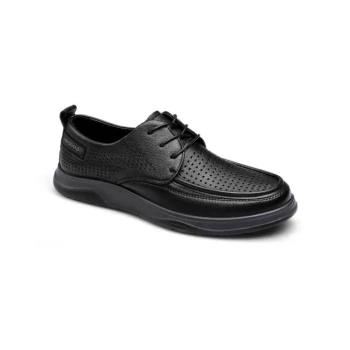
Specialized orthopedic shoes distinguish themselves through engineered structural components designed to manage forces that standard footwear often ignores. Unlike standard shoes, they utilize widened toe boxes, reinforced heel stabilizers, and mechanical arch supports to actively redistribute plantar pressure and compensate for localized muscle weaknesses.
The core advantage of orthopedic design lies in mechanical integration. By combining specialized outsoles with internal orthotic liners, these shoes function as corrective tools that absorb shock and optimize gait efficiency, rather than simply covering the foot.
Engineering for Pressure and Stability
The Function of the Widened Toe Box
Standard footwear frequently tapers at the front, crowding the toes. Orthopedic designs prioritize a widened toe box to alter how the foot sits within the shoe structure.
This design allows the toes to splay naturally. It specifically reduces pressure points that can exacerbate existing foot conditions.
Reinforced Heel Stabilizers
Stability is determined by how the shoe manages the back of the foot. Reinforced heel stabilizers are integrated to provide a rigid foundation.
These components prevent excessive lateral movement. They ensure the foot remains aligned during the initial strike phase of walking.
Targeted Mechanical Arch Supports
Internal support is critical for correcting biomechanical issues. Targeted mechanical arch supports are designed to address weight-bearing imbalances.
These supports compensate for small muscle atrophy in the foot. By redistributing the load, they prevent strain on weakened muscles.
Enhancing Gait Dynamics
Specialized Mechanical Outsoles
The bottom of an orthopedic shoe is designed for movement efficiency. Specialized mechanical outsoles govern how the foot interacts with the ground.
These outsoles are engineered to improve gait transition efficiency. They help guide the foot smoothly from heel-strike to toe-off.
Internal Orthotic Liners
Impact protection is a primary focus of the internal design. Internal orthotic liners work in conjunction with the outsole mechanics.
Together, they provide superior shock absorption. This system reduces the impact force that travels up the leg with every step.
Understanding the Trade-offs
Weight and Bulk
The integration of reinforced stabilizers and mechanical soles requires more material structure. Consequently, specialized orthopedic shoes may be heavier or bulkier than standard fashion sneakers.
Specificity of Fit
These shoes are engineered for correction, not general flexibility. A shoe designed to correct muscle atrophy may feel rigid to a user who does not require that specific mechanical intervention.
Making the Right Choice for Your Foot Health
To determine if specialized structural features are necessary for you, consider your primary biomechanical goals.
- If your primary focus is correcting balance: Prioritize shoes with reinforced heel stabilizers and mechanical arch supports to compensate for muscle atrophy.
- If your primary focus is pain reduction: Look for designs featuring internal orthotic liners and mechanical outsoles to maximize shock absorption and pressure redistribution.
Effective foot protection relies on selecting footwear that acts as a structural extension of your body's mechanics.
Summary Table:
| Feature | Structural Design Advantage | Primary Biomechanical Benefit |
|---|---|---|
| Widened Toe Box | Increased forefoot volume | Allows natural toe splay; reduces pressure points |
| Heel Stabilizers | Reinforced rigid foundation | Prevents lateral movement; ensures heel-strike alignment |
| Arch Supports | Targeted mechanical integration | Redistributes load; compensates for muscle atrophy |
| Specialized Outsoles | Engineered tread & rocker profiles | Improves gait transition efficiency from heel to toe |
| Orthotic Liners | High-density shock absorption | Minimizes impact force; enhances long-term comfort |
Partner with 3515 for High-Performance Orthopedic & Safety Footwear Solutions
As a large-scale manufacturer serving distributors and brand owners globally, 3515 offers comprehensive production capabilities for all footwear types. Our flagship Safety Shoes series is built on the same rigorous structural principles found in specialized orthopedic designs—prioritizing stability, pressure redistribution, and durability.
From work and tactical boots to training shoes and formal dress options, we provide bulk manufacturing excellence tailored to your brand's specific requirements. Contact us today to explore our catalog and custom manufacturing services and see how our expertise can elevate your product line.
References
- Alessandro Bertini, Davide Pareyson. Use, tolerability, benefits and side effects of orthotic devices in Charcot-Marie-Tooth disease. DOI: 10.1136/jnnp-2023-332422
This article is also based on technical information from 3515 Knowledge Base .
Related Products
- Custom OEM Training Shoes Wholesale Manufacturer Durable & Breathable
- Advanced KPU Athletic Safety Shoe with Steel Toe Cap Anti-Slip Rotary Lacing System
- Premium Suede Sport Safety Shoes for Wholesale & Bulk Orders
- Premium KPU Athletic Safety Shoes for Wholesale
- Wholesale Breathable Training Shoes Custom Athletic Footwear Manufacturer
People Also Ask
- Why is sole stiffness testing using a force gauge necessary? Build Superior Training Shoes with Precision
- Why is specialized athletic footwear necessary for ankle rehab? Unlock Safety and Stability in Recovery
- Why is the integration of advanced cushioning in training shoes necessary for athletes? Boost Recovery and Performance
- Why is it necessary for participants to wear professional training shoes? Ensuring Data Accuracy & Patient Safety
- Why is the use of flat-soled or professional training shoes essential for WBV? Maximize Vibration Energy Transfer