
To identify a quality pair of leather Wellington boots, you must look beyond the style and focus on three core components. The best boots feature full-grain leather uppers for maximum durability and breathability, a well-constructed, high-traction outsole designed for your intended environment, and practical design elements like dual pull loops for ease of use.
The true measure of a leather Wellington isn't a single feature, but how its materials and construction align with your specific needs—whether that's navigating a hazardous worksite or a muddy country path.
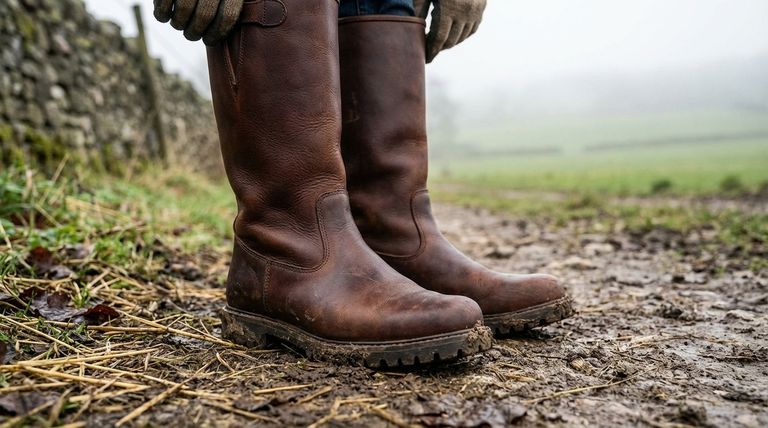
Deconstructing the Ideal Leather Wellington
A high-quality boot is a system of well-chosen components working together. Understanding each part allows you to assess its overall quality and suitability for your purpose.
The Foundation: Full-Grain Leather Uppers
The single most important material is the leather itself. Full-grain leather, taken from the strongest and most durable part of the hide, is the gold standard.
This type of leather is highly resilient, breathable, and develops a unique patina over time as it ages. It has the ability to mold to your foot, creating a custom fit that improves with wear.
The Outsole: Your Connection to the Ground
The outsole dictates the boot's traction and stability. For muddy, uneven countryside, look for deep tread patterns and a pronounced heel for superior grip.
For wet, flat surfaces like those in urban or industrial settings, a wedge outsole can provide better surface contact. Materials like polyurethane or rubber are excellent choices for their durability and slip resistance.
Construction and Fit: Beyond the Materials
A quality Wellington must be built for practicality. Look for waterproof construction to ensure your feet stay dry, a key function of any Wellington-style boot.
Features like adjustable gussets allow for a more customized fit around the calf, while pull loops on both sides of the collar make the boots significantly easier to put on and take off.
Internal Comfort: The Unseen Details
What's inside the boot is just as critical for all-day wear. Shock-absorbing cushions or insoles reduce fatigue, which is essential for long days on your feet.
For colder climates, look for boots with built-in insulation. A breathable inner lining is also crucial for managing moisture and maintaining comfort in various conditions.
Aligning Features with Your Primary Use
The "best" boot is entirely relative to its intended job. A feature that is critical for one environment may be unnecessary for another.
For Everyday and Countryside Wear
If your primary use is for casual wear or country walks, your focus should be on comfort and general durability.
Prioritize the quality of the leather, a comfortable footbed, and an outsole with good grip for natural terrain. The aesthetic quality of the leather's patina will also be a key long-term benefit.
For Hazardous Work Environments
In a professional setting with known hazards, safety features become non-negotiable. Your selection should be guided by workplace requirements, such as OSHA standards.
Look for certified protection like reinforced toe caps (steel, composite, or alloy) and metatarsal guards to protect against impacts. Puncture-resistant soles are also critical in environments with sharp debris.
Understanding the Trade-offs of Leather
Leather is an exceptional material, but it comes with its own set of characteristics and responsibilities that differ from typical rubber or synthetic boots.
The Benefit: Durability and Custom Fit
Leather's primary advantages are its longevity and ability to conform to the wearer's foot. A well-made leather boot can last for years, becoming more comfortable over time. Its natural structure also allows for better breathability compared to solid rubber.
The Responsibility: Maintenance is Non-Negotiable
Unlike a rubber boot you can simply hose off, leather requires care. Regular cleaning and conditioning are essential to preserve its strength, flexibility, and water resistance. Neglecting maintenance will shorten the boot's lifespan.
The Limitation: Water Resistance
While a well-constructed leather boot is highly water-resistant, it needs proper care to protect it from excessive moisture. It is not inherently as impermeable as a seamless rubber boot, making diligent maintenance a key factor in its performance in wet conditions.
Making the Right Choice for Your Goal
To select the right boot, anchor your decision in your primary reason for wearing it.
- If your primary focus is durability and casual style: Prioritize a full-grain leather upper and a comfortable, shock-absorbing sole for all-day wear.
- If your primary focus is safety in the workplace: Your first check must be for certified safety features like steel or composite toe caps and puncture-resistant outsoles.
- If your primary focus is all-weather country walking: Look for deep outsole treads for reliable traction and features like adjustable gussets for a secure fit.
Ultimately, choosing the right leather Wellington is about investing in a reliable tool perfectly suited for the task at hand.
Summary Table:
| Key Component | Why It Matters | Ideal Feature |
|---|---|---|
| Upper Material | Determines durability, breathability, and fit | Full-grain leather for maximum longevity |
| Outsole | Provides traction and stability for your environment | Deep treads for mud or wedge soles for flat surfaces |
| Safety Features | Essential for hazardous work environments | Steel/composite toe caps, puncture-resistant soles |
| Comfort & Fit | Ensures all-day wearability | Adjustable gussets, shock-absorbing insoles, pull loops |
Ready to equip your team or customers with premium leather Wellington boots?
As a large-scale manufacturer, 3515 produces a comprehensive range of durable, safety-compliant, and comfortable footwear for distributors, brand owners, and bulk clients. Our production capabilities encompass all types of shoes and boots, including the high-quality leather Wellingtons detailed above. We ensure your footwear meets the highest standards of material quality, construction, and performance for any environment.
Contact us today to discuss your specific needs and receive a customized solution.
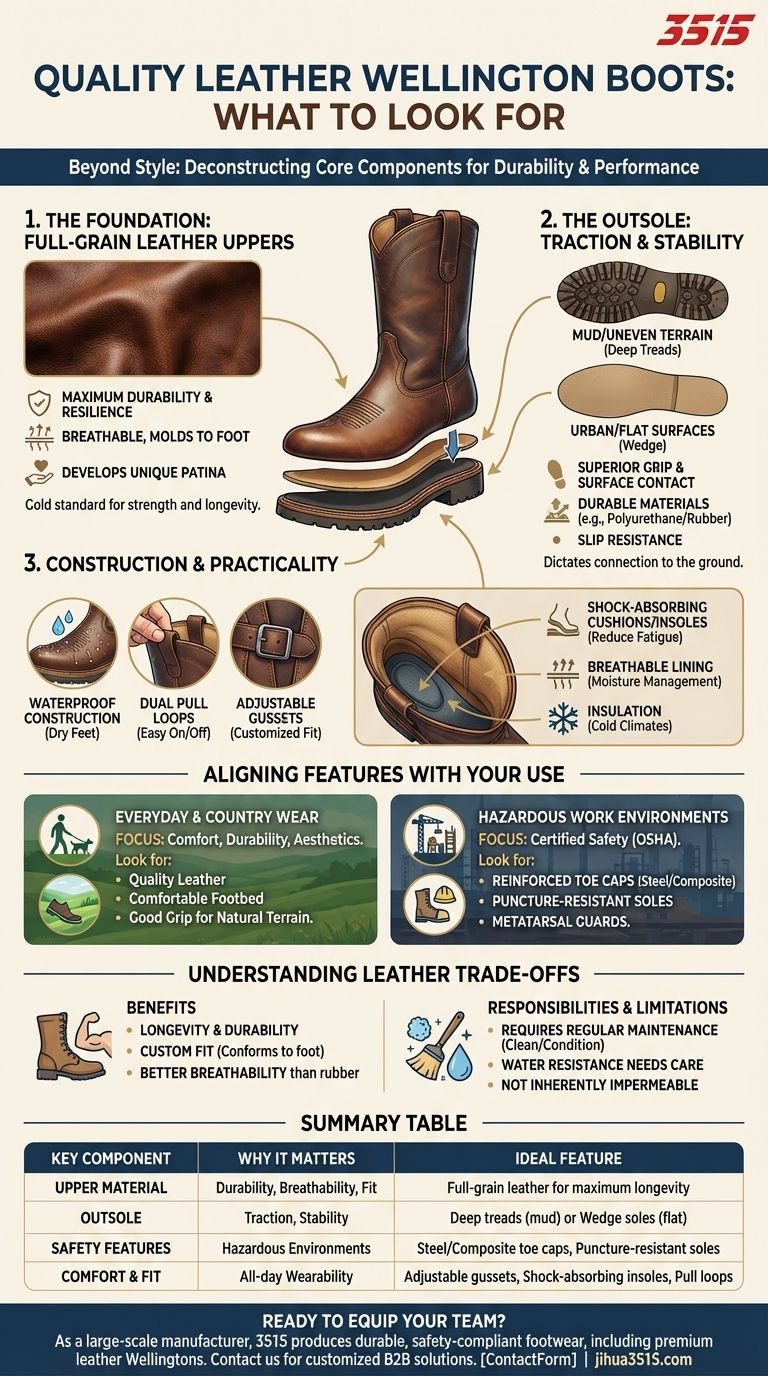
Visual Guide
Related Products
- Durable Goodyear Welt Leather Work Boots for Wholesale & Private Label
- Wholesale Durable Leather Work Boots | 8-Inch Goodyear Welt Manufacturer
- Durable Leather High-Ankle Tactical Boots for Wholesale & Custom Manufacturing
- Wholesale Leather Work Boots with Customizable Wedge Sole for Brands
- Durable Leather Work Boots for Wholesale & Custom Manufacturing
People Also Ask
- What is the difference between full-grain and top-grain leather? Premium Material Guide for Boot Manufacturers
- What are the advantages of leather as an upper material for work boots? Unmatched Durability & Custom Comfort
- Why is it important to waterproof leather work boots? Protect Your Investment and Performance
- How should new leather work boots be broken in? A Guide to Comfort and Durability
- What are the advantages of leather uppers in work boots? Unmatched Durability & Protection
















