At their core, supportive insoles are an ergonomic upgrade for your work boots, designed to provide critical shock absorption, structural arch support, and superior comfort. They transform a standard boot into a piece of equipment that works with your body's anatomy, helping to distribute weight evenly and reduce stress not just on your feet, but throughout your entire kinetic chain.
The fundamental role of a supportive insole is to bridge the gap between your foot's unique shape and the generic, mass-produced interior of a work boot. This customization is key to reducing daily fatigue and preventing long-term joint and muscle strain.
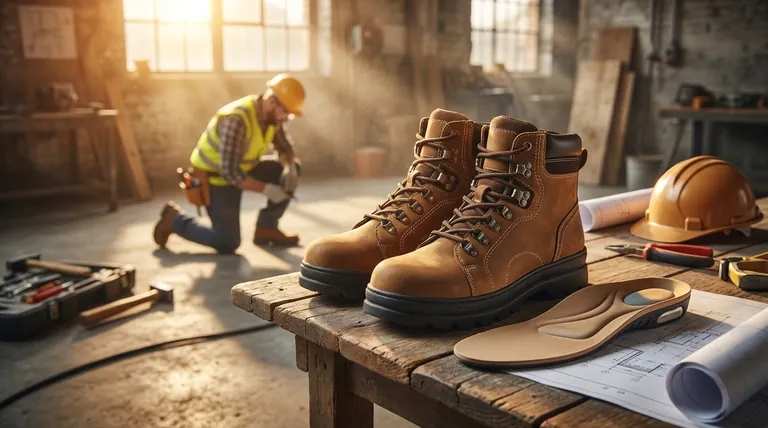
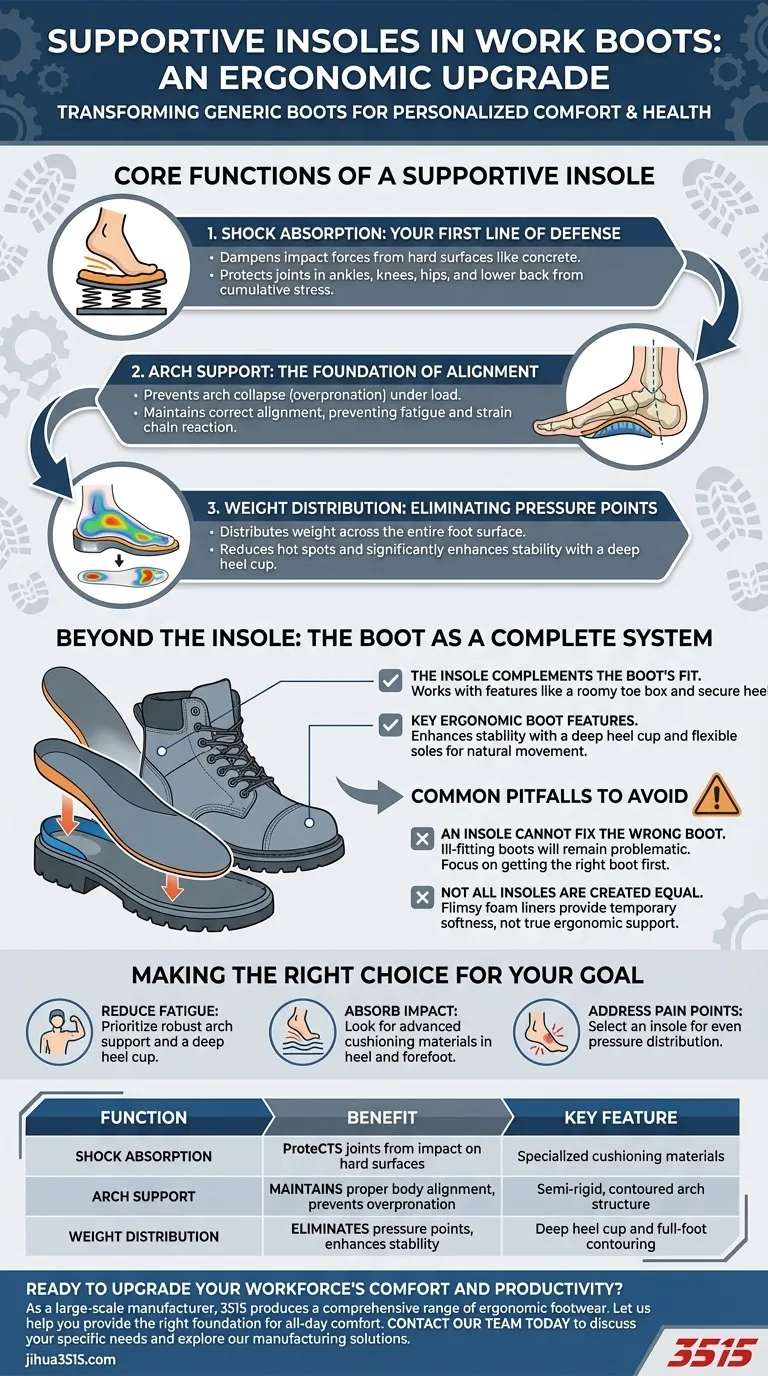
The Core Functions of a Supportive Insole
A high-quality insole does more than just add a layer of cushioning. It performs three distinct, critical jobs that the manufacturer's stock liner often fails to do adequately.
Shock Absorption: Your First Line of Defense
Walking or standing on hard surfaces like concrete sends repetitive impact forces up through your body. Supportive insoles use specialized materials to dampen these forces at the source.
This absorption is crucial for protecting the joints in your ankles, knees, hips, and even your lower back from cumulative stress over a long workday.
Arch Support: The Foundation of Alignment
The arch of your foot is a natural shock absorber. An insole with proper arch support ensures this structure doesn't collapse under load, a condition known as overpronation.
By keeping your arch properly supported, the insole helps maintain correct alignment from your ankle all the way up your leg. This prevents the chain reaction of strain that leads to fatigue and pain.
Weight Distribution: Eliminating Pressure Points
A generic, flat insole forces a few small areas of your foot to bear the majority of your body weight. This creates painful pressure points, or "hot spots."
A supportive, contoured insole distributes that weight across the entire surface of your foot. This includes providing a deep heel cup to secure the foot, which significantly reduces stress and enhances stability.
Beyond the Insole: The Boot as a Complete System
An insole is a powerful component, but it works best as part of a correctly fitted, ergonomic boot. To solve the root problem of foot fatigue and pain, you must consider the entire system.
The Insole Complements the Boot's Fit
An insole cannot fix a fundamentally ill-fitting boot. Always try on new boots at the end of the day when your feet are most swollen, and wear the same socks you use for work.
The insole should work with features like a roomy toe box and a secure heel, not fight against them.
Key Ergonomic Boot Features
A supportive insole enhances other essential boot characteristics. It works in tandem with a deep heel cup for stability and flexible soles that allow for natural foot movement.
The goal is a boot that feels like an extension of your body, where the insole provides the personalized interface between you and the shoe.
Common Pitfalls to Avoid
Simply adding an insole is not always a complete solution. Understanding the limitations is key to achieving the best results and avoiding wasted effort.
An Insole Cannot Fix the Wrong Boot
If a boot is too narrow, too short, or lacks basic structural integrity, even the best insole will be ineffective. It might even make the fit worse by taking up too much volume.
Focus on getting the right boot first, then use an insole to optimize its performance for your specific needs.
Not All Insoles Are Created Equal
There is a significant difference between a simple foam cushion and a structured, supportive insole. A flimsy foam liner offers temporary softness but provides no meaningful arch support or alignment correction.
For true ergonomic benefit, you need an insole with a semi-rigid structure that supports your arch and cradles your heel.
Making the Right Choice for Your Goal
Select an insole based on the specific problem you are trying to solve.
- If your primary focus is reducing end-of-day fatigue: Prioritize an insole with robust arch support and a deep heel cup to maintain proper body alignment.
- If your primary focus is absorbing impact on hard surfaces: Look for insoles with advanced cushioning materials specifically engineered for maximum shock absorption in the heel and forefoot.
- If your primary focus is addressing specific pain points: A well-designed insole that distributes pressure evenly can alleviate issues like plantar fasciitis or pain in the ball of the foot.
By viewing a supportive insole as a vital piece of your work equipment, you can take direct control over your daily comfort and long-term physical health.
Summary Table:
| Function | Benefit | Key Feature |
|---|---|---|
| Shock Absorption | Protects joints from impact on hard surfaces | Specialized cushioning materials |
| Arch Support | Maintains proper body alignment and prevents overpronation | Semi-rigid, contoured arch structure |
| Weight Distribution | Eliminates pressure points and enhances stability | Deep heel cup and full-foot contouring |
Ready to upgrade your workforce's comfort and productivity?
As a large-scale manufacturer, 3515 produces a comprehensive range of footwear for distributors, brand owners, and bulk clients. Our production capabilities encompass all types of ergonomic work boots and shoes, designed from the ground up for superior support and durability.
Let us help you provide the right foundation for all-day comfort. Contact our team today to discuss your specific needs and explore our manufacturing solutions.
Visual Guide
Related Products
- Durable Leather Work Boots for Wholesale & Custom Manufacturing
- Durable Leather Work Boots for Wholesale & Custom OEM Manufacturing
- Durable Leather Work Boots Wholesale Manufacturer & Custom Factory
- Durable Leather Moc Toe Work Boots for Wholesale & Custom Manufacturing
- Wholesale Leather Work Boots with Customizable Wedge Sole for Brands
People Also Ask
- What is the difference between full-grain and top-grain leather? Premium Material Guide for Boot Manufacturers
- What are the common workplace hazards that can be mitigated with the right work boots? Protect Your Workforce
- What are the common foot issues workers face due to uncomfortable work boots? Prevent Pain & Deformities
- What are the advantages of leather versus synthetic work boots? A Guide to Choosing the Right Material
- What are the key components of modern work boots? Engineered for Ultimate Durability and Comfort