
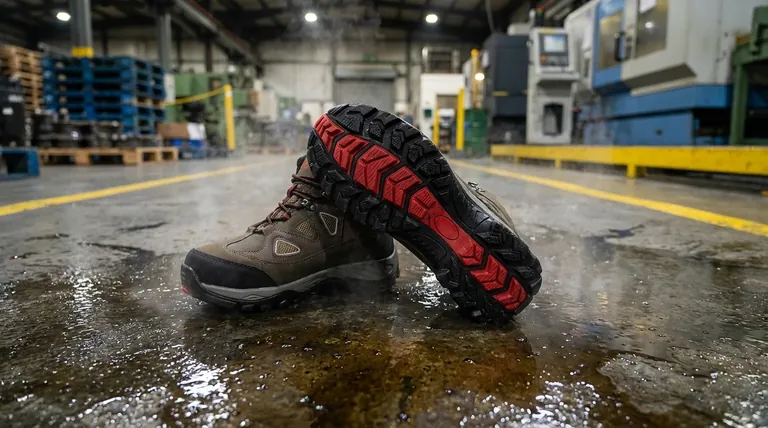
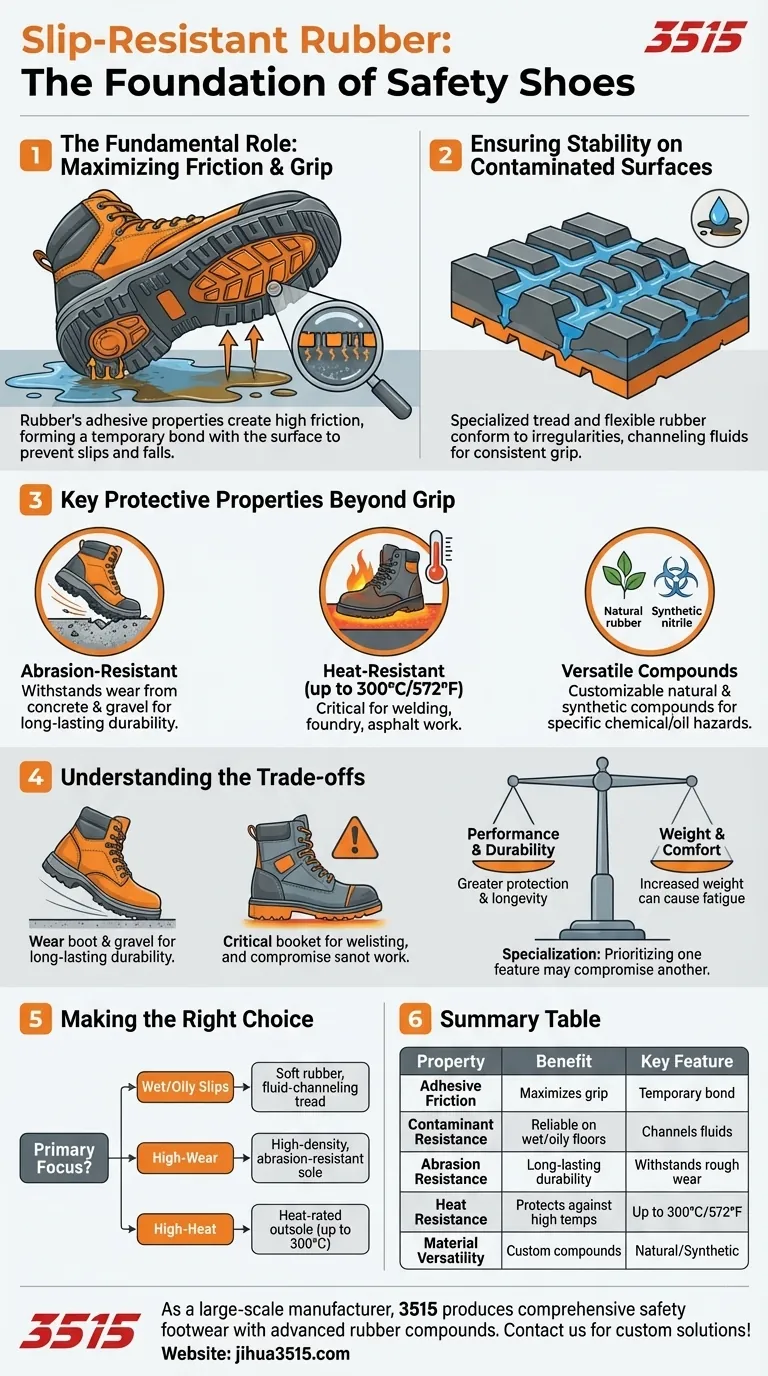
The fundamental role of slip-resistant rubber in safety shoes is to generate high friction between the outsole and the walking surface. This maximizes grip and stability, directly preventing the slips and falls that are a leading cause of workplace injuries, especially in environments contaminated with water, oil, or other slick substances.
The effectiveness of a safety shoe is not just about its protective toe cap; it's fundamentally determined by the material connecting the wearer to the ground. Slip-resistant rubber is the critical material that ensures this connection remains stable, even in the most hazardous conditions.
The Core Principles of Rubber-Based Grip
To understand why rubber is the standard for slip resistance, we need to look at its inherent material properties. The design of the outsole tread is important, but the material itself does the most critical work.
Maximizing Friction Through Adhesion
Rubber possesses natural adhesive properties at a microscopic level. This allows it to form a temporary bond with the walking surface, creating the high coefficient of friction necessary for a secure grip.
This quality means the shoe doesn't just rely on tread patterns to "bite" into the ground; it actively sticks to it, providing superior stability.
Ensuring Stability on Contaminated Surfaces
Many workplace floors are not perfectly clean or dry. Slip-resistant rubber is engineered to perform reliably on slippery or oily surfaces.
The material's flexibility allows it to conform to ground irregularities, while specialized tread patterns work to channel fluids away from the point of contact, ensuring the rubber maintains its grip.
Providing Durable, Long-Lasting Performance
Safety is compromised if a shoe's sole wears down quickly. Rubber is inherently abrasion-resistant, meaning it withstands wear and tear from rough surfaces like concrete or gravel.
This durability ensures that the sole maintains its tread and material integrity, providing consistent, long-lasting slip resistance throughout the life of the shoe.
Key Protective Properties Beyond Grip
While grip is its primary function, the rubber used in high-quality safety outsoles offers additional protective benefits that are vital in many industrial settings.
Resistance to High Heat
Certain rubber compounds are formulated to withstand extreme temperatures. It is common for high-performance safety soles to be rated for contact heat up to 300°C (572°F).
This is a critical feature for workers in industries like welding, asphalt paving, or foundry work, where accidental contact with hot surfaces is a constant risk.
Natural and Synthetic Variations
Rubber can be sourced naturally or created synthetically. This allows manufacturers to engineer specific compounds tailored to different hazards.
For example, a synthetic nitrile rubber might be used for its superior resistance to oils and chemicals, while another compound might be optimized for abrasion or heat resistance.
Understanding the Trade-offs
Selecting the right rubber outsole involves balancing key characteristics. No single compound is perfect for every possible application, and understanding the trade-offs is key to making an informed choice.
Performance vs. Weight
Generally, denser and more durable rubber outsoles offer greater protection and longevity. However, this often comes with increased weight, which can contribute to wearer fatigue over a long shift.
Specialization for Different Hazards
A sole compound optimized for extreme oil resistance might have a different wear characteristic than one designed for abrasion on dry concrete. Prioritizing one feature may slightly compromise another.
Making the Right Choice for Your Environment
Your specific workplace hazards should dictate your choice of safety footwear. Use the following guidelines to select the appropriate rubber outsole.
- If your primary focus is preventing slips on wet or oily surfaces: Seek out shoes with a soft rubber compound and a tread pattern designed to effectively channel liquids.
- If your primary focus is durability in high-wear environments: Choose a high-density, abrasion-resistant rubber sole that can withstand constant friction on rough surfaces.
- If your primary focus is protection from high-temperature contact: Verify that the shoe's outsole is explicitly rated for heat resistance, ideally to 300°C.
Ultimately, choosing the right rubber material is a foundational step in ensuring workplace safety from the ground up.
Summary Table:
| Property | Benefit | Key Feature |
|---|---|---|
| Adhesive Friction | Maximizes grip on surfaces | Creates a temporary bond for stability |
| Contaminant Resistance | Reliable performance on wet/oily floors | Channels fluids away, maintains grip |
| Abrasion Resistance | Long-lasting durability on rough surfaces | Withstands wear from concrete, gravel |
| Heat Resistance | Protects against high temperatures (up to 300°C/572°F) | Essential for welding, foundry work |
| Material Versatility | Custom compounds for specific hazards (e.g., oil, chemicals) | Natural or synthetic rubber options |
Need safety shoes with superior slip-resistant rubber soles?
As a large-scale manufacturer, 3515 produces a comprehensive range of safety footwear for distributors, brand owners, and bulk clients. Our production capabilities encompass all types of industrial shoes and boots, engineered with advanced rubber compounds for maximum grip, durability, and hazard-specific protection. Ensure your workforce's safety from the ground up—contact us today to discuss your custom safety shoe requirements!
Visual Guide
Related Products
- Heavy-Duty Waterproof Nubuck Safety Boots Safety Shoes for Bulk Supply
- Premium Suede Sport Safety Shoes for Wholesale & Bulk Orders
- Durable High-Traction Canvas Sneakers Wholesale & Custom Manufacturing
- Advanced KPU Athletic Safety Shoe with Steel Toe Cap Anti-Slip Rotary Lacing System
- Wholesale Durable 6-Inch Work Boots | Custom & Private Label Manufacturer
People Also Ask
- What primary protective functions do professional safety boots provide in urban solid waste recovery and waste picking processes? Discover Dual-Layer Protection.
- How do safety boots reduce cutting hazards? Essential Protection for Your Workforce
- Which organizations develop safety standards for work boots? Ensure Compliance & Worker Safety
- What are the common types of safety boots and their primary uses? A Guide to Industrial Footwear
- Why is ankle and arch support important in safety footwear? Prevent Injury & Fatigue















