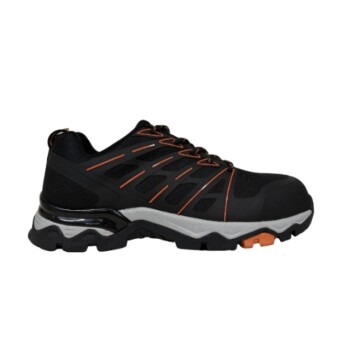
In the hierarchy of risk control for open-pit mining, safety shoes function as the definitive final line of defense. Classified strictly as Personal Protective Equipment (PPE), they are deployed when higher-level interventions—such as engineering barriers or administrative procedures—cannot completely eliminate on-site hazards. Their primary role is not to prevent the accident itself, but to drastically reduce the severity of injury should an incident occur.
While engineering and administrative controls aim to remove hazards from the environment, safety shoes serve as the ultimate physical barrier between the operator and residual risks. They ensure that unavoidable contact with heavy machinery, falling debris, or uneven terrain results in minimal physical damage.
Positioning PPE in the Control Hierarchy
The Last Barrier
In the Hazard Identification, Risk Assessment, and Risk Control (HIRADC) model, elimination and substitution are the priority. However, open-pit mining environments present dynamic variables that cannot always be engineered away.
Managing Residual Risk
When physical barriers and standard operating procedures reach their limit, safety shoes bridge the gap. They manage the "residual risk"—the danger that remains after all other safety measures have been implemented.
Mechanical Protection Against Mining Hazards
Impact and Crush Resistance
Open-pit sites are rife with heavy machinery and loose rock formations. Professional safety shoes integrate high-strength protective toe caps, made of steel or composite materials, to shield the foot from crushing injuries caused by falling objects.
Puncture Defense
Mining terrain often contains sharp debris that can penetrate standard footwear. High-quality safety shoes incorporate puncture-resistant midsoles, providing a critical shield against sharp objects attempting to pierce the sole of the foot.
Addressing Environmental Risks
Stability on Uneven Terrain
The ground in an open pit is rarely flat or dry; it is often wet, muddy, or comprised of loose gravel. Safety shoes with slip-resistant outsoles provide the necessary traction to prevent slips and falls.
Efficient Movement
Beyond protection, this stability is fundamental for operational efficiency. It allows operators to move confidently across complex terrains without the constant fear of losing their footing.
Understanding the Trade-offs
Hazard Persistence
It is critical to remember that PPE does not remove the hazard. Wearing safety shoes does not stop a rock from falling or a surface from being slippery; it only mitigates the bodily damage resulting from those conditions.
The Risk of Mismatched Equipment
Safety shoes are not a "one-size-fits-all" solution. As noted in risk identification protocols, equipment must match the specific risk; for example, standard steel-toed boots may not offer the necessary insulation for electrical work, requiring specific insulated footwear instead.
Making the Right Choice for Your Goal
To effectively implement safety shoes within your HIRADC strategy, you must match the specific shoe feature to the identified risk.
- If your primary focus is preventing crush injuries: Prioritize footwear with reinforced steel or composite toe caps to withstand heavy impacts.
- If your primary focus is navigating complex terrain: Select shoes with aggressive, slip-resistant outsoles to ensure stability on wet or uneven surfaces.
- If your primary focus is debris protection: Ensure the footwear includes a puncture-resistant midsole to stop sharp objects from penetrating the foot.
By treating safety shoes as a calculated component of risk management rather than a generic accessory, you transform them from simple clothing into a vital safety instrument.
Summary Table:
| Hazard Category | HIRADC Control Level | Protective Feature | Benefit to Worker |
|---|---|---|---|
| Falling Rocks/Heavy Objects | PPE (Final Barrier) | Steel/Composite Toe Caps | Prevents crushing injuries and toe fractures |
| Sharp Debris/Jagged Stones | PPE (Final Barrier) | Puncture-resistant Midsoles | Shields the foot from piercing and penetration |
| Wet/Uneven Mining Terrain | PPE (Final Barrier) | Slip-resistant Outsoles | Enhances stability and prevents falls/slips |
| Residual Operational Risk | PPE (Final Barrier) | Full Protective Construction | Reduces injury severity when other controls fail |
Partner with 3515 for Industry-Leading Mining Safety Solutions
As a large-scale manufacturer serving global distributors and brand owners, 3515 offers comprehensive production capabilities for all footwear types, anchored by our flagship Safety Shoes series. In high-stakes environments like open-pit mining, your customers need more than just footwear—they need a reliable final line of defense against residual risks.
Our extensive portfolio covers:
- Work & Tactical Boots: Built for the harshest terrains and heavy-duty protection.
- Outdoor & Training Shoes: Combining durability with ergonomic performance.
- Sneakers, Dress & Formal Shoes: High-quality options to meet diverse bulk requirements.
Maximize your supply chain efficiency and safety standards today. Contact us now to discuss your bulk manufacturing needs and let 3515 provide the quality and scale your brand deserves.
References
- Fadhilah Fadhilah, Risma Erwi Gusvita. Hazard Identification, Risk Assessment and Determining Control (HIRADC) in Mining Operations at PT Semen Padang. DOI: 10.46574/motivection.v5i3.249
This article is also based on technical information from 3515 Knowledge Base .
Related Products
- Premium Suede Sport Safety Shoes for Wholesale & Bulk Orders
- Premium Lightweight Safety Shoes for Wholesale & Bulk Orders
- Wholesale Anti-Smash & Puncture-Proof Safety Shoes Custom Manufacturing for Brands
- Premium KPU Injection Athletic Style Safety Shoes
- Premium Safety Shoes with Rotating Buckle Safety Sneakers
People Also Ask
- What are the primary functions of professional safety shoes? Maximize Safety in Water Supply Confined Spaces
- What industries have specific OSHA footwear requirements? Ensure Compliance & Protect Your Workforce
- What role do specialized safety shoes play in preventing falls? Engineering Stability in Industrial Environments
- What are the main components of safety shoes? A Guide to Protective Footwear Design
- Why should ergonomics and comfort be prioritized when selecting safety shoes? Boost Compliance & Worker Health