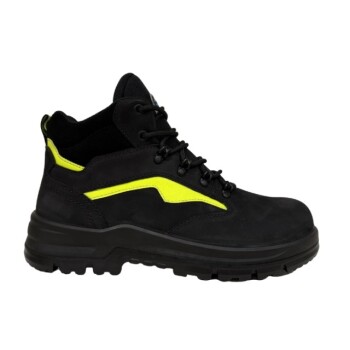
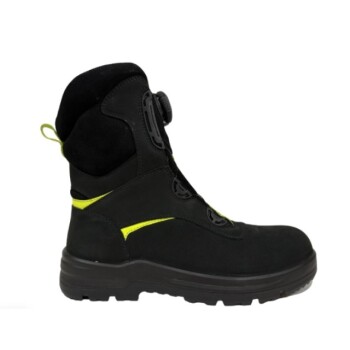
Anti-slip safety boots serve as the primary preventative measure against loss of balance during high-altitude construction. Specifically, during beam bracing and installation, they utilize specialized outsoles to generate critical friction against narrow or smooth surfaces like scaffolding and ladders. This mechanical grip is essential for preventing the initial slip that leads to catastrophic falls.
The core function of anti-slip footwear is to secure stable footing on precarious surfaces, effectively neutralizing the risk of unstable steps before a loss of balance can occur.
The Mechanics of Stability at Height
To understand the protective value of these boots, we must look at how they interact with the specific environments found in high-altitude construction.
Increasing Friction on Metal Surfaces
Workers installing beams often operate on scaffolding and ladders, surfaces that are frequently smooth and metal-based.
Professional safety boots feature specialized outsoles designed to maximize the coefficient of friction against these materials.
This increased friction "locks" the foot in place, preventing the sliding motion that typically precedes a fall.
Preventing Loss of Balance
Beam bracing requires workers to manipulate heavy materials, often necessitating awkward body positioning or shifting weight.
If a worker's footing is insecure during these shifts, the result is an unstable step and an immediate loss of balance.
Anti-slip boots provide the foundational stability required to execute these physical tasks without the foot shifting unexpectedly.
Critical Considerations and Limitations
While anti-slip boots are vital, relying on them without understanding their limitations can lead to a false sense of security.
Maintenance of the Outsole
The friction provided by the specialized outsole is not permanent; it relies on the physical condition of the boot's tread.
Worn-down treads or outsoles clogged with debris will lose their ability to grip scaffolding effectively.
Not a Replacement for Fall Arrest Systems
It is critical to distinguish between fall prevention and fall arrest.
Anti-slip boots are a prevention tool designed to stop the slip from happening.
However, they do not replace the need for harnesses and lanyards, which are the final safeguard should the boots fail or stability be compromised by external forces.
Making the Right Choice for Your Project
Selecting the correct footwear is a strategic decision that impacts both safety compliance and worker confidence.
- If your primary focus is Accident Prevention: Prioritize boots with aggressive tread patterns explicitly rated for the specific surfaces (e.g., metal grating, scaffolding) your team uses.
- If your primary focus is Task Efficiency: Ensure the anti-slip technology does not compromise flexibility, as workers need to maneuver comfortably on ladders to perform installation tasks effectively.
Equipping workers with proper anti-slip footwear is the first and most effective step in stabilizing the human element of high-altitude construction.
Summary Table:
| Feature | Function in High-Altitude Work | Impact on Safety |
|---|---|---|
| Specialized Outsole | Maximizes friction on metal scaffolding/ladders | Prevents initial sliding and slips |
| Aggressive Tread | Grips narrow and precarious surfaces | Neutralizes risk of unstable steps |
| Balance Support | Secures footing during heavy material handling | Maintains center of gravity at height |
| Maintenance Care | Ensures tread remains clear of debris | Sustains long-term grip performance |
Partner with 3515 for Unmatched Workplace Stability
As a large-scale manufacturer serving distributors and brand owners, 3515 offers comprehensive production capabilities for all footwear types, anchored by our flagship Safety Shoes series. Our extensive portfolio covers work and tactical boots, outdoor shoes, training shoes, and sneakers, as well as Dress & Formal shoes to meet diverse bulk requirements.
Whether you need high-performance anti-slip technology for construction crews or specialized footwear for industrial distribution, we provide the scale and expertise to deliver. Contact us today to discuss your bulk manufacturing needs and see how our footwear solutions can add value to your brand.
References
- Bayu Aninditya, Fitri Suryani. Implementation of the Hazard Identification, Risk Assessment and Risk Control (HIRARC) Method on Erection Girder Work of South Japek II Toll Road Construction Project Package 3. DOI: 10.58631/injurity.v2i9.127
This article is also based on technical information from 3515 Knowledge Base .
Related Products
- Wholesale Premium Waterproof Nubuck Safety Shoes Boots
- Heavy-Duty Waterproof Nubuck Safety Boots Safety Shoes for Bulk Supply
- Wholesale Suede Chelsea Safety Boots for Custom & Private Label Manufacturing
- Durable Leather Moc Toe Work Boots for Wholesale & Custom Manufacturing
- Wholesale Durable 6-Inch Work Boots | Custom & Private Label Manufacturer
People Also Ask
- Why are waterproof safety boots recommended for certain work environments? Essential Protection for Wet & Hazardous Jobs
- What materials are commonly used in waterproof boots? The Complete Guide to Durable, Breathable Protection
- What are the drawbacks of waterproof boots? The Breathability vs. Protection Trade-Off
- What is the advantage of one-piece construction in waterproof boots? Unbeatable Seamless Protection
- What is the difference between waterproof, water-resistant, and water-repellent boots? Choose the Right Protection for Your Feet