At their core, ankle straps function as a critical stability system for your footwear. They prevent slips not by changing the shoe's grip on the ground, but by locking your foot to the sole of the shoe. This fusion of foot and footwear creates a single, predictable unit, drastically reducing the internal foot movement that leads to imbalance and falls, especially in shoes like heels and sandals.
The crucial distinction is this: ankle straps prevent your foot from slipping inside the shoe. They do not increase the traction of the shoe's outsole on the walking surface. Mastering this internal stability is the key to preventing a common cause of rolled ankles and stumbles.
The Mechanics of Footwear Instability
To appreciate the role of an ankle strap, you must first understand the problem it solves. The danger often isn't the ground, but the disconnect between your foot and your shoe.
The Problem: Internal Foot Slippage
In open-heeled or loose-fitting shoes, your foot is a separate object resting on a platform. With each step, it can slide forward, backward, or sideways on the insole.
This subtle movement disconnects your body's sense of balance from the shoe's actual point of contact with the ground, forcing constant, tiny corrections that lead to fatigue and instability.
How a Strap Creates a Secure System
An ankle strap acts as an anchor. It mechanically fastens your foot to the shoe, ensuring they move in unison.
By securing the shoe around the ankle—a natural hinge point—it transfers control directly from your leg to the shoe's sole. This prevents your heel from lifting out of the shoe unintentionally and stops your foot from sliding forward on an incline.
The Impact on Different Shoe Types
The stabilizing benefit of an ankle strap becomes more pronounced in specific types of footwear where the design inherently creates instability.
In High Heels
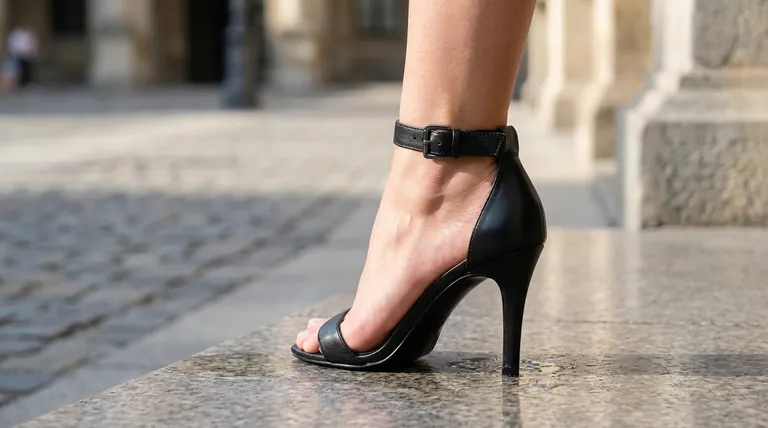
The steep angle of a high heel constantly pushes your foot forward due to gravity. An ankle strap provides a hard stop, preventing your foot from sliding down the insole.
This stops your toes from being crushed into the toe box and keeps your heel securely in the heel cup, maintaining the intended balance point of the shoe.
In Sandals and Wedges
Even on flat or low-angled shoes like sandals, an ankle strap is vital. It prevents the foot from shifting side-to-side or the heel from slipping off the back.
This ensures your foot maintains full contact with the shoe's sole, providing a consistent and reliable platform for every step.
Understanding the Trade-offs
While highly effective, ankle straps are not a universal solution for all footwear problems. Their effectiveness is dependent on design and context.
Fit Is Non-Negotiable
The benefit of an ankle strap is entirely lost if it is not fitted correctly.
A strap that is too loose provides no stability and can become a tripping hazard. A strap that is too tight can cause friction, restrict circulation, and impede the natural flexion of your ankle.
The Illusion of External Grip
It is critical to remember that an ankle strap adds zero traction. It will not prevent a slip on a wet floor or an icy patch.
A shoe with an ankle strap but a smooth, leather sole is still a slippery shoe. Stability and traction are two separate safety features.
Making the Right Choice for Your Goal
Select footwear based on a clear understanding of what you need it to do. Ankle straps are a feature that solves a specific stability problem.
- If your primary focus is preventing falls in high heels: Prioritize shoes with a well-placed ankle strap to counteract the forward foot-slide caused by the shoe's incline.
- If your primary focus is secure, all-day walking in sandals or flats: Choose a strap that anchors your heel firmly to the back of the shoe to prevent slippage and instability.
- If your primary focus is safety on potentially slick surfaces: Your first priority must be a shoe with a high-traction, non-slip rubber outsole; an ankle strap should be considered a secondary stability feature.
By understanding that ankle straps master internal stability, you can make more informed footwear choices for a confident and secure stride.
Summary Table:
| Function | Benefit | Key Consideration |
|---|---|---|
| Anchors Foot to Shoe | Creates a single, stable unit with the sole | Prevents foot from slipping inside the shoe |
| Counters Forward Slide | Essential for stability in high heels | Stops toes from being crushed in the toe box |
| Prevents Heel Lift | Secures foot in sandals and wedges | Ensures consistent platform for walking |
| Improves Balance | Reduces internal movement that causes imbalance | Does not increase external traction on the ground |
Need secure, stable footwear for your customers?
As a large-scale manufacturer, 3515 produces a comprehensive range of footwear for distributors, brand owners, and bulk clients. Our production capabilities encompass all types of shoes and boots, including designs with integrated stability features like functional ankle straps.
We can help you develop or source footwear that combines internal stability with high-traction outsoles for ultimate safety and confidence.
Contact our experts today to discuss your production needs and bring secure, stable footwear to your market.
Visual Guide

Related Products
- Wholesale Durable & Breathable Training Shoes for Custom Brands
- Wholesale Classic Leather Lace-Up Ankle Boots for Brand Manufacturing
- Durable Leather High-Ankle Tactical Boots for Wholesale & Custom Manufacturing
- Wholesale Leather Ankle Boots with Lug Soles for Custom Brand Manufacturing
- Wholesale Breathable Training Shoes Custom Athletic Footwear Manufacturer
People Also Ask
- Why is structural stability in footwear required during dual-task walking tests? Ensure Sensor Precision & Data Integrity
- Why is the integration of advanced cushioning in training shoes necessary for athletes? Boost Recovery and Performance
- Why is the use of flat-soled or professional training shoes essential for WBV? Maximize Vibration Energy Transfer
- Why is it necessary for participants to wear professional training shoes? Ensuring Data Accuracy & Patient Safety
- How does the Ground Reaction Force (GRF) constancy hypothesis influence professional training shoes and sneakers?