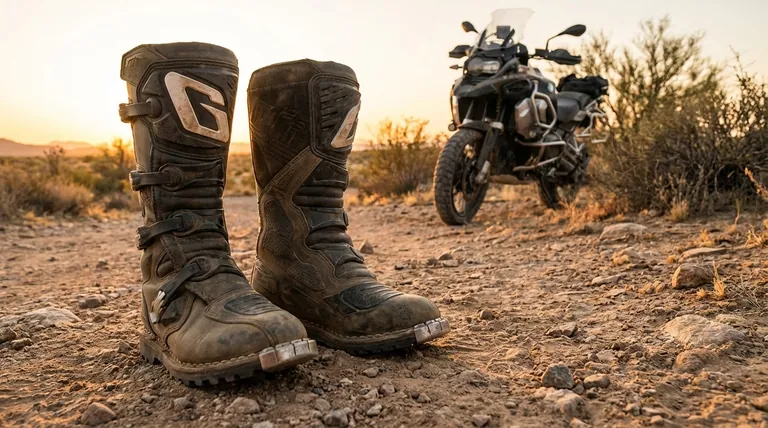
The most protective adventure motorcycle boots integrate rugged materials like cowhide with a system of purpose-built armor. Key features include rigid shin protection, reinforced toe and heel boxes for impact absorption, and a taller design to provide critical ankle support against twisting forces common in off-road environments.
True protection in an adventure boot is not about a single feature, but a holistic design that balances the robust impact and abrasion resistance of a dirt boot with the functional comfort required for long-distance travel on pavement.
The Anatomy of Protection: Key Structural Components
An adventure boot is a complex piece of equipment where each component serves a specific protective function. Understanding these elements allows you to accurately assess a boot's ability to keep you safe across varied terrain.
The Chassis: Material Matters
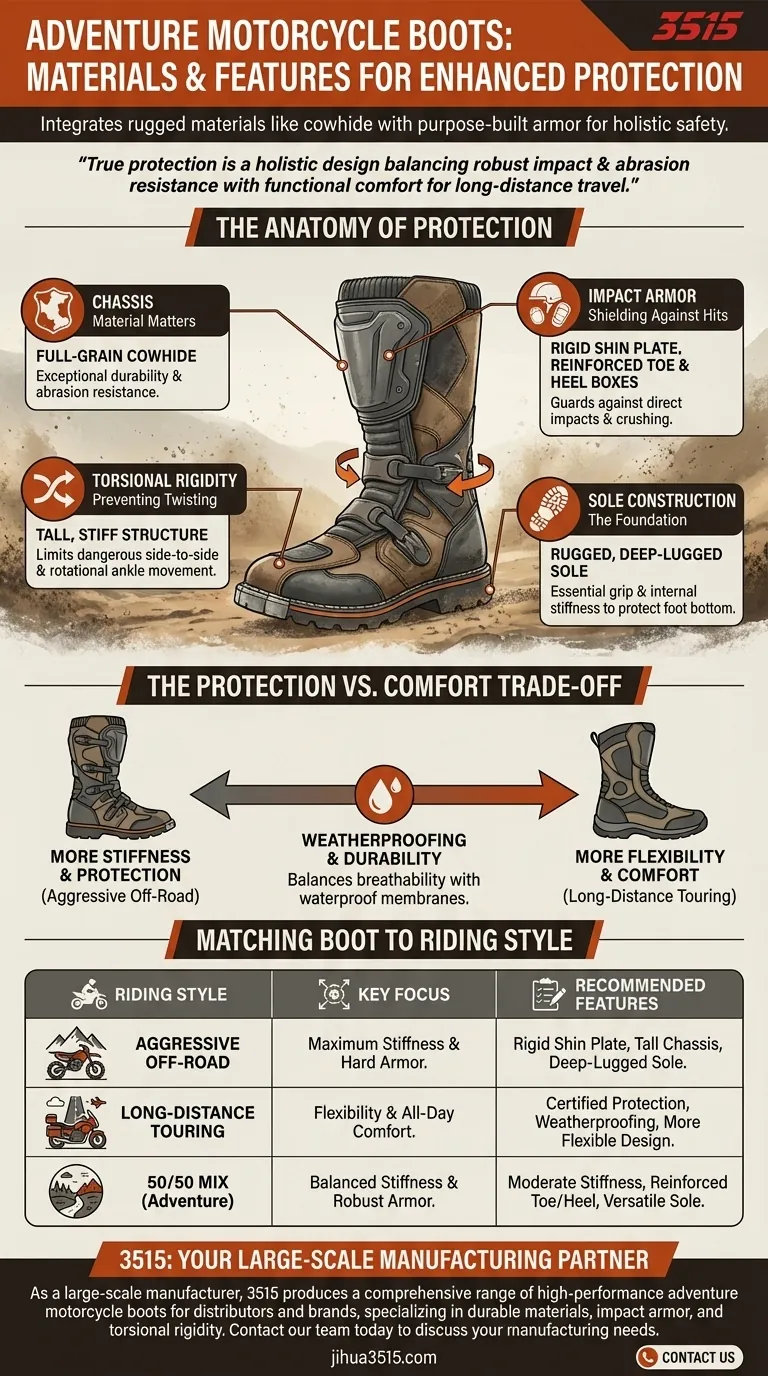
The main body of the boot, or chassis, is your first line of defense. Most high-quality adventure boots use full-grain cowhide or advanced synthetic equivalents. This material is chosen for its exceptional durability and resistance to abrasion during a slide.
Impact Armor: Shielding Against Hits
Hard armor is integrated at critical points to protect against direct impacts from rocks, branches, or the motorcycle itself. Look for a rigid shin plate to guard against front-facing impacts and heavily reinforced toe and heel areas to prevent crushing injuries.
Torsional Rigidity: Preventing Twisting Injuries
One of the most significant risks in off-road riding is a twisting injury to the ankle. A protective adventure boot features a tall, stiff structure that limits dangerous side-to-side and rotational movement of the ankle joint, often referred to as torsional rigidity.
Sole Construction: The Foundation of Safety
The sole of an adventure boot serves a dual purpose. A rugged, deep-lugged sole provides essential grip on unstable surfaces like mud or gravel. Internally, the sole must be stiff enough to protect the bottom of your foot from impacts and to prevent it from folding over the footpeg in an accident.
Understanding the Core Trade-off: Protection vs. Comfort
The central challenge in designing an adventure boot is balancing uncompromising protection with the flexibility and comfort needed for long rides and walking.
The Stiffness Spectrum
A boot with more motocross-derived features will be stiffer and offer superior protection against twisting and impacts. However, this rigidity makes it less comfortable for walking around or for nuanced control on the pavement.
The Flexibility Compromise
Conversely, a boot that feels more like a standard touring boot will be more flexible and comfortable for all-day wear. This comfort often comes at the cost of reduced torsional support and less robust armor, making it less suitable for aggressive off-road riding.
Weatherproofing and Durability
Effective weatherproofing is critical for adventure riding, but it can impact breathability. The most protective boots use high-quality waterproof membranes that are bonded to durable outer materials to withstand the abuse of off-road use without compromising their integrity.
Matching the Boot to Your Riding Style
Choosing the right boot requires an honest assessment of how you plan to ride. There is no single "best" boot, only the best boot for your specific needs.
- If your primary focus is aggressive off-road with some road connections: Prioritize maximum stiffness, a tall chassis, and extensive hard armor, accepting the compromise in walking comfort.
- If your primary focus is long-distance touring with occasional gravel roads: Look for a more flexible design with certified ankle, toe, and heel protection, emphasizing all-day comfort and weatherproofing.
- If your primary focus is a true 50/50 mix of pavement and moderate trails: Seek a balanced boot with moderate stiffness and robust armor, representing the ideal compromise at the heart of the adventure category.
Ultimately, choosing the right boot is about aligning its protective features with the real-world risks of the terrain you intend to conquer.
Summary Table:
| Protective Feature | Key Function | Best For Riding Style |
|---|---|---|
| Rigid Shin Plate | Guards against front-facing impacts | Aggressive Off-Road |
| Reinforced Toe/Heel | Prevents crushing injuries | All Styles |
| Tall, Stiff Chassis | Limits ankle twisting | Aggressive Off-Road / 50-50 Mix |
| Rugged, Deep-Lugged Sole | Provides grip & foot protection | All Styles, especially Off-Road |
As a large-scale manufacturer, 3515 produces a comprehensive range of protective footwear for distributors, brand owners, and bulk clients. We specialize in manufacturing high-performance adventure motorcycle boots that integrate the critical protective features discussed—like durable cowhide, impact armor, and torsional rigidity—ensuring safety without compromising on quality or scalability. Our production capabilities encompass all types of motorcycle boots and boots for any application. Ready to equip your customers with boots built for real adventure? Contact our team today to discuss your manufacturing needs and see how we can enhance your product line.
Visual Guide
Related Products
- Durable Spiked Camouflage Boots Wholesale & Factory Production
- Wholesale High-Traction Camo Boots - Custom Manufacturer for Brands
- High Performance Fire-Retardant Waterproof Safety Boots
- Wholesale Tactical Boots High-Traction & Reflective for Bulk & Brand Orders
- Wholesale Waterproof Tactical Boots Custom Suede & High-Traction Soles
People Also Ask
- How does boot height affect waterproofing? Choose the Right Height for Ultimate Protection
- What are the best types of shoes for different gardening conditions? Find Your Perfect Match.
- What role does camouflage play in hunting boots? It's More Than Just a Pattern
- What should you look for to ensure boots are fully waterproof? The Essential 2-Part System
- How does boot construction affect waterproofing? The Science Behind Truly Dry Feet