
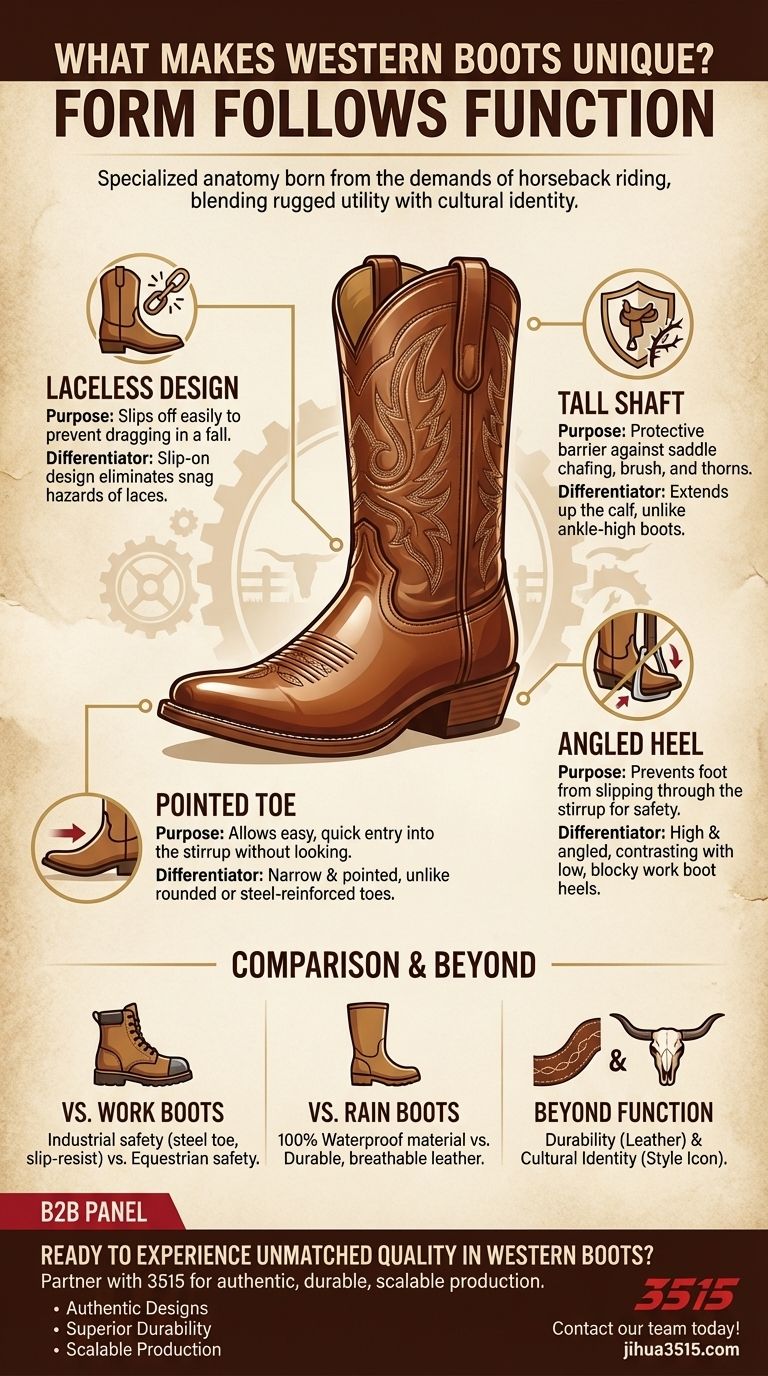
What makes a western boot truly unique is its specialized anatomy, born from the functional demands of horseback riding. Every core feature—the angled heel, tall shaft, pointed toe, and laceless design—serves a specific purpose for safety and efficiency in the stirrup, creating an iconic silhouette that blends rugged utility with cultural identity.
The iconic shape of a western boot is not arbitrary; it is a direct reflection of its original function. Each curve and component was engineered to solve a specific problem faced by a rider in the saddle, making it a masterclass in purpose-driven design.

The Anatomy of a Western Boot: Form Follows Function
To understand what sets a western boot apart, you must examine its core components. Unlike many other boots, its primary features were developed for a single activity: riding a horse.
The Angled Heel
The most critical safety feature of a western boot is its high, angled heel. This design is engineered to prevent the rider's foot from accidentally slipping all the way through the stirrup, which could be catastrophic if the rider falls.
This contrasts sharply with the low, blocky heels on service boots or the flatter soles of many work boots, which are designed for stability while walking on flat ground.
The Pointed Toe
A western boot typically features a narrow and pointed toe. Its function is purely practical: it helps a rider easily and quickly guide their foot into the stirrup without looking down.
This is a key differentiator from work or safety boots, which have rounded and often steel-reinforced toes to protect against impacts in industrial environments.
The Tall Shaft
The boot's tall shaft, which extends up the calf, serves as a protective barrier. It guards the rider's leg against chafing from the saddle and stirrup leathers, as well as from brush, thorns, and even snakebites.
This is fundamentally different from ankle-high boots like chukkas, which offer minimal leg protection and are designed for casual wear.
The Laceless Design
Western boots are defined by their laceless, slip-on design. This is another crucial safety feature. In the event of a fall where the rider's foot gets hung in the stirrup, a laceless boot is more likely to slip off, freeing the rider from being dragged.
Laces, common on work, service, and racing boots, could easily snag on branches or equipment, creating a significant hazard for a rider.
How Western Boots Compare to Other Boot Types
The specialized nature of the western boot becomes even clearer when compared directly against other common types of footwear.
vs. Work & Safety Boots
The primary difference is protection type. Work boots are built for industrial job sites with features like steel toe caps, puncture-resistant midsoles, and slip-resistant outsoles. Western boots prioritize equestrian safety and lack these industrial protections.
vs. Rain Boots
The defining factor here is material. Rain boots (or Wellingtons) are made of rubber or other synthetic materials to be 100% waterproof. Western boots are typically crafted from leather, which offers durability and breathability but is not inherently waterproof.
vs. Specialized Riding Boots
Even within the world of riding, boots differ. Motorcycle racing boots, for instance, are designed for high-speed pavement riding and feature heavy armored protection made of plastic, metal, and composites. A western boot's protection is simpler, focused on the unique challenges of a saddle and stirrups.
Beyond Function: Durability and Cultural Identity
While its design is rooted in function, the western boot's uniqueness also stems from its materials and cultural significance.
The Importance of Leather
Traditionally made of leather, a good pair of western boots is known for its exceptional durability. When properly cared for, these boots are an investment that can last for years of hard use on a ranch or as a daily staple.
The Role of Style
Western boots are a powerful symbol of an entire culture. The ornate, decorative stitching and polished leathers are not just for aesthetics; they are a form of expression and identity that elevates the boot from a piece of equipment to a style icon.
Making the Right Choice for Your Goal
Understanding these core differences is key to selecting the right boot for your specific needs.
- If your primary focus is horseback riding: The angled heel, tall shaft, and smooth sole of a traditional western boot are designed specifically for your safety and performance in the saddle.
- If your primary focus is industrial safety: You must choose a dedicated work boot with certified features like a steel toe and slip-resistant sole.
- If your primary focus is protection from wet weather: A fully waterproof rain boot is the only appropriate choice to keep your feet completely dry.
- If your primary focus is style and cultural expression: The distinctive silhouette and ornate stitching of a western boot offer an unmatched aesthetic.
Ultimately, the western boot's unique character comes from its perfect fusion of specialized equestrian function and powerful cultural symbolism.
Summary Table:
| Feature | Purpose | Key Differentiator |
|---|---|---|
| Angled Heel | Prevents foot from slipping through stirrup | High & angled vs. low, flat heels on work boots |
| Pointed Toe | Allows easy entry into stirrup | Narrow & pointed vs. rounded, reinforced toes |
| Tall Shaft | Protects leg from saddle chafing & brush | Calf-high vs. ankle-high designs |
| Laceless Design | Slips off easily to prevent dragging in a fall | Slip-on vs. laced boots for safety |
Ready to Experience Unmatched Quality in Western Boots?
As a large-scale manufacturer, 3515 produces a comprehensive range of durable, purpose-built footwear for distributors, brand owners, and bulk clients. Our production capabilities encompass all types of boots, including authentic western boots designed with the perfect blend of tradition, safety, and style.
Partner with us to offer your customers:
- Authentic Designs: Boots built with true equestrian functionality.
- Superior Durability: Crafted from high-quality materials for long-lasting wear.
- Scalable Production: Reliable supply to meet your business demands.
Let's discuss how we can support your footwear line. Contact our team today to explore partnership opportunities!
Visual Guide
Related Products
- Durable Goodyear Welt Leather Work Boots for Wholesale & Private Label
- High-Traction Suede Tactical Boots Wholesale & Custom Manufacturing
- Wholesale Lightweight Tactical Boots Custom Manufacturer for Desert & Combat Use
- Durable Leather Tactical Boots Wholesale & Custom Manufacturing for Brands
- Durable Waterproof Rain Boots | Custom Manufacturer for Wholesale & Brands
People Also Ask
- What is the difference between full-grain and top-grain leather? Premium Material Guide for Boot Manufacturers
- What are the advantages of leather as an upper material for work boots? Unmatched Durability & Custom Comfort
- Why is it important to waterproof leather work boots? Protect Your Investment and Performance
- How should new leather work boots be broken in? A Guide to Comfort and Durability
- What are the advantages of leather uppers in work boots? Unmatched Durability & Protection














