
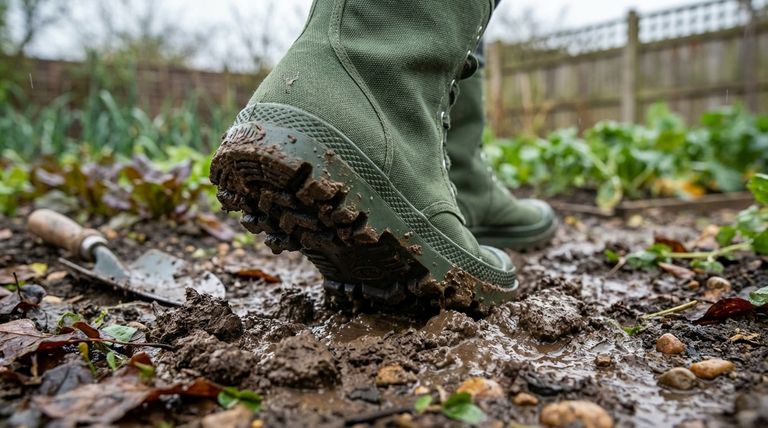
The grip of a gardening boot is not a feature; it is the foundation of your safety. It is essential because gardening constantly forces you to balance on unstable and unpredictable surfaces. A well-designed grip with deep traction prevents dangerous slips and falls on wet soil, slick mud, frost, or uneven inclines, ensuring your stability as you work.
While waterproofing keeps you comfortable, it's the boot's outsole design—specifically the depth, pattern, and spacing of its treads—that directly translates to your safety on treacherous ground. Understanding this design is the key to preventing injury.
Why Standard Footwear Fails in the Garden
Many boots provide protection, but a garden environment presents a unique set of challenges that renders typical flat-soled footwear ineffective and unsafe.
The Challenge of Unpredictable Surfaces
A garden is a dynamic surface. It can be soft soil one moment and slick, compacted mud the next.
You are constantly navigating awkward inclines, stepping over plants, and balancing on uneven ground, all of which demand a reliable connection to the earth.
The Failure of Smooth Soles
Smooth or shallow-treaded soles cannot "bite" into the ground. On wet grass or mud, they create a hydroplaning effect, leading to a complete loss of traction.
This makes them unsuitable for the core tasks of gardening, where leverage and a stable footing are paramount for everything from digging to carrying heavy loads.
Deconstructing an Effective Gardening Outsole
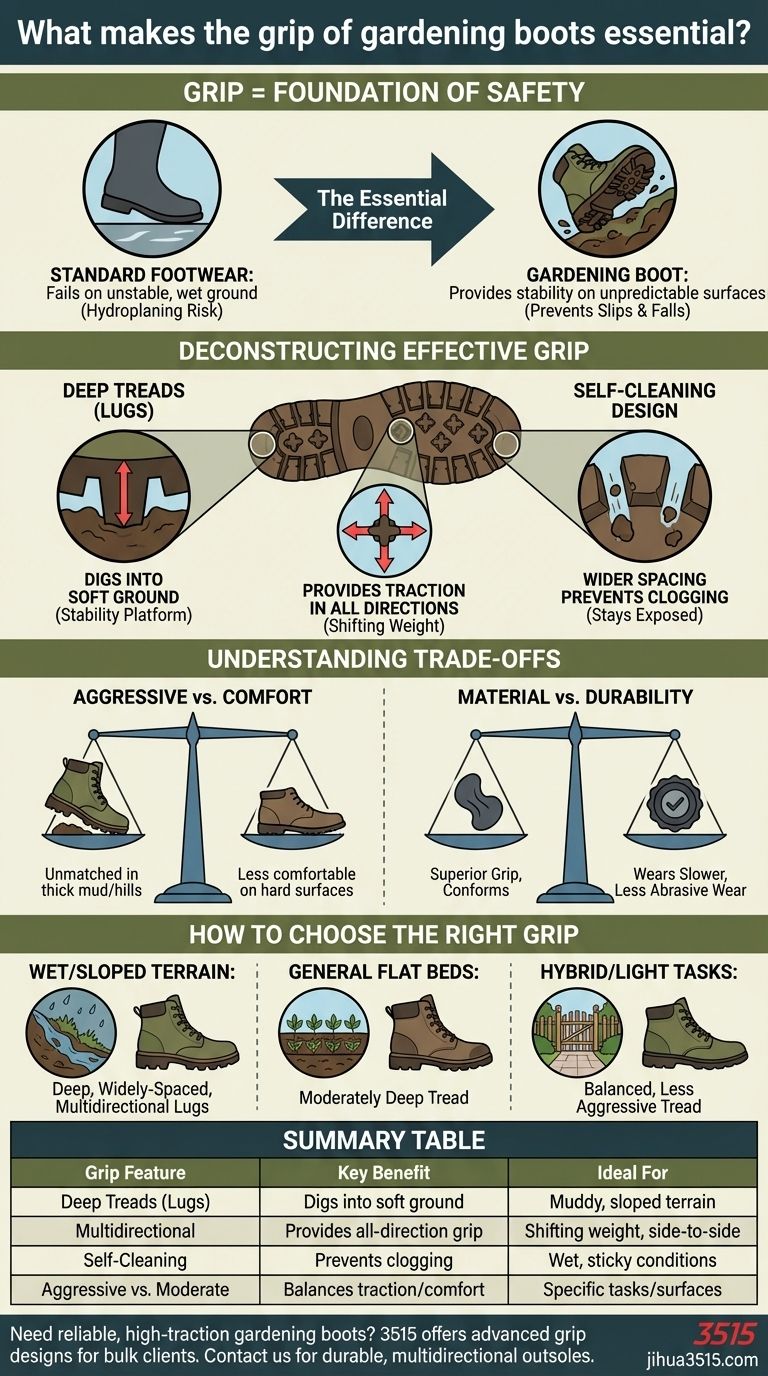
The effectiveness of a boot's grip is determined by the specific engineering of its outsole. Several key design elements work together to provide maximum stability.
The Role of Deep Treads
Deep treads, often called lugs, are the most critical feature. Their depth allows them to dig into soft or loose ground, creating a stable platform under your foot.
Without sufficient depth, the sole simply rests on top of slippery surfaces like mud instead of penetrating through to more stable ground beneath.
The Importance of a Multidirectional Pattern
Gardening is not a straight-line activity. You move forwards, backwards, and sideways, often shifting your weight unexpectedly.
An effective outsole has a multidirectional tread pattern. This ensures that no matter which way you push off or need to brace yourself, some part of the tread is oriented to provide grip and prevent a slip.
The Concept of a Self-Cleaning Design
Traction is lost when treads become clogged with mud and debris, effectively creating a smooth, slippery surface.
Self-cleaning outsoles are designed with wider spacing between the lugs. This allows mud and soil to fall away as you walk, ensuring the deep treads remain exposed and functional. This also makes the boots significantly easier to clean.
Understanding the Trade-offs
Choosing the perfect grip involves balancing competing needs. No single design is superior for every possible task.
Aggressive Treads vs. Surface Comfort
Boots with extremely deep, aggressive lugs are unmatched in thick mud or on steep, soft hills.
However, these same lugs can feel unstable or uncomfortable when walking on hard, flat surfaces like stone patios, decks, or pavement.
Material vs. Durability
The rubber compound of the sole also plays a role. A softer rubber may offer superior grip, especially on wet, hard surfaces, as it conforms better to microscopic textures.
The trade-off is that softer compounds tend to wear down faster than harder, more durable rubber formulas, especially with frequent use on abrasive surfaces like concrete or gravel.
How to Choose the Right Grip for Your Garden
Your specific gardening environment and tasks should dictate your choice. Use these guidelines to select the right level of traction for your needs.
- If your primary focus is working on wet, sloped, or muddy terrain: Prioritize boots with deep, widely-spaced, and multidirectional lugs for maximum traction and self-cleaning capability.
- If your primary focus is general gardening on mostly flat, prepared beds: A moderately deep tread will provide all the safety you need without being overly aggressive for walking on adjacent paths or patios.
- If your primary focus is light tasks with frequent moves between the garden and hard surfaces: Look for a hybrid outsole with a less aggressive tread pattern that offers a balance of reliable grip and walking comfort.
Ultimately, selecting the right boot grip is a direct investment in your stability, allowing you to focus on your garden with complete confidence.
Summary Table:
| Grip Feature | Key Benefit | Ideal For |
|---|---|---|
| Deep Treads (Lugs) | Digs into soft ground for stability | Muddy, sloped terrain |
| Multidirectional Pattern | Provides grip in all directions | Shifting weight, side-to-side movement |
| Self-Cleaning Design | Prevents clogging with mud/debris | Wet, sticky conditions |
| Aggressive vs. Moderate Treads | Balances traction and comfort | Specific garden tasks and surfaces |
Need reliable, high-traction gardening boots for your customers?
As a large-scale manufacturer, 3515 produces a comprehensive range of safety-focused footwear with advanced grip designs for distributors, brand owners, and bulk clients. Our production capabilities ensure durable, multidirectional outsoles tailored to any gardening environment.
Contact us today to discuss your footwear needs and enhance your product line with boots built for stability and safety.
Visual Guide
Related Products
- Durable Goodyear Welt Leather Work Boots for Wholesale & Private Label
- Factory Direct Wholesale Rain Boots Durable Waterproof & Fully Customizable
- Wholesale High-Traction Camo Boots - Custom Manufacturer for Brands
- Wholesale Tactical Boots High-Traction & Reflective for Bulk & Brand Orders
- Durable Moc-Toe Wedge Work Boots | Wholesale Manufacturing for Brands
People Also Ask
- What is the difference between full-grain and top-grain leather? Premium Material Guide for Boot Manufacturers
- What are the advantages of leather as an upper material for work boots? Unmatched Durability & Custom Comfort
- Why is it important to waterproof leather work boots? Protect Your Investment and Performance
- How should new leather work boots be broken in? A Guide to Comfort and Durability
- What are the advantages of leather uppers in work boots? Unmatched Durability & Protection
















