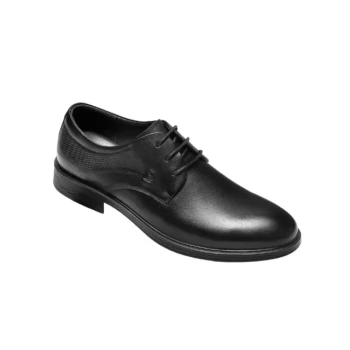
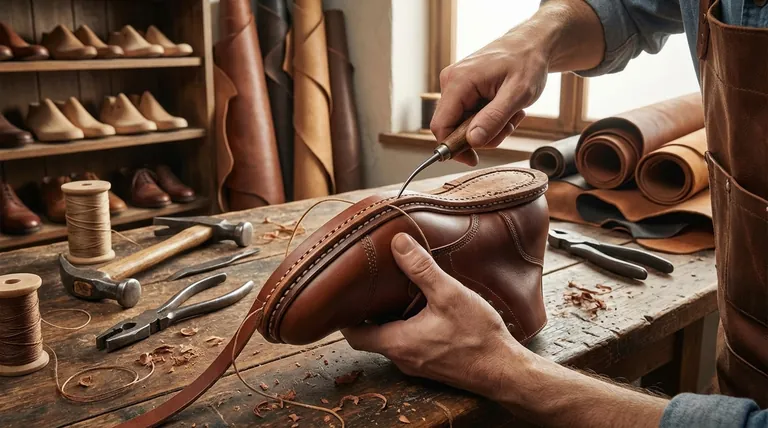
The defining feature of Goodyear welted footwear is not the leather itself, but the construction method used to attach the sole. This 19th-century technique involves stitching a strip of leather—the welt—to the shoe's upper, and then separately stitching the outsole to that welt. This creates an exceptionally durable, water-resistant, and easily repairable shoe designed for longevity.
The true value of a Goodyear welt lies in its architecture. By creating a separate layer between the upper and the outsole, it makes the shoe fully resolable, transforming a disposable item into a long-term, sustainable investment.
The Core Principle: Why It's Built to Last
The Goodyear welting process, patented by Charles Goodyear Jr. in 1871, revolutionized shoemaking. Its design prioritizes structural integrity and repairability over the speed and low cost of modern cemented or glued constructions.
The Welt: A Replaceable Foundation
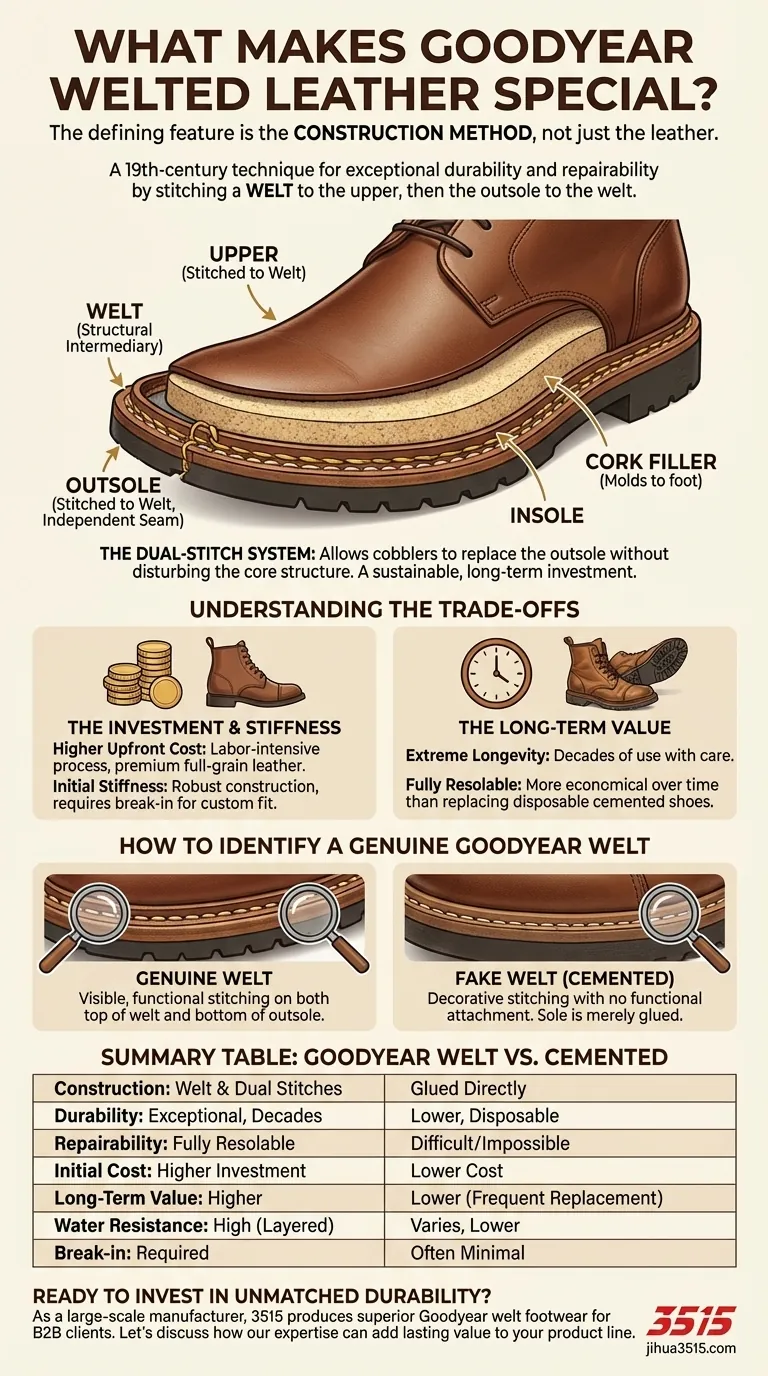
The welt is a robust strip of leather that runs along the perimeter of the outsole. It acts as a structural intermediary.
The shoe's upper is first stitched to this welt. This initial stitch holds the primary structure of the shoe together securely.
The Dual-Stitch System
Next, the outsole is stitched directly to the welt, creating a second, independent seam.
This two-level stitching is critical. Since the outsole is never directly attached to the upper, a cobbler can easily cut the second stitch, remove the old sole, and attach a new one without ever disturbing the shoe's core structure.
The Role of Premium Leather
This durable construction is almost always paired with high-quality materials to justify the labor involved.
Manufacturers use full-grain leathers that have not been sanded or corrected. This preserves the hide's natural strength and porousness, allowing it to breathe and develop a rich patina over decades of wear.
Understanding the Trade-offs
While the Goodyear welt is a benchmark for quality, it involves clear trade-offs that are important to understand before investing.
The Upfront Investment
Goodyear welted shoes are significantly more expensive than their mass-market counterparts.
This higher price reflects the labor-intensive process and the cost of premium materials, such as full-grain leather from renowned tanneries.
The Long-Term Value Proposition
The initial cost is offset by extreme longevity. A well-cared-for pair can last for decades.
The ability to be resoled multiple times means they are often more economical over the long term compared to repeatedly buying cheaper, cemented construction shoes that must be discarded once the sole wears out.
Initial Stiffness and Break-in
The robust, multi-layered construction makes these shoes stiffer out of the box. They typically require a break-in period as the leather and footbed mold to your foot.
This contrasts with glued shoes, which are often more flexible immediately but lack the same structural support and durability.
How to Identify a Genuine Goodyear Welt
Distinguishing a true Goodyear welt from a cosmetic imitation is straightforward if you know what to look for.
Examine the Outsole Stitching
On a genuine Goodyear welted shoe, you will see a visible line of stitching on the top of the welt and on the bottom of the outsole.
This stitch should be a single, continuous thread that appears consistent and functional. It is the seam that holds the outsole to the welt.
Spotting a Fake Welt
Many cheaper shoes feature a decorative plastic or leather welt that is simply glued on.
The tell-tale sign of a fake is decorative stitching that doesn't correspond to any functional attachment. You might see stitches on top of the welt but find no corresponding stitches on the outsole, indicating the sole is merely glued in place.
Making the Right Choice for Your Footwear
Ultimately, the best shoe construction depends entirely on your priorities.
- If your primary focus is maximum longevity and repairability: The Goodyear welt is the undisputed standard, offering a shoe you can maintain for decades.
- If your primary focus is the lowest initial cost and immediate comfort: A cemented construction is a better fit, but you must accept it as a disposable item.
- If your primary focus is a balance of sleekness and some durability: The Blake stitch, which sews the upper directly to the sole, offers a less bulky profile but is harder to resole and less water-resistant.
Choosing a Goodyear welt is an investment in a piece of craftsmanship engineered to last a lifetime.
Summary Table:
| Feature | Goodyear Welted | Cemented Construction |
|---|---|---|
| Construction | Welt stitched to upper, outsole stitched to welt | Outsole glued directly to upper |
| Durability | Exceptional, built to last decades | Lower, often disposable |
| Repairability | Fully resolable multiple times | Difficult or impossible to resole |
| Initial Cost | Higher upfront investment | Lower initial cost |
| Long-Term Value | Higher (cost per wear decreases over time) | Lower (frequent replacement needed) |
| Water Resistance | High due to layered construction | Varies, generally lower |
| Break-in Period | Required due to robust structure | Often minimal or none |
Ready to Invest in Unmatched Durability?
As a large-scale manufacturer, 3515 produces a comprehensive range of footwear for distributors, brand owners, and bulk clients. Our production capabilities encompass all types of shoes and boots, including the superior Goodyear welt construction.
We can help you offer your customers the ultimate in long-lasting, repairable footwear built with premium materials. Let's discuss how our manufacturing expertise can add lasting value to your product line.
Contact 3515 today to explore our capabilities and request a quote.
Visual Guide
Related Products
- Durable Goodyear Welt Leather Work Boots for Wholesale & Private Label
- Wholesale Durable Leather Work Boots | 8-Inch Goodyear Welt Manufacturer
- Wholesale Comfort Leather Business Shoes with Dial Lacing System
- Factory Direct Wholesale Leather Comfort Shoes with Dial Closure
- Wholesale Modern Perforated Leather Derby Shoes with Chunky Sole for Custom Branding
People Also Ask
- What is the difference between full-grain and top-grain leather? Premium Material Guide for Boot Manufacturers
- What are the advantages of leather as an upper material for work boots? Unmatched Durability & Custom Comfort
- Why is it important to waterproof leather work boots? Protect Your Investment and Performance
- How should new leather work boots be broken in? A Guide to Comfort and Durability
- What are the advantages of leather uppers in work boots? Unmatched Durability & Protection