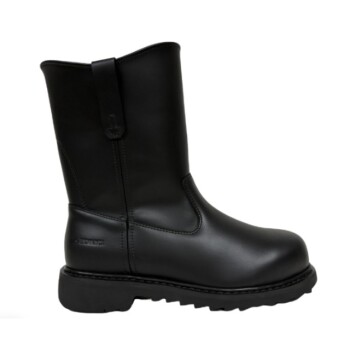
The primary technical advantage of dual-hardness construction lies in its ability to offer localized performance attributes—specifically, flexibility for comfort and rigidity for impact protection—within a single, integrated component. By utilizing advanced molding techniques, manufacturers can ensure the boot shell is soft where it contacts the leg for a precision fit, while maintaining a hardened strike zone to resist blunt trauma. This eliminates the performance compromises inherent in traditional single-mold designs that must settle for a uniform, middle-ground hardness.
Dual-hardness construction represents a significant leap in safety and ergonomics, allowing brand owners to provide a product that offers both "all-day" comfort and extreme-duty protection. For distributors, this technology serves as a high-value differentiator that signals superior engineering and manufacturing maturity.
The Engineering Behind Dual-Hardness Construction
Localized Material Optimization
Traditional boot construction relies on a single-mold design, which forces a compromise: if the material is too hard, it lacks comfort; if it is too soft, it lacks protection. Dual-hardness technology solves this by injection-molding different polymer densities into specific zones of the boot shell.
The "wrap" area of the boot is engineered with a softer, flexible material that contours to the wearer’s leg. This ensures a secure, personalized fit that reduces fatigue and prevents pressure points during extended use.
Conversely, the strike zones are reinforced with high-density, rigid polymers. These areas are specifically designed to absorb and deflect blunt trauma and direct impacts, providing a critical safety barrier that single-mold boots cannot match.
Integration with Advanced Lacing Systems
To further enhance the benefits of a dual-hardness shell, premium constructions often incorporate dual-zone lacing systems. These systems utilize high-capacity reels and aircraft-grade stainless braided wire to provide independent tension control.
When the lower zone is adjusted for comfort and the upper zone is tightened for stability, the dual-hardness shell responds more effectively. The smooth-sliding lace guides ensure that tension is distributed evenly across the varying material densities, maximizing rider control.
Strategic Manufacturing for Global Distributors
Heritage and Technical Precision
Implementing dual-hardness construction requires sophisticated machinery and deep metallurgical and polymer expertise. Our manufacturing roots date back to 1951, providing a foundation of technical heritage that informs every modern component we produce.
We utilize state-of-the-art equipment to manage the complexities of multi-material injection. This ensures that the bond between different hardness levels is chemically and structural sound, preventing delamination under extreme stress.
Supply Chain Stability and Certifications
For B2B partners, the ability to deliver complex technical products at scale is paramount. Our facilities are optimized for massive production scale, ensuring that even high-specification dual-hardness boots are delivered with consistent quality.
Every product is backed by comprehensive international certifications, providing distributors with the confidence that their inventory meets global safety standards. This robust supply chain stability allows for consistent large-volume delivery to meet fluctuating market demands.
Understanding the Trade-offs
Production Complexity and Tooling Costs
The primary trade-off for dual-hardness construction is the increased complexity in the manufacturing process. This requires more expensive, specialized tooling and longer cycle times compared to basic single-mold production.
Material Compatibility Requirements
Not all polymers can be fused effectively; achieving a permanent bond between different hardness levels requires precise chemical matching. Incompatibility can lead to structural failure at the transition zones if not managed by expert engineering teams.
Market Positioning vs. Unit Cost
Because of the advanced technology involved, dual-hardness boots typically carry a higher unit cost. While this positions the product in the premium tier, it requires a sales strategy that emphasizes long-term durability and superior protection over baseline pricing.
How to Apply This to Your Product Strategy
The decision to utilize dual-hardness construction should align with your brand's market positioning and the specific needs of your end-users.
- If your primary focus is Professional Safety/Performance: Prioritize dual-hardness construction to provide the highest level of impact protection while maintaining the comfort required for long shifts.
- If your primary focus is Market Differentiation: Leverage dual-hardness as a premium "hero feature" to distinguish your product line from competitors who rely on cheaper, single-mold designs.
- If your primary focus is High-Volume Retail: Use dual-hardness in your flagship models to build brand authority, while utilizing our scalable OEM capabilities to manage costs across your broader catalog.
Utilizing dual-hardness levels transforms a standard boot into a precision tool, offering a sophisticated balance of safety and ergonomics that drives brand loyalty and market share.
Summary Table:
| Feature | Technical Advantage | Strategic Benefit for B2B |
|---|---|---|
| Soft Shell Zones | Contours to the leg for a precision, ergonomic fit. | Reduces user fatigue; increases brand loyalty through comfort. |
| Rigid Strike Zones | High-density polymers resist blunt trauma and impacts. | Meets high-tier safety specs; differentiates from basic models. |
| Integrated Molding | Chemically bonded materials prevent delamination. | Ensures product durability and reduces return rates for distributors. |
| Lacing Compatibility | Optimized for dual-zone stainless braided wire systems. | High-value technical feature for premium market positioning. |
Partner with 3515 for High-Performance Footwear Manufacturing
Elevate your product portfolio with 3515’s advanced dual-hardness technology. Since 1951, we have combined technical heritage with state-of-the-art equipment to deliver superior footwear solutions. As a large-scale manufacturer serving distributors and brand owners, 3515 offers comprehensive production capabilities for all footwear types, anchored by our flagship Safety Shoes series.
Whether you need work and tactical boots, outdoor shoes, training sneakers, or formal dress shoes, our robust supply chain and international certifications ensure consistent large-volume delivery. Leverage our premium OEM/ODM capabilities to provide your customers with the perfect balance of all-day comfort and extreme-duty protection.
Ready to scale your business with a reliable manufacturing partner?
Contact us today to discuss your bulk requirements
Related Products
- Wholesale Tactical Boots High-Traction & Reflective for Bulk & Brand Orders
- High-Traction Suede Tactical Boots Wholesale & Custom Manufacturing
- Durable Leather Tactical Boots Wholesale & Custom Manufacturing for Brands
- Durable High-Ankle Tactical Boots for Wholesale & Custom Manufacturing
- Wholesale Durable Mid-Cut Tactical Boots for Custom & Private Label Brands
People Also Ask
- How do tactical boots protect against injuries? Discover the Integrated Safety System
- Who commonly uses tactical boots? From Military to Outdoor Enthusiasts
- What features enhance breathability and comfort in tactical boots? A Guide to Superior Footwear Performance
- How does creative short video content support functional footwear sales? Boost Trust and Traffic with Visual Proof
- What makes tactical boots valuable for specialized use? Essential Protection & Performance for High-Stakes Roles