
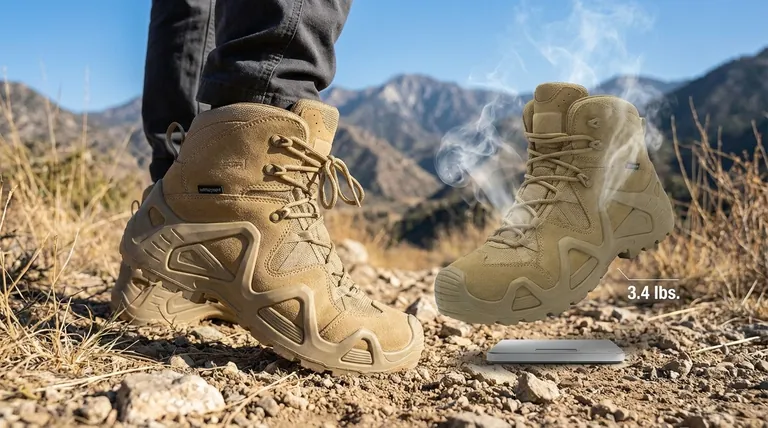
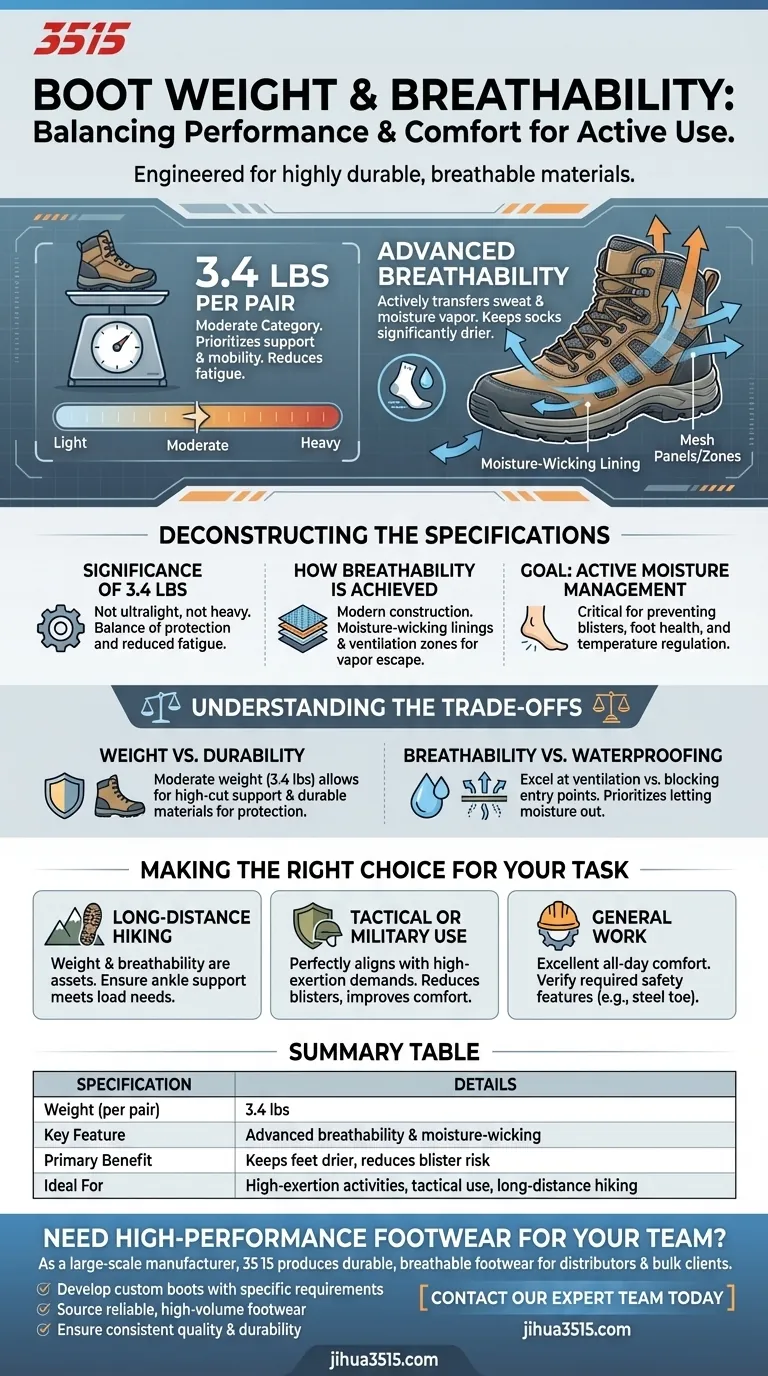
These boots weigh 3.4 lbs per pair and are engineered with highly durable, breathable materials. This design focuses on actively transferring sweat and moisture vapor away from your foot, ensuring your socks and feet remain significantly drier than they would in traditional all-leather boots.
The core takeaway is that these boots strike a deliberate balance: they are not ultralight, but their moderate weight is paired with advanced breathability. This makes them a specialized tool designed for performance and comfort during active use, rather than for maximum ruggedness or pure waterproofing alone.
Deconstructing the Specifications
To understand if these boots are right for you, we must look beyond the numbers and analyze what they mean for performance and comfort in the field.
The Significance of 3.4 lbs
A total weight of 3.4 lbs per pair places these boots in a moderate category. They are not as heavy as many traditional walking or hiking boots, which are often the heaviest type of footwear to provide maximum protection on rugged terrain.
This weight suggests a design that prioritizes a blend of support and mobility. While providing substantial protection, they aim to reduce the fatigue that comes with lifting heavier boots over thousands of steps.
How Breathability is Achieved
The reference to "breathable materials" that "transfer sweat out" points to a modern, multi-component construction. This is a significant departure from simple leather boots.
Such systems typically use a combination of features seen in high-performance footwear, such as moisture-wicking linings to pull sweat from the skin and mesh panels or ventilation zones to allow moisture vapor to escape.
The Goal: Active Moisture Management
The key benefit highlighted is "keeping socks drier." This is critical for preventing blisters, maintaining foot health, and regulating temperature.
Unlike boots that simply block external water, these are designed to manage moisture from the inside out. This is a hallmark of boots intended for high-exertion activities, such as those found in tactical or military applications.
Understanding the Trade-offs
No single boot can excel in every category. The design choices for weight and breathability come with inherent trade-offs that are critical to understand.
Weight vs. Durability and Protection
While 3.4 lbs is a moderate weight, it is not featherlight. This weight is necessary to incorporate features like high-cut ankle support and durable materials that protect against abrasions and twists.
Choosing a lighter boot would likely mean sacrificing some of this protective structure or long-term durability.
Breathability vs. Waterproofing
There is a constant tension between letting moisture out (breathability) and keeping water from getting in (waterproofing).
Features that excel at ventilation, like mesh panels or vented holes, can create points of entry for external water. Conversely, a fully waterproof boot with a membrane like Gore-Tex may not offer the same level of breathability as a boot designed primarily for hot or arid conditions. These boots appear to prioritize breathability.
Making the Right Choice for Your Task
Use these characteristics to determine if the boots align with your specific operational needs.
- If your primary focus is long-distance hiking on rugged terrain: The weight is reasonable and the breathability is a major asset for comfort, but ensure the level of ankle support and sole rigidity meets your needs for heavy loads.
- If your primary focus is tactical or military use: The emphasis on active moisture management and keeping feet dry aligns perfectly with the demands of high-exertion activity, reducing blisters and improving comfort during long operations.
- If your primary focus is general work in a controlled environment: The breathability will provide excellent all-day comfort, but verify they have any required safety features, such as a steel toe or non-slip sole, which are not explicitly mentioned.
By understanding the interplay of weight and breathability, you can confidently determine if these boots are the right tool for your specific mission.
Summary Table:
| Specification | Details |
|---|---|
| Weight (per pair) | 3.4 lbs |
| Key Feature | Advanced breathability & moisture-wicking |
| Primary Benefit | Keeps feet drier, reduces blister risk |
| Ideal For | High-exertion activities, tactical use, long-distance hiking |
Need High-Performance Footwear for Your Team?
As a large-scale manufacturer, 3515 produces a comprehensive range of durable, breathable footwear for distributors, brand owners, and bulk clients. Our production capabilities encompass all types of specialized boots designed for performance and comfort.
We can help you:
- Develop custom boots with specific weight and breathability requirements.
- Source reliable, high-volume footwear for your distribution network.
- Ensure consistent quality and durability for your brand.
Let's discuss your specific needs. Contact our expert team today for a personalized consultation and quote.
Visual Guide
Related Products
- Durable Leather Tactical Boots Wholesale & Custom Manufacturing for Brands
- High-Traction Suede Tactical Boots Wholesale & Custom Manufacturing
- Durable Leather High-Ankle Tactical Boots for Wholesale & Custom Manufacturing
- Durable Mid-Cut Tactical Boots for Wholesale & Private Label
- Wholesale Waterproof Tactical Boots Custom Suede & High-Traction Soles
People Also Ask
- What specialized protections do tactical boots offer? Maximize Endurance with High-Performance Footwear
- What features should law enforcement officers look for in tactical boots? Essential Guide for Safety & Performance
- Importance of Professional Tactical Boots in Loess Gully Regions: Ensure Safety and Precision for Field Monitoring
- What is rucking, and why are tactical boots suitable for it? Discover the Ultimate Footwear for Heavy Loads
- What makes the traction of tactical boots superior? Unlock the Science of Unbeatable Grip















