
In a combat environment, the ground beneath your feet is as much a factor as the mission itself. The significance of a slip-resistant outsole on a combat boot is to provide the critical traction, stability, and durability necessary for a soldier's safety and effectiveness. This feature ensures they can move with confidence across unpredictable and hazardous terrains, preventing injuries and allowing them to maintain focus on their duties.
The true value of a slip-resistant outsole isn't just about preventing a fall; it's about providing the foundational stability that allows a soldier to focus completely on the objective, regardless of the environmental conditions.
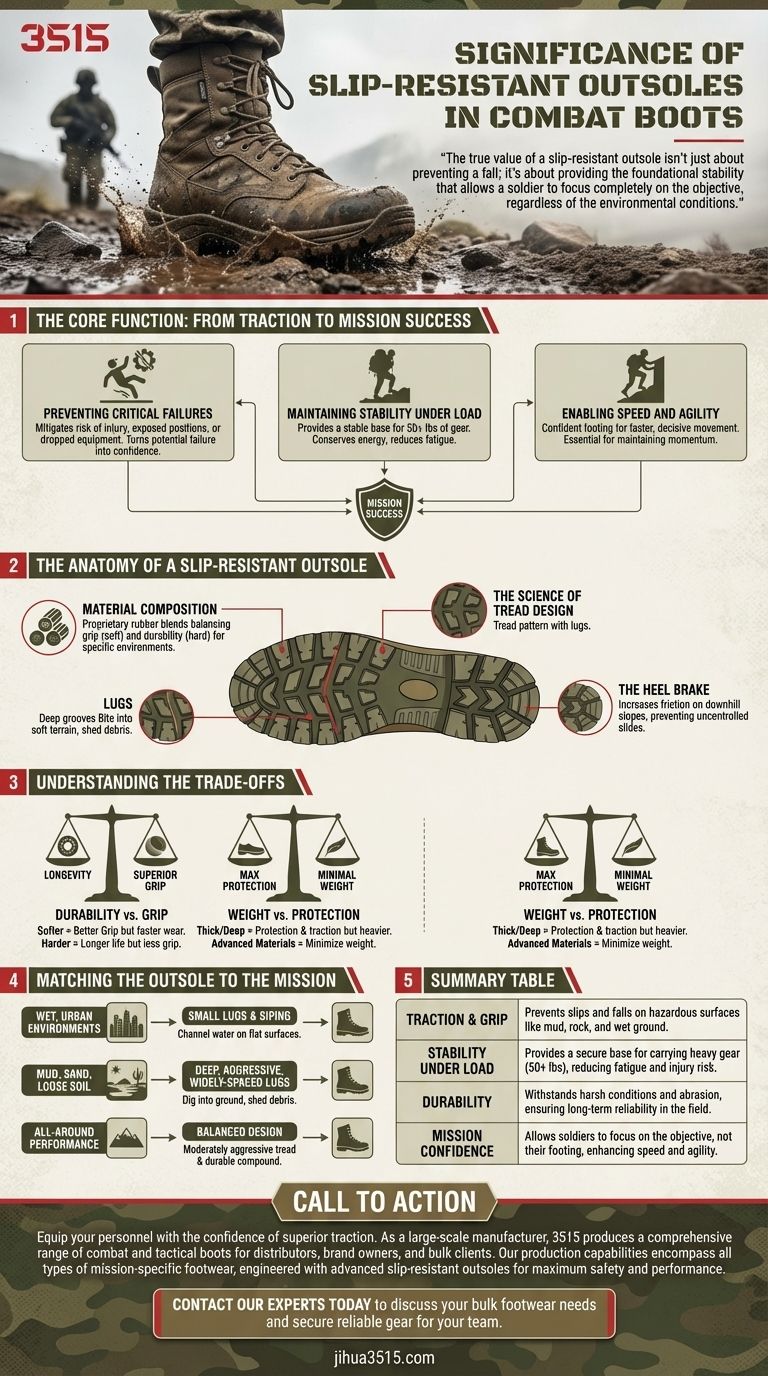
The Core Function: From Traction to Mission Success
A boot's outsole is the single point of contact between a soldier and their environment. Its performance is not a matter of comfort, but of operational capability.
Preventing Critical Failures
A slip at the wrong moment can have catastrophic consequences. It can lead to a debilitating injury, reveal a tactical position to an adversary, or cause a soldier to drop critical equipment.
Reliable traction mitigates this risk, turning a potential point of failure into a source of confidence.
Maintaining Stability Under Load
Soldiers operate while carrying heavy loads, often over 50 pounds of gear. A slip-resistant outsole provides the stable base needed to manage this weight on uneven or slick ground.
This stability is crucial for conserving energy, reducing fatigue on long patrols, and maintaining combat readiness.
Enabling Speed and Agility
Confident footing allows for faster and more decisive movement. Whether scaling an obstacle, moving to cover, or navigating treacherous terrain, a soldier must trust their boots will not fail them.
This trust in their equipment is essential for maintaining momentum and reacting quickly to changing circumstances.
The Anatomy of a Slip-Resistant Outsole
The slip-resistance of a combat boot is not an accident; it is the result of deliberate engineering in both material and design.
Material Composition
Outsoles are typically made from proprietary rubber compounds. These materials are engineered to find a precise balance between softness for grip and hardness for durability.
Different compounds offer varying performance on surfaces like wet rock, mud, or oil, making material selection critical for the boot's intended environment.
The Science of Tread Design
The pattern of grooves and blocks on an outsole is called the tread, and the blocks themselves are known as lugs.
Deep, aggressive lugs are designed to bite into soft terrain like mud and sand. The wide spacing between them helps shed debris to prevent the sole from getting clogged and losing traction.
The Importance of the Heel Brake
Many combat boot outsoles feature a distinct, sharp-angled heel. This is known as a heel brake.
Its specific function is to increase friction and control when moving downhill on steep or loose terrain, preventing uncontrolled slides.
Understanding the Trade-offs
No single outsole design is perfect for every possible situation. The engineering of a slip-resistant sole involves balancing competing priorities.
Durability vs. Grip
A softer rubber compound generally provides superior grip, especially on smooth, wet surfaces. However, it will wear down much faster.
A harder compound offers excellent longevity and resistance to abrasion but can be less effective on slick surfaces. Manufacturers constantly work to find the ideal compromise.
Weight vs. Protection
A thick, deeply-lugged outsole provides maximum protection and traction in rough terrain but adds significant weight to the boot.
This extra weight can increase fatigue over long distances. Modern designs use advanced materials and construction to minimize weight without sacrificing performance.
Terrain-Specific Optimization
An outsole designed for deep mud will have a different tread pattern than one optimized for urban environments or rocky mountains.
A tread pattern that excels in one area may be merely adequate in another. This is why some specialized units are issued boots designed for their specific operational environment.
Matching the Outsole to the Mission
Understanding the design principles of slip-resistant outsoles allows you to select the right boot for the task at hand.
- If your primary focus is operating in wet, urban environments: Look for outsoles with numerous smaller lugs and thin slits (siping) designed to channel water away effectively on flat surfaces.
- If your primary focus is traversing mud, sand, or loose soil: Prioritize boots with deep, widely-spaced, and aggressive lugs that can dig into the ground and shed debris easily.
- If your primary focus is all-around performance in varied terrain: Seek a balanced design with a moderately aggressive tread pattern and a durable rubber compound that offers a compromise between grip and longevity.
Ultimately, a well-designed slip-resistant outsole instills the confidence to move decisively, turning uncertain ground into a stable platform for success.
Summary Table:
| Feature | Significance for the Soldier |
|---|---|
| Traction & Grip | Prevents slips and falls on hazardous surfaces like mud, rock, and wet ground. |
| Stability Under Load | Provides a secure base for carrying heavy gear (50+ lbs), reducing fatigue and injury risk. |
| Durability | Withstands harsh conditions and abrasion, ensuring long-term reliability in the field. |
| Mission Confidence | Allows soldiers to focus on the objective, not their footing, enhancing speed and agility. |
Equip your personnel with the confidence of superior traction. As a large-scale manufacturer, 3515 produces a comprehensive range of combat and tactical boots for distributors, brand owners, and bulk clients. Our production capabilities encompass all types of mission-specific footwear, engineered with advanced slip-resistant outsoles for maximum safety and performance. Contact our experts today to discuss your bulk footwear needs and secure reliable gear for your team.
Visual Guide
Related Products
- Factory-Direct Wholesale Canvas Boots with High-Traction Rubber Soles
- Durable Leather Moc Toe Work Boots for Wholesale & Custom Manufacturing
- Heavy-Duty Waterproof Nubuck Safety Boots Safety Shoes for Bulk Supply
- Durable Goodyear Welt Leather Work Boots for Wholesale & Private Label
- Durable Leather Tactical Boots Wholesale & Custom Manufacturing for Brands
People Also Ask
- What types of jobs are canvas work boots suitable for? Ideal for Light-Duty, High-Mobility Roles
- What are the functional advantages of choosing rubber soles over leather soles for work boots? Superior Safety & Durability
- What are the advantages of rubber soles for work boots? Unbeatable Grip & Durability
- Why are slip-resistant soles important in work boots? Prevent Slips & Boost Safety
- What are the benefits and limitations of using canvas as a primary material for footwear? Key B2B Manufacturing Insights



















