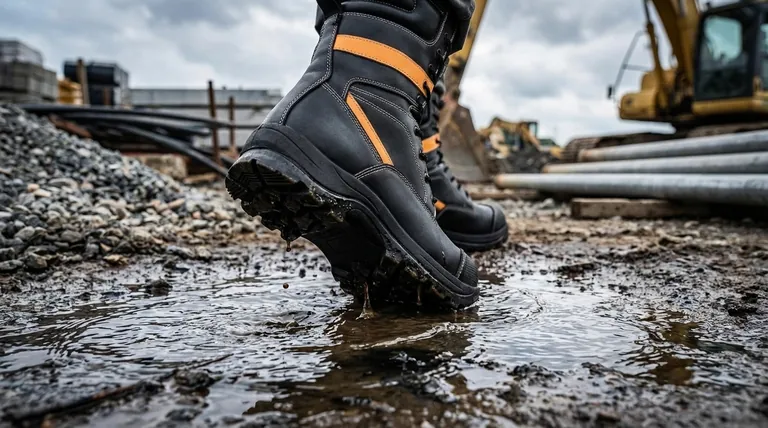
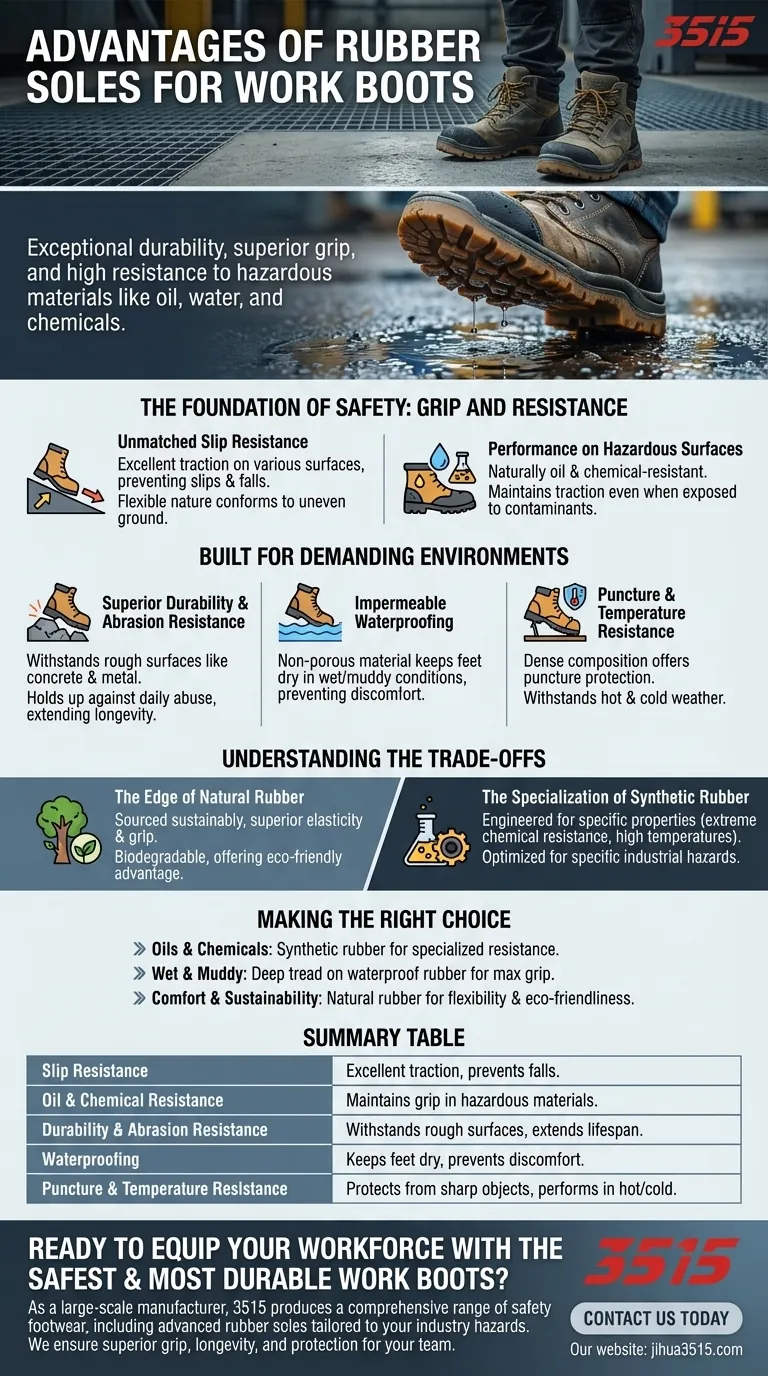
The primary advantages of rubber soles for work boots are their exceptional durability, superior grip, and high resistance to hazardous materials like oil, water, and chemicals. These qualities make rubber a foundational material for safety and performance in demanding work environments.
Rubber's value in work boots goes beyond a single feature. It delivers a critical combination of grip, resilience, and environmental protection that is difficult to achieve with other sole compounds, making it an engineering choice for uncompromising safety.
The Foundation of Safety: Grip and Resistance
The most critical function of a work boot is to keep you safe and stable. Rubber's inherent properties make it uniquely suited for this task.
Unmatched Slip Resistance
Rubber provides excellent traction on a wide variety of surfaces. This natural grip is essential for preventing slips and falls, especially in unpredictable conditions.
Its flexible nature allows the sole to conform to uneven ground, maximizing surface contact and stability.
Performance on Hazardous Surfaces
Many work environments contain fluids that can create dangerous, slick surfaces. Rubber soles are naturally oil-resistant and chemical-resistant.
This ensures that the sole's material does not degrade and maintains its traction even when exposed to contaminants.
Built for Demanding Environments
Work boots are subjected to constant punishment. Rubber soles are engineered to withstand this daily abuse while protecting the wearer.
Superior Durability and Abrasion Resistance
Rubber is highly durable and abrasion-resistant, meaning it holds up against rough surfaces like concrete, gravel, and metal grating without wearing down quickly.
This resistance to wear and tear directly contributes to the longevity of the work boot, making it a sound investment.
Impermeable Waterproofing
As a non-porous material, rubber is completely waterproof. This is critical for keeping feet dry in wet or muddy conditions, preventing discomfort and potential health issues.
This quality makes rubber the ideal material for both the sole and, in many cases, the entire boot upper in occupations that involve constant exposure to water.
Puncture and Temperature Resistance
The dense composition of rubber offers a degree of puncture resistance, protecting the foot from sharp objects on the ground.
Natural rubber compounds also withstand a wide range of weather conditions, maintaining their flexibility and performance in both hot and cold environments.
Understanding the Trade-offs
While "rubber" is used as a general term, the distinction between natural and synthetic rubber involves different advantages.
The Edge of Natural Rubber
Sourced sustainably from rubber trees, natural rubber is often noted for its superior elasticity and grip.
It is also biodegradable, offering an eco-friendly advantage over purely synthetic materials that persist in the environment.
The Specialization of Synthetic Rubber
Synthetic rubber compounds can be engineered to enhance specific properties. For example, some blends are formulated for extreme chemical resistance or to withstand very high temperatures.
These specialized formulas allow manufacturers to create soles optimized for very specific industrial hazards.
Making the Right Choice for Your Goal
Selecting the correct boot means matching its features to the primary demands of your job.
- If your primary focus is safety around oils and chemicals: Prioritize a synthetic rubber sole specifically rated for oil and chemical resistance.
- If your primary focus is outdoor work in wet and muddy conditions: Look for a boot with a deep, aggressive tread pattern on a waterproof rubber sole for maximum grip.
- If your primary focus is comfort and sustainability on varied terrain: A natural rubber sole can offer superior flexibility and grip while being a more eco-friendly choice.
Ultimately, choosing a work boot with a rubber sole is an investment in your safety, comfort, and daily performance on the job.
Summary Table:
| Advantage | Key Benefit |
|---|---|
| Slip Resistance | Excellent traction on various surfaces, preventing slips and falls. |
| Oil & Chemical Resistance | Maintains grip and integrity when exposed to hazardous materials. |
| Durability & Abrasion Resistance | Withstands rough surfaces, extending the boot's lifespan. |
| Waterproofing | Keeps feet dry in wet conditions, preventing discomfort. |
| Puncture & Temperature Resistance | Protects from sharp objects and performs in hot/cold weather. |
Ready to equip your workforce with the safest and most durable work boots?
As a large-scale manufacturer, 3515 produces a comprehensive range of footwear for distributors, brand owners, and bulk clients. Our production capabilities encompass all types of safety shoes and boots, including those with advanced rubber soles tailored to your specific industry hazards.
We ensure superior grip, longevity, and protection for your team. Contact us today to discuss your requirements and get a quote.
Visual Guide
Related Products
- Factory-Direct Wholesale Canvas Boots with High-Traction Rubber Soles
- Durable Canvas Work Shoes with Rubber Lug Sole | Wholesale Manufacturer
- Durable Rubber-Soled Utility Shoes for Wholesale & Custom Brand Manufacturing
- Durable Rubber Sole Outdoor Shoes Wholesale & Custom Manufacturing
- Durable Moc Toe Wedge Sole Work Boots for Wholesale and Private Label
People Also Ask
- What types of jobs are canvas work boots suitable for? Ideal for Light-Duty, High-Mobility Roles
- What are the functional advantages of choosing rubber soles over leather soles for work boots? Superior Safety & Durability
- Why are slip-resistant soles important in work boots? Prevent Slips & Boost Safety
- What are the benefits and limitations of using canvas as a primary material for footwear? Key B2B Manufacturing Insights
- How do high-traction, slip-resistant outsoles on safety boots contribute to worker safety in mines? | Prevent Mining Falls