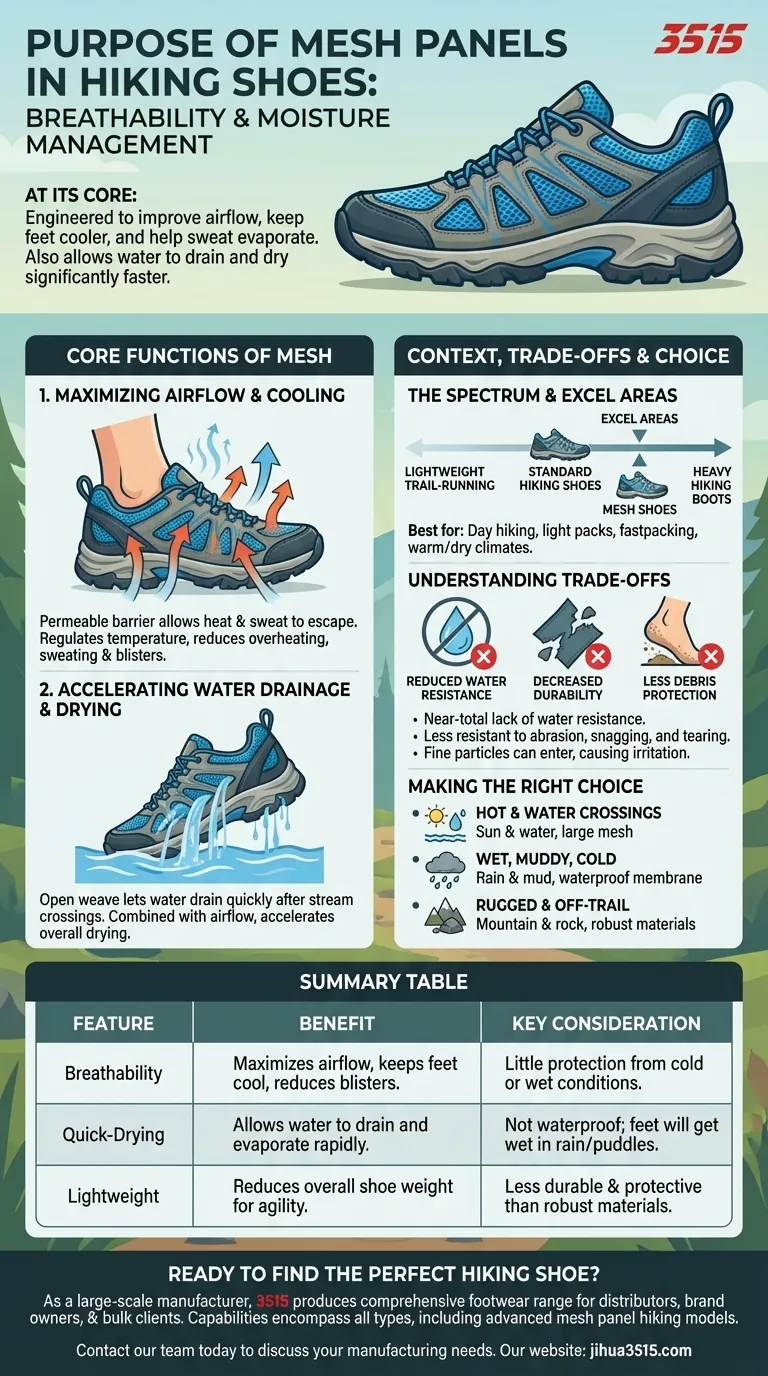
At its core, the purpose of mesh panels in hiking shoes is to prioritize breathability and moisture management. These panels are specifically engineered to improve airflow, which keeps your feet cooler and helps sweat evaporate during strenuous activity. They also allow a shoe that has been submerged in water to drain and dry significantly faster than a non-mesh equivalent.
Choosing hiking footwear involves a critical trade-off between environmental protection and breathability. Mesh panels firmly favor breathability, making them ideal for certain conditions but a liability in others.
The Core Functions of Mesh in Hiking Footwear
The inclusion of mesh is a deliberate design choice that signals the shoe's intended purpose. Understanding its two primary benefits is key to selecting the right footwear.
Maximizing Airflow and Cooling
Your feet generate a significant amount of heat and sweat during a hike. Mesh panels create a permeable barrier that allows this heat and water vapor to escape easily.
This constant ventilation helps regulate the temperature inside your shoe, reducing the risk of overheating, excessive sweating, and the blisters that can result from them.
Accelerating Water Drainage and Drying
While waterproof shoes are designed to keep water out, shoes with mesh panels operate on a different principle. They accept that water will get in during a stream crossing.
Their advantage is that the open weave of the mesh allows that water to drain out just as quickly. This, combined with the increased airflow, means the entire shoe will dry much faster while you continue hiking.
Placing Mesh in the Broader Context of Hiking Shoes
Mesh is just one component of a complex system. Its benefits are best understood when viewed alongside the other features that define a modern hiking shoe.
The Spectrum of Hiking Footwear
Hiking footwear exists on a spectrum. On one end are lightweight trail-running shoes built for speed, and on the other are heavy, supportive hiking boots built for rugged terrain and heavy loads.
Standard hiking shoes sit in the middle. They are typically low-cut with flexible midsoles, offering a balance of agility and the stability needed for day hiking.
Where Shoes with Mesh Excel
Shoes with significant mesh panels are best suited for day hiking with light packs, fastpacking where low weight is a priority, and hiking on maintained trails in warm, dry climates.
Their lightweight and breathable nature makes them far more comfortable than heavy leather boots when the primary challenges are heat and distance, not technical terrain or water.
Understanding the Trade-offs of Mesh Panels
Opting for a shoe with prominent mesh panels involves accepting a clear set of compromises. Acknowledging these is crucial for avoiding discomfort and equipment failure on the trail.
Reduced Water Resistance
The most significant trade-off is the near-total lack of water resistance. Mesh lets water, dew, and moisture in as easily as it lets vapor out.
If you frequently hike in wet, muddy conditions or through damp morning grass, a shoe with a waterproof membrane is a more appropriate choice.
Decreased Durability
Mesh is inherently less resistant to abrasion than leather or dense synthetic fabrics. It can be snagged and torn by sharp rocks, thorns, and dense brush.
For off-trail scrambling or hiking in particularly rugged environments, a shoe constructed from more robust materials will offer a longer lifespan.
Less Protection from Debris
Fine particles like sand and grit can work their way through the open weave of mesh panels. Over a long day, this can lead to significant irritation and abrasion inside the shoe.
Making the Right Choice for Your Hike
Your decision should be based on the most likely conditions you will face on the trail, not on a single feature.
- If your primary focus is hot-weather performance or frequent water crossings: Choose a shoe with large mesh panels for maximum breathability and quick-dry capability.
- If your primary focus is hiking in wet, muddy, or cold conditions: Select a shoe with a waterproof membrane and more robust, non-mesh upper materials for protection and insulation.
- If your primary focus is durability for rugged, off-trail terrain: Prioritize shoes made from leather or reinforced synthetics that can withstand high levels of abrasion.
Ultimately, understanding the role of each component allows you to select footwear that works with you, not against you.
Summary Table:
| Feature | Benefit | Key Consideration |
|---|---|---|
| Breathability | Maximizes airflow to keep feet cool and reduce blisters. | Offers little protection from cold or wet conditions. |
| Quick-Drying | Allows water to drain and evaporate rapidly after submersion. | Not waterproof; feet will get wet in rain or puddles. |
| Lightweight | Reduces overall shoe weight for agility and speed. | Less durable and protective than leather or robust synthetics. |
Ready to find the perfect hiking shoe for your needs?
As a large-scale manufacturer, 3515 produces a comprehensive range of footwear for distributors, brand owners, and bulk clients. Our production capabilities encompass all types of shoes and boots, including high-performance hiking models with advanced mesh paneling for optimal breathability.
Let us help you equip your customers with the right gear. Contact our team today to discuss your manufacturing needs.
Visual Guide
Related Products
- Durable Rubber Sole Outdoor Shoes Wholesale & Custom Manufacturing
- Wholesale High-Traction Camo Boots - Custom Manufacturer for Brands
- Wholesale Durable Camouflage Canvas Shoes with High-Traction Cleated Rubber Sole
- Wholesale Durable Camo Canvas Shoes with High-Traction Rubber Soles
- Wholesale Lightweight Tactical Boots Custom Manufacturer for Desert & Combat Use
People Also Ask
- What is the function of the sole in outdoor shoes? Find the Perfect Grip and Support
- What role do outdoor shoes and sneakers play in navigating external terrains? Engineered Stability for Every Surface
- How is AI utilized in the design of outdoor and safety footwear? Harnessing Big Data for Market-Driven Shoe Innovation
- Why is durability important when selecting outdoor shoes? A Guide to Safety & Long-Term Value
- What are the key components of outdoor shoes that affect comfort and sturdiness? A Guide to Durable, High-Performance Footwear