
Breaking in cowboy boots is a necessary process of transforming stiff, new leather into a comfortable, custom-fit extension of your foot. It primarily involves wearing the boots for gradually increasing periods of time, often with thick socks, to allow your body heat and the pressure of your foot to slowly mold the leather to its unique shape.
The core principle is not to force the boot to fit, but to patiently guide the leather to conform. Slow, consistent wear is the most effective and safest method for both your feet and the long-term integrity of the boots.
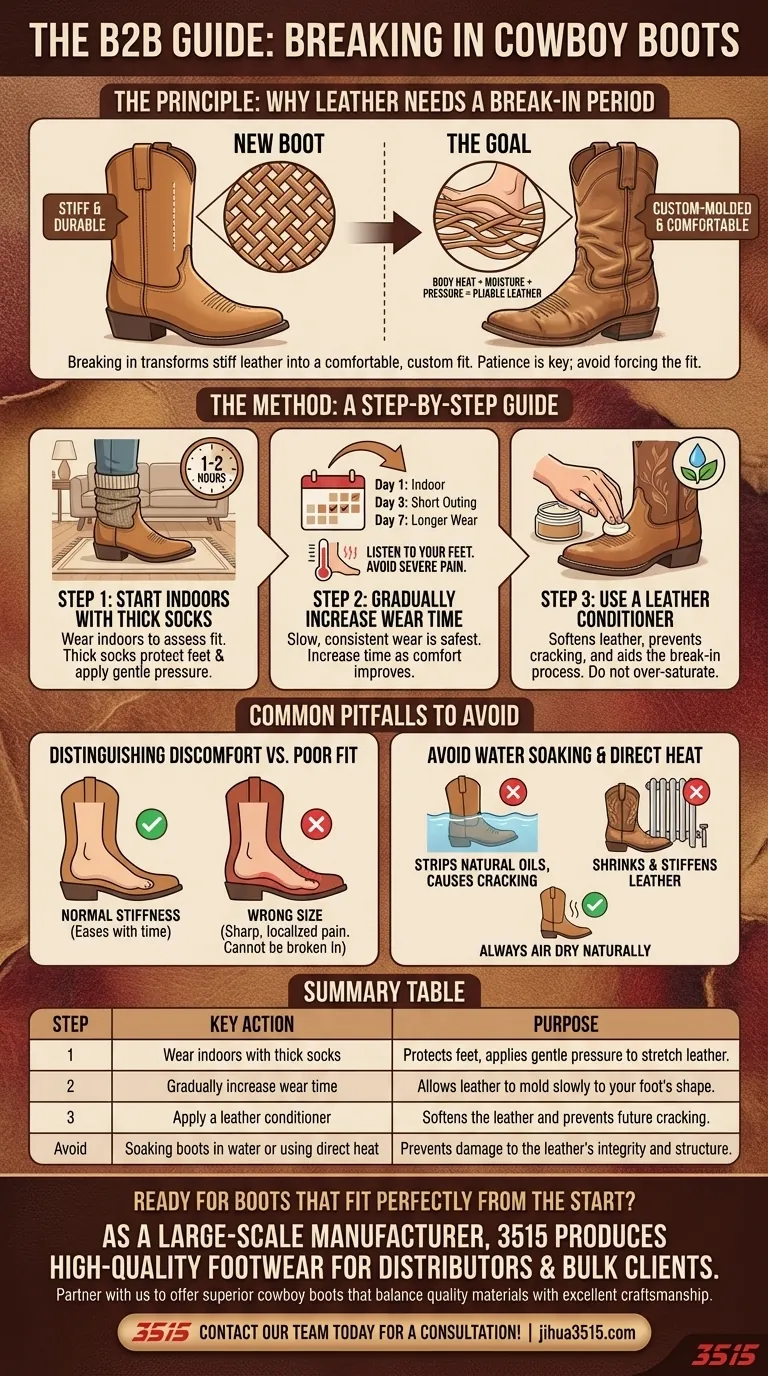
The Principle: Why Leather Needs a Break-In Period
Understanding Leather's Properties
New leather, particularly the thick kind used in quality cowboy boots, is inherently stiff. This rigidity provides structure and durability but can cause significant discomfort at first.
The goal of breaking in boots is to make the leather more pliable. The combination of your body heat, moisture from your feet, and consistent pressure works to soften the leather's fibers, allowing them to stretch and reshape.
The Goal is a Custom Mold
Unlike synthetic materials, leather has a unique ability to mold itself to a specific shape over time. A properly broken-in boot has conformed precisely to the contours of your foot, creating a custom fit that is far more comfortable than what you can achieve off the shelf.
The Method: A Step-by-Step Guide
Step 1: Start Indoors with Thick Socks
Begin by wearing your boots around the house for an hour or two at a time. This controlled environment allows you to assess the fit without committing to a full day of discomfort.
Wear one or two pairs of thick socks. This serves two purposes: it protects your feet from blisters and provides gentle, consistent pressure from the inside to help stretch the leather in tight spots.
Step 2: Gradually Increase Wear Time
After a few days of short indoor sessions, begin wearing your boots for longer periods and on short outings. The key is gradual progression.
Listen to your feet. If you start to feel significant pain or hot spots, take the boots off. Pushing through severe pain will only cause blisters and won't speed up the process meaningfully. The break-in period can last from a few days to several weeks.
Step 3: Use a Leather Conditioner
Applying a quality leather conditioner can soften the material and make it more supple. This not only aids the break-in process but also moisturizes the leather, preventing it from drying out and cracking over time.
Apply the conditioner as directed, focusing on areas that feel particularly stiff or tight. Be careful not to over-saturate the leather.
Common Pitfalls to Avoid
Distinguishing Discomfort from a Poor Fit
It is critical to know the difference between normal break-in stiffness and a fundamentally incorrect size. General tightness and stiffness that eases over time is normal.
However, sharp, pinching pain, especially in the toe box or the width of your foot, is often a sign that the boots are simply the wrong size. No amount of breaking in will fix a boot that is too short or too narrow.
The Myth of Water Soaking
You may hear advice to soak your boots in water and wear them until they dry. Avoid this method. While it can rapidly shape the leather, it also strips the material of its natural oils, leading to premature drying, cracking, and potential damage to the boot's construction.
The Danger of Direct Heat
If your boots get wet, never place them near a direct heat source like a radiator or fire to speed up drying. This will cause the leather to shrink, stiffen, and crack.
Always let your boots air dry naturally at room temperature. You can stuff them with paper towels to absorb excess moisture from the inside.
Making the Right Choice for Your Goal
- If your primary focus is comfort: Pair the thick-sock method with a light application of leather conditioner early on to soften the material.
- If your primary focus is preserving the boot's integrity: Prioritize the slow-and-steady approach of gradually increasing wear time, as this is the safest method for the leather.
- If you are experiencing sharp, localized pain: Stop the process and have the fit re-evaluated by a professional; the boot is likely the wrong size or shape for your foot.
Ultimately, a well-broken-in pair of cowboy boots is an investment in both your style and your long-term comfort.
Summary Table:
| Step | Key Action | Purpose |
|---|---|---|
| 1 | Wear indoors with thick socks | Protects feet, applies gentle pressure to stretch leather. |
| 2 | Gradually increase wear time | Allows leather to mold slowly to your foot's shape. |
| 3 | Apply a leather conditioner | Softens the leather and prevents future cracking. |
| Avoid | Soaking boots in water or using direct heat | Prevents damage to the leather's integrity and structure. |
Ready for Boots That Fit Perfectly From the Start?
As a large-scale manufacturer, 3515 produces a comprehensive range of high-quality footwear for distributors, brand owners, and bulk clients. Our production capabilities encompass all types of shoes and boots, including durable cowboy boots designed with both style and comfort in mind.
Partner with us to offer your customers superior footwear that balances quality materials with excellent craftsmanship. Let's discuss how we can meet your specific needs.
Contact our team today for a consultation!
Visual Guide
Related Products
- High-Traction Suede Tactical Boots Wholesale & Custom Manufacturing
- Wholesale High-Traction Camo Boots - Custom Manufacturer for Brands
- Wholesale Lightweight Tactical Boots Custom Manufacturer for Desert & Combat Use
- Durable Leather Tactical Boots Wholesale & Custom Manufacturing for Brands
- Wholesale Durable Mid-Cut Tactical Boots for Custom & Private Label Brands
People Also Ask
- Why is sequential analysis utilized to evaluate tactical boots? Master Dynamic Boot Development and Ergonomic Performance
- How does the material of tactical boots affect their performance? Choose the Right Material for Your Mission
- How do tactical boots differ from regular boots? Performance, Durability & Design Explained
- How do military uniforms and tactical boots impact the prediction of thermal risk? Essential Safety Insights
- What are the benefits of integrating FES and sEMG into tactical boots? Safety, Reliability & Field-Ready Performance


















