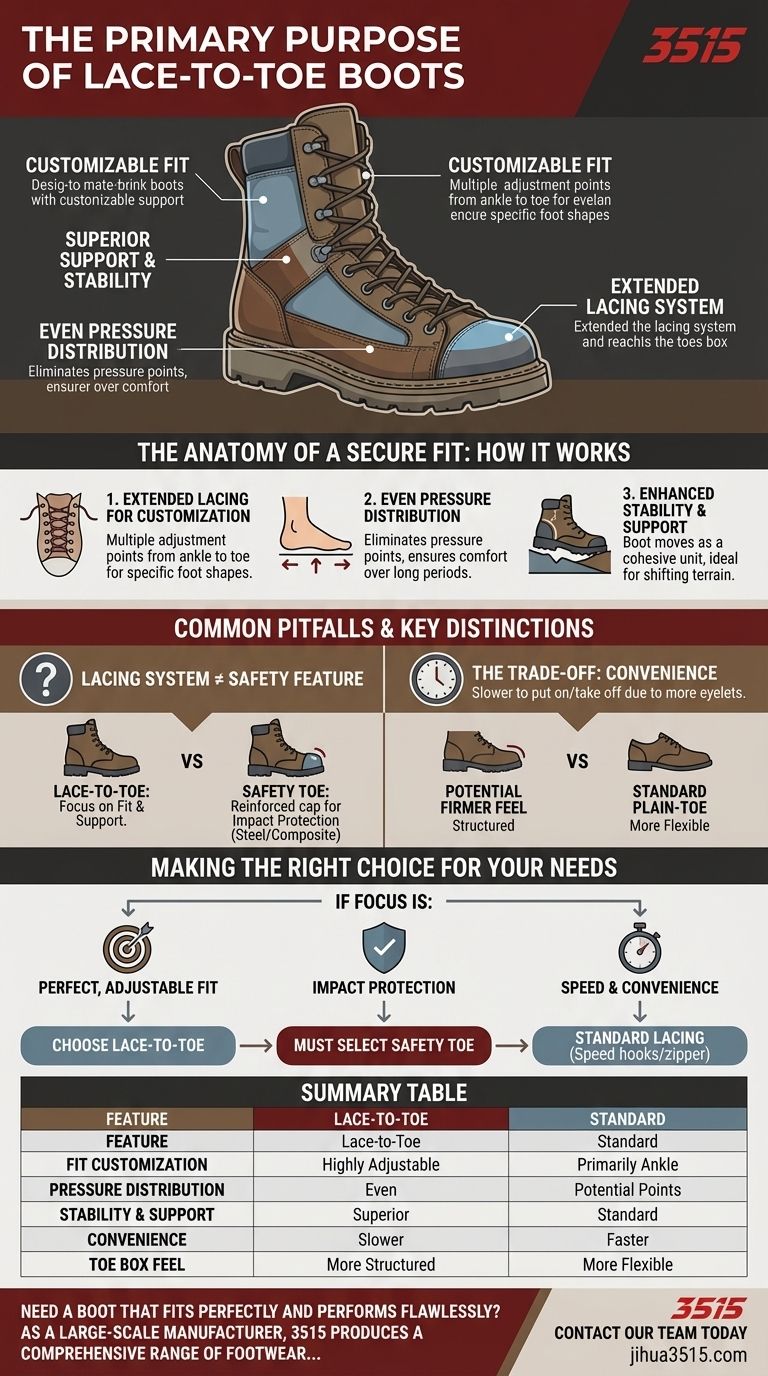
The primary purpose of lace-to-toe boots is to provide a highly customizable fit by extending the lacing system closer to the toe. This design allows you to adjust the tightness across the entire top of your foot—not just the ankle—delivering superior support, stability, and comfort compared to standard boot patterns.
While a standard boot offers a fixed shape over the foot's forepart, a lace-to-toe boot acts more like a moldable exoskeleton. Its true purpose is to give the wearer precise control over pressure distribution, creating a near-perfect fit for a wide variety of foot shapes and demanding tasks.
The Anatomy of a Secure Fit: How Lace-to-Toe Works
To understand the value of this design, you need to see it as an engineering solution for a common problem: feet are not one-size-fits-all, but boots often are. The lace-to-toe system directly addresses this discrepancy.
Extended Lacing for Precise Customization
Unlike traditional designs where the laces start higher up, the lace-to-toe style brings the lacing down over the vamp, the area where your foot begins to flex.
This extended system gives you multiple points of adjustment. You can keep the toe box snug while leaving the ankle looser, or vice-versa, tailoring the fit to your specific foot shape and comfort needs.
Even Pressure Distribution
By spreading the lacing tension over a much larger area, this design eliminates the need to overtighten the ankle section to achieve a secure feel.
This prevents uncomfortable pressure points and ensures the entire foot is held firmly but gently, which is crucial for long periods of wear.
Enhanced Stability and Support
A boot that is perfectly cinched from the ankle to the ball of the foot moves with you as a single, cohesive unit.
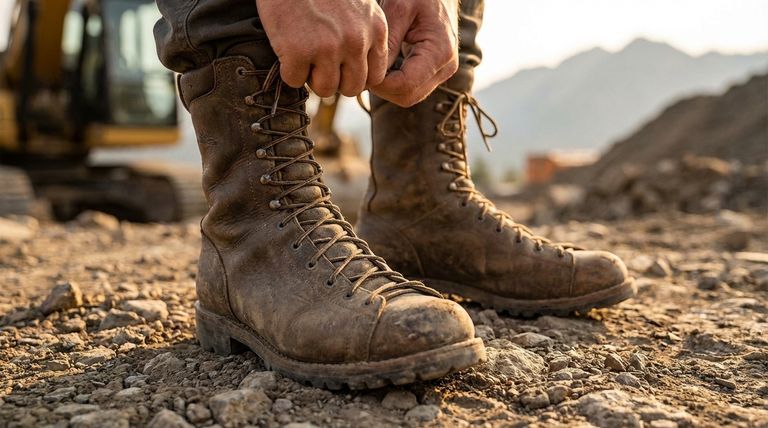
This creates exceptional stability and ankle support, making lace-to-toe boots a preferred choice for work on uneven or shifting ground where a sloppy fit could lead to an injury.
Common Pitfalls and Key Distinctions
While highly effective, the lace-to-toe design has specific characteristics and is often confused with other boot features. Understanding these distinctions is crucial for making an informed choice.
It's a Lacing System, Not a Protective Feature
The most critical distinction is between lace-to-toe and safety toe. A lace-to-toe design is about fit and support.
A safety toe is a reinforced cap, typically made of steel or composite materials, built inside the boot to protect your toes from impact and compression hazards. A boot can be one or the other, both, or neither.
The Trade-off: Convenience
The primary drawback of the lace-to-toe design is the time it takes to put the boots on and take them off.
Lacing and unlacing a greater number of eyelets is inherently slower than with a standard boot, a trade-off you make for the superior fit.
Potential for a Firmer Feel
The structure required for the extended lacing can sometimes make the toe box feel more rigid than a standard plain-toe boot.
While this adds to the supportive feel, some users may prefer the greater, unstructured flexibility found in other designs.
Making the Right Choice for Your Needs
Your ideal boot depends entirely on your priorities. Use these guidelines to determine if the lace-to-toe design is the right solution for you.
- If your primary focus is a perfect, adjustable fit: Choose a lace-to-toe boot, especially if you have wide or narrow feet or require maximum support on varied terrain.
- If your primary focus is impact protection: You must select a boot with a certified safety toe, regardless of its lacing style.
- If your primary focus is speed and convenience: A standard lacing pattern, particularly one with speed hooks or a side zipper, will likely serve you better.
Ultimately, choosing the right boot is about matching its design to your specific functional demands.
Summary Table:
| Feature | Lace-to-Toe Boots | Standard Boots |
|---|---|---|
| Fit Customization | Highly adjustable from ankle to toe | Primarily adjustable at the ankle |
| Pressure Distribution | Even across the entire foot | Can create pressure points |
| Stability & Support | Superior, especially on uneven terrain | Standard |
| Convenience | Slower to put on/take off | Faster with fewer eyelets |
| Toe Box Feel | More structured and supportive | More flexible and less structured |
Need a boot that fits perfectly and performs flawlessly?
As a large-scale manufacturer, 3515 produces a comprehensive range of footwear for distributors, brand owners, and bulk clients. Our production capabilities encompass all types of shoes and boots, including lace-to-toe designs that deliver the superior, customizable fit your customers demand.
Let us help you source or develop the ideal boot for your market. Contact our team today to discuss your specific needs and explore our manufacturing solutions.
Visual Guide
Related Products
- Durable Goodyear Welt Leather Work Boots for Wholesale & Private Label
- Premium Wholesale Wheat Nubuck Safety Boot with Rapid Lacing System
- Wholesale Classic Leather Lace-Up Ankle Boots for Brand Manufacturing
- Advanced KPU Athletic Safety Shoe with Steel Toe Cap Anti-Slip Rotary Lacing System
- Premium Wholesale Tactical Style Safety Shoes Boots with Quick Lacing
People Also Ask
- What is the difference between full-grain and top-grain leather? Premium Material Guide for Boot Manufacturers
- What are the advantages of leather as an upper material for work boots? Unmatched Durability & Custom Comfort
- Why is it important to waterproof leather work boots? Protect Your Investment and Performance
- How should new leather work boots be broken in? A Guide to Comfort and Durability
- What are the advantages of leather uppers in work boots? Unmatched Durability & Protection