
The primary benefit is stabilization. Military boots with significant ankle support are engineered to physically restrict excessive side-to-side movement of the ankle joint. This rigid structure is crucial for preventing the ankle from rolling or spraining, particularly when navigating uneven or unpredictable terrain under load.
The core function of a high-ankled military boot is to act as an external skeleton for your ankle. It provides the mechanical stability that your own ligaments and muscles may not be able to offer when faced with the abrupt, awkward foot placements common on rugged ground.
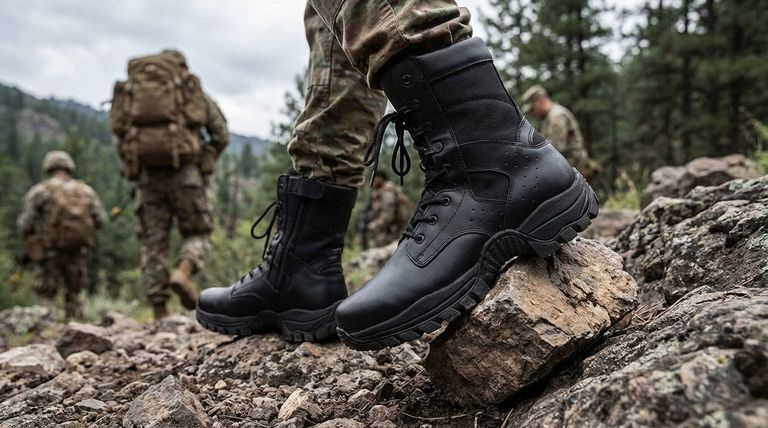
How Ankle Support Prevents Injury
To understand the benefit, we must first look at the mechanism of the most common ankle injuries. The environment and the body's natural signaling system are key factors.
The Challenge of Uneven Terrain
Walking on a flat surface is predictable. Walking over rocky ground, through forests, or on loose scree forces your foot to land at countless awkward angles.
Each of these unpredictable steps creates an opportunity for your ankle to roll outwards, an event known as an inversion sprain. This is the most common type of ankle injury.
The Boot as an External Stabilizer
A high-cut, laced boot creates a rigid cuff around the ankle joint. This structure physically limits the joint's range of motion, especially the side-to-side tilting that leads to a sprain.
By keeping the foot and lower leg in a more stable alignment, the boot essentially prevents the ankle from reaching the angle at which ligaments would tear. This is critical during demanding activities like yomping or tabbing.
Compensating for Proprioceptive Loss
Proprioception is your body's ability to sense its position in space. Nerves in your ligaments send constant signals to your brain about the ground's angle and your joint's position.
After an ankle sprain, these ligaments are damaged, and so is their ability to send accurate signals. The boot's rigid support compensates for this loss, providing the stability that your body can no longer reliably create on its own.
Understanding the Trade-offs
While crucial for protection in certain contexts, a highly supportive boot is not without its compromises. True objectivity requires acknowledging these factors.
Reduced Flexibility
The very rigidity that prevents injury also limits the ankle's natural range of motion. On flat, predictable surfaces, this can feel restrictive and less efficient than a more flexible shoe.
Potential for Muscle De-conditioning
Constant reliance on an external support structure can, over the long term, lead to the stabilizing muscles and ligaments in the ankle doing less work. This is a biomechanical principle to consider, though for military applications, preventing acute injury often outweighs this concern.
Making the Right Choice for Your Mission
The decision to prioritize ankle support should be based on your environment, activity, and personal injury history.
- If your primary focus is operating on rugged, unpredictable terrain: Maximum ankle support from a high, rigid boot is your best defense against sprains.
- If your primary focus is speed and movement on stable surfaces: A lower-cut, more flexible boot may offer a better balance of mobility and protection.
- If you have a history of previous ankle injuries: A boot with substantial ankle support is critical to compensate for existing ligament weakness and prevent re-injury.
Ultimately, understanding how ankle support functions empowers you to select footwear that protects your most valuable asset: your operational readiness.
Summary Table:
| Benefit | Key Function | Ideal Use Case |
|---|---|---|
| Ankle Stabilization | Restricts side-to-side movement to prevent rolling/sprains | Rugged, uneven terrain under load |
| Proprioceptive Compensation | Provides external stability when ligaments are weakened | Post-injury or high-risk environments |
| Injury Prevention | Acts as an external skeleton for the ankle joint | Military operations, hiking, demanding activities |
Protect your team's operational readiness with professional-grade footwear from 3515. As a large-scale manufacturer, we produce a comprehensive range of military boots and tactical footwear designed for maximum ankle support, durability, and performance. Whether you are a distributor, brand owner, or bulk client requiring reliable gear for demanding environments, our production capabilities ensure top-quality solutions tailored to your needs. Contact us today to discuss your specific requirements and discover how 3515 can enhance your footwear supply chain.
Visual Guide

Related Products
- Durable High-Ankle Tactical Boots for Wholesale & Custom Manufacturing
- Durable Leather High-Ankle Tactical Boots for Wholesale & Custom Manufacturing
- Durable High-Ankle Tactical Boots Wholesale Manufacturer for Custom & Bulk Orders
- Durable Military Combat Boots with Water Drainage for Wholesale & OEM
- High-Traction Suede Tactical Boots Wholesale & Custom Manufacturing
People Also Ask
- How do tactical boots protect against injuries? Discover the Integrated Safety System
- What is the role of high-frequency acquisition hardware in technical skill analysis for outdoor and tactical boots?
- How does additive manufacturing equipment reduce environmental risks? Sustainable Tactics for Modern Footwear Production
- How is the compatibility of polymer materials demonstrated in smart footwear? Enhancing Tactical & Training Performance
- What are the main construction similarities between tactical boots and tactical sneakers? Built for Performance & Durability















