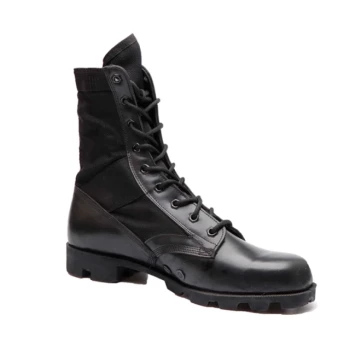
Additive manufacturing equipment fundamentally transforms production by utilizing digital models to construct products layer by layer, rather than cutting material away. For customized tactical boots and outdoor shoes, this approach significantly reduces environmental risks by minimizing the need for multi-stage assembly and virtually eliminating the physical waste typical of traditional manufacturing.
By enabling on-demand production, additive manufacturing decouples resource usage from volume forecasting. This eliminates the environmental burden of excess inventory and ensures resources are only consumed when a specific product is required.
The Mechanics of Risk Reduction
Layer-by-Layer Efficiency
Traditional footwear manufacturing is often subtractive, meaning material is cut away and discarded to form shapes. Additive equipment builds the product layer by layer based on a precise digital model.
This direct-to-shape process ensures that raw material is used only where it is structurally necessary. This is particularly advantageous for the complex geometries found in tactical boots, resulting in significantly lower production waste.
Minimizing Assembly Stages
Standard shoe production involves creating multiple distinct parts—soles, uppers, reinforcements—and bonding them together using adhesives and energy-intensive processes.
Additive manufacturing equipment can often produce these complex structures as fewer integrated units. By reducing the number of assembly stages, manufacturers lower energy consumption and reduce the chemical risks associated with industrial glues and primers.
Optimizing Resource Utilization
On-Demand Production Capabilities
One of the greatest environmental risks in manufacturing is the overproduction of goods that are never sold. Additive manufacturing is uniquely suited for small-batch, on-demand runs.
Because the equipment requires no re-tooling between different designs, customized outdoor shoes can be produced individually. This prevents the accumulation of "dead stock" that eventually ends up in landfills.
Preventing Resource Loss
In traditional mass production, materials must be procured in bulk based on speculative forecasts. If demand shifts, those resources are wasted.
Additive manufacturing allows for a just-in-time approach to resource consumption. This ensures that high-value materials are not tied up in excess inventory, effectively decreasing the risk of resource loss.
Understanding the Trade-offs
The Necessity of Material Selection
While the equipment reduces process waste, the environmental impact is also dictated by the input material. The additive process is most effective environmentally when paired with specific inputs.
To fully mitigate environmental risks, manufacturers should prioritize low-carbon synthetic fibers or certified sustainable leather. The equipment optimizes how these materials are used, but it cannot change the inherent footprint of the material itself.
Balancing Sustainability and Performance
Reducing waste cannot come at the expense of utility, especially for tactical gear. The equipment must be capable of processing high-performance materials that provide structural support, breathability, and durability.
There is a risk if the additive process creates a weaker structure than traditional methods. Therefore, the equipment must be calibrated to ensure the "printed" layers offer the same rugged reliability as standard tactical boots.
Strategic Implementation for Footwear Production
To maximize the environmental and operational benefits of additive manufacturing, consider your primary objectives:
- If your primary focus is Waste Reduction: Leverage the layer-by-layer capability to consolidate parts and eliminate the scrap material generated by cutting and trimming.
- If your primary focus is Inventory Management: Utilize the on-demand capabilities to switch to a "produce-to-order" model, eliminating the environmental cost of warehousing and unsold goods.
- If your primary focus is Product Integrity: Ensure your digital models and chosen materials are rigorously tested to maintain essential support and durability standards despite the change in production method.
Additive manufacturing offers a precise, low-waste pathway to producing high-performance footwear that aligns with modern environmental standards.
Summary Table:
| Environmental Risk Factor | Traditional Manufacturing Impact | Additive Manufacturing Solution |
|---|---|---|
| Material Waste | High (Subtractive cutting/scraps) | Minimal (Layer-by-layer precision) |
| Energy Consumption | High (Multi-stage assembly) | Lower (Integrated single-unit builds) |
| Chemical Usage | High (Adhesives/glues for assembly) | Reduced (Structural integration) |
| Inventory Risk | High (Bulk forecasting/Dead stock) | Low (On-demand/Just-in-time production) |
Partner with 3515 for Sustainable, High-Performance Footwear Solutions
As a large-scale manufacturer serving global distributors and brand owners, 3515 leverages advanced production capabilities to deliver eco-efficient and durable footwear. Whether you require our flagship Safety Shoes series or high-performance tactical boots, outdoor shoes, training shoes, sneakers, and formal dress shoes, we offer the scale and expertise to meet your bulk requirements while minimizing environmental impact.
Unlock the benefits of our optimized manufacturing process:
- Precision Manufacturing: Reduce material waste without compromising on rugged reliability.
- Versatile Portfolio: Access a comprehensive range of footwear types tailored to your brand's specifications.
- Sustainable Scaling: Benefit from our large-scale production efficiency and waste-reduction strategies.
Ready to elevate your product line with a reliable manufacturing partner? Contact us today to discuss your project!
References
- Jamal El Baz, Ridha Derrouiche. Environmental Supply Chain Risk Management for Industry 4.0: A Data Mining Framework and Research Agenda. DOI: 10.3390/systems11010046
This article is also based on technical information from 3515 Knowledge Base .
Related Products
- Durable Leather Tactical Boots Wholesale & Custom Manufacturing for Brands
- High-Traction Suede Tactical Boots Wholesale & Custom Manufacturing
- Durable Leather High-Ankle Tactical Boots for Wholesale & Custom Manufacturing
- Durable Mid-Cut Tactical Boots for Wholesale & Private Label
- Wholesale Waterproof Tactical Boots Custom Suede & High-Traction Soles
People Also Ask
- What specialized protections do tactical boots offer? Maximize Endurance with High-Performance Footwear
- What features should law enforcement officers look for in tactical boots? Essential Guide for Safety & Performance
- Importance of Professional Tactical Boots in Loess Gully Regions: Ensure Safety and Precision for Field Monitoring
- What is rucking, and why are tactical boots suitable for it? Discover the Ultimate Footwear for Heavy Loads
- What makes the traction of tactical boots superior? Unlock the Science of Unbeatable Grip