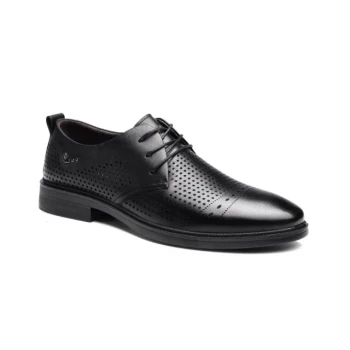
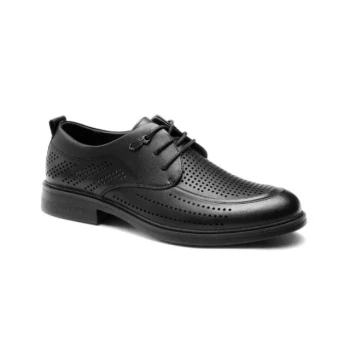
The decorative holes on brogue shoes are not a random design choice. They are a direct legacy of a practical solution developed centuries ago by farmers and outdoorsmen navigating the wet, boggy landscapes of Ireland and Scotland. These perforations were originally engineered to allow water that entered the shoe to drain out, helping the wearer's feet dry more quickly.
The brogue's evolution from a rudimentary, functional field shoe into a staple of modern wardrobes is a classic story of utility becoming style. Understanding its rugged origins is the key to wearing it correctly today.
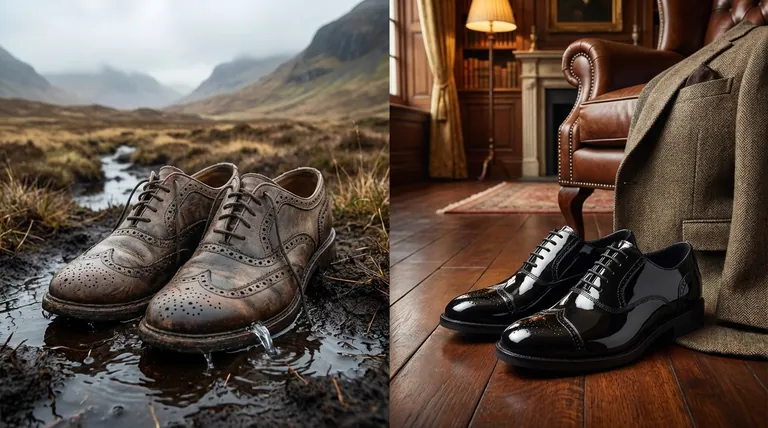
From Practical Necessity to Decorative Style
The journey of the brogue is a transformation from a piece of essential equipment to a mark of sophisticated, yet grounded, style.
The Functional Origins in Gaelic Lands
The term brogue comes from the Gaelic word bróg, meaning "shoe." The original shoes were simple, untanned hides wrapped around the foot.
Living and working in consistently wet, marshy terrain meant that keeping water out of a shoe was impossible. The Gaelic ancestors of the Scots and Irish developed a more practical solution: letting the water out.
The perforations punched into the hide allowed bog water to drain away from the foot, preventing trench foot and increasing comfort during long days in the field.
The Transition to a Gentleman's Shoe
In the early 20th century, the style was adopted by country gentlemen for walking and outdoor pursuits. At this stage, the perforations began their transition from functional to decorative.
As shoemakers refined the designs, the broguing was retained as a nod to the shoe's rustic heritage. It became a detail that signified a shoe was for the country or for casual wear, not for formal city life.
Broguing: A Detail, Not a Shoe Type
A common point of confusion is thinking of a "brogue" as a specific shoe silhouette. In reality, broguing is the decorative detail applied to another shoe style.
Brogue vs. Oxford and Derby
The two most common men's dress shoe constructions are the Oxford (with a "closed" lacing system) and the Derby (with an "open" lacing system).
Broguing can be applied to either style. Therefore, you can have an Oxford brogue or a Derby brogue. The presence of perforations defines it as a brogue, while the lacing system defines its underlying structure.
The Spectrum of Formality
The amount of broguing on a shoe directly impacts its formality. This is the most critical principle to understand.
A full brogue, also known as a wingtip, features extensive perforations and a distinctive 'W' or 'M' shaped toe cap. It is the least formal.
A quarter brogue has perforations only along the edge of the toe cap, making it the most formal and subtle variation. A semi-brogue sits between the two.
Common Pitfalls to Avoid
Understanding the brogue's history helps prevent common style mistakes that arise from ignoring its context.
The Myth of Modern Functionality
In a modern, well-constructed dress shoe, the perforations are purely aesthetic. They do not go all the way through the leather and lining.
The holes offer no ventilation or water drainage. In fact, on a rainy day, the seams and decorative holes can be points where water is more likely to seep in.
Ignoring the Formality Rule
The most frequent mistake is wearing a heavily brogued shoe in a highly formal setting. A full-brogue wingtip, for instance, is fundamentally a casual or semi-formal shoe because of its rustic, sporting origins.
Pairing a chunky, heavily-brogued shoe with a sleek business suit or, worse, black-tie attire, clashes with the shoe's inherent character. The more holes it has, the less formal it is.
Making the Right Choice for Your Goal
Select your brogue based on the occasion and the statement you want to make.
- If your primary focus is business formal: Choose a quarter-brogue on a dark Oxford, as its minimal detailing adds texture without sacrificing professionalism.
- If your primary focus is smart casual: A semi-brogue or full-brogue Derby in a shade of brown or tan offers the perfect balance of elegance and relaxed confidence.
- If your primary focus is rugged heritage style: A heavy, full-brogue boot channels the shoe's practical origins and pairs perfectly with tweed, flannel, or raw denim.
By understanding the story behind its design, you can wear a brogue not just as a shoe, but as a piece of history.
Summary Table:
| Brogue Type | Key Characteristic | Recommended Use |
|---|---|---|
| Full Brogue (Wingtip) | Extensive perforations, 'W' shaped toe cap | Smart casual, rugged heritage style |
| Semi-Brogue | Perforations on toe cap and along seams | Smart casual |
| Quarter Brogue | Minimal perforations along toe cap edge | Business formal |
Elevate Your Footwear Collection with 3515's Expertise
As a large-scale manufacturer, 3515 produces a comprehensive range of footwear for distributors, brand owners, and bulk clients. Our production capabilities encompass all types of shoes and boots, including classic brogues designed with an understanding of their heritage and modern appeal. We combine quality craftsmanship with scalable production to meet your specific needs.
Ready to source high-quality, stylish footwear? Contact us today to discuss your requirements and discover how we can be your trusted manufacturing partner.
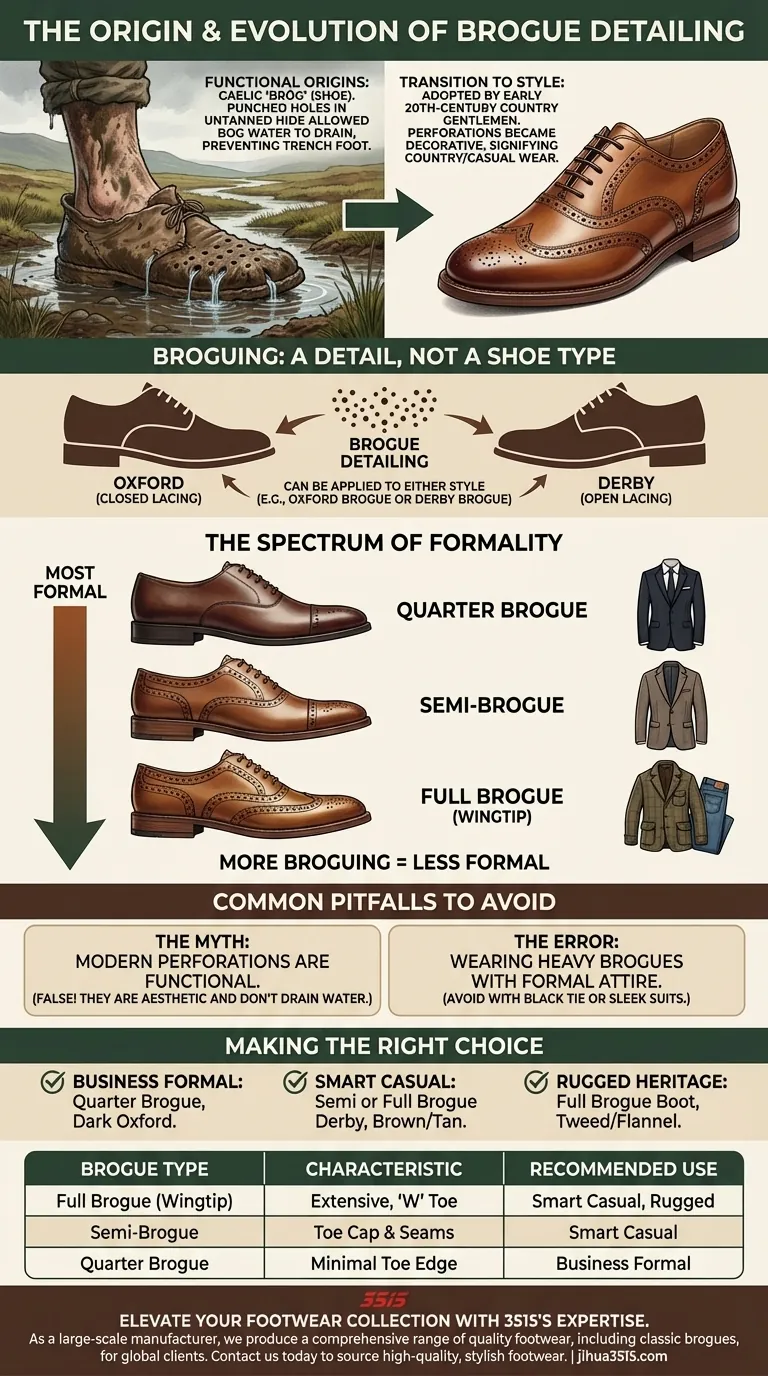
Visual Guide
Related Products
- Wholesale Perforated Comfort Dress Shoes | Custom Derby Shoe Manufacturer
- Wholesale Breathable Perforated Leather Derby Dress Shoes for Custom Brands
- Wholesale Durable Camouflage Canvas Shoes with High-Traction Cleated Rubber Sole
- Wholesale Leather Apron Toe Derby Shoes Custom Factory Production
- Custom Manufactured Air Cushion Leather Business Shoes for Wholesale
People Also Ask
- How do comfort dress shoes differ from traditional dress shoes? Discover the Ergonomic Advantage
- What are the recommended construction methods for quality dress shoes? Goodyear Welt vs. Blake Stitch Explained
- What are some quick tips for achieving a mirror shine on dress shoes? Speed Up Your Shine with Pro Hacks
- What is aniline leather and why is it considered high quality for dress shoes? Discover the Pinnacle of Luxury
- What role do socks play in improving the comfort of dress shoes? Essential Tips for All-Day Wear