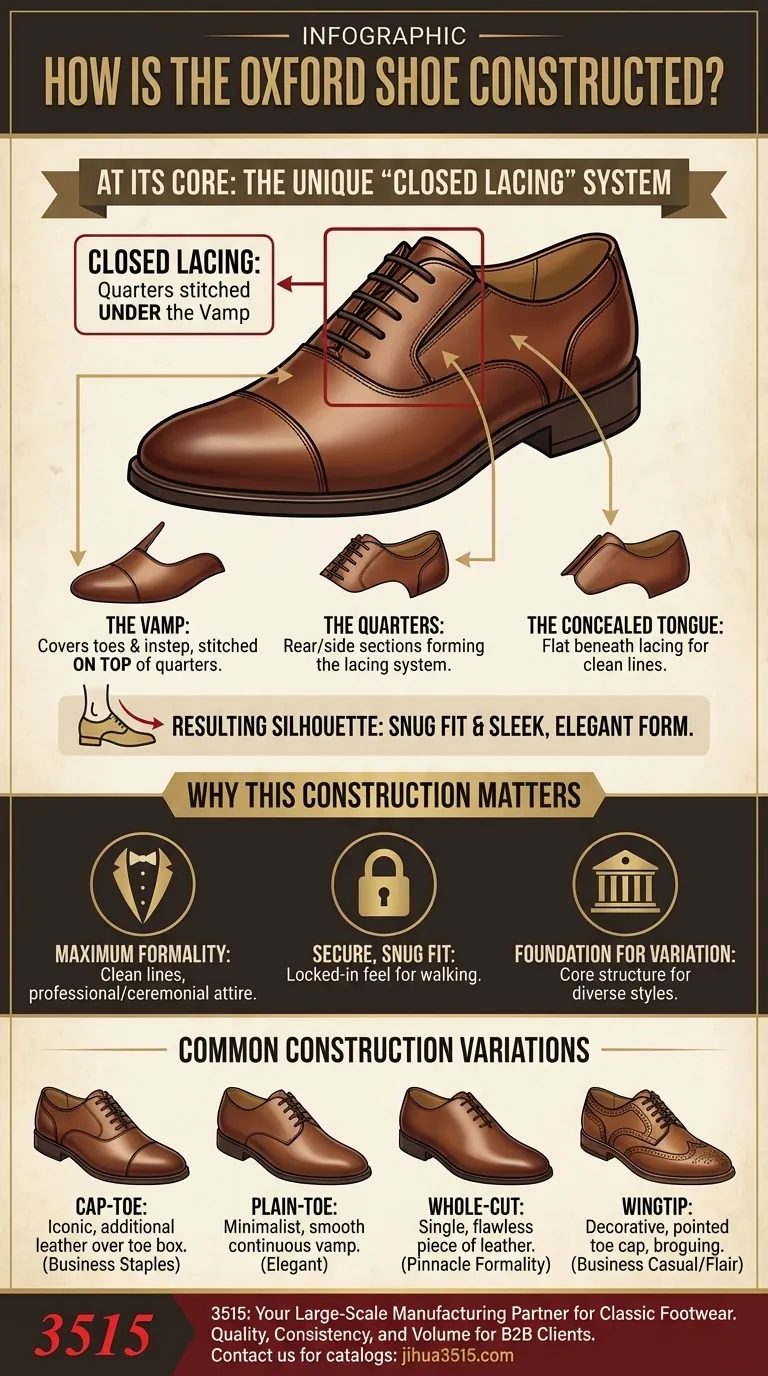
At its core, an Oxford shoe is defined by its unique "closed lacing" system. This specific construction method involves stitching the eyelet facings (the quarters) underneath the front part of the shoe (the vamp), creating a clean, seamless line across the instep and a characteristically sleek silhouette.
The essential principle behind the Oxford's construction is integration. By sewing the back sections of the shoe under the front, it creates a slim, low-profile form that is inherently more formal than any other dress shoe design.
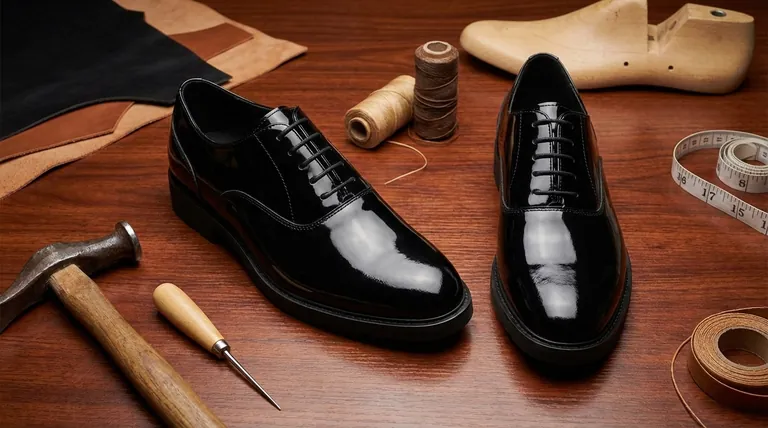
The Anatomy of an Oxford
To truly understand the Oxford, you must look at how its key components are assembled. The specific arrangement of the vamp, quarters, and tongue is what gives the shoe its definitive character.
The Defining "Closed Lacing" System
The single most important feature of an Oxford is its lacing. The two sides of the shoe that hold the eyelets, known as the quarters, are sewn underneath the vamp (the top front section of the shoe).
When the laces are tied, they pull these quarters together, closing the "V" shape they form. This creates a smooth, uninterrupted surface over the foot.
The Vamp and Quarters
The vamp is the part of the shoe's upper that covers the toes and instep. The quarters are the rear and side sections of the upper that wrap around the heel.
In an Oxford, the vamp is stitched on top of the quarters at the seam where the lacing begins. This integration is the source of the shoe's slim profile.
The Concealed Tongue
A separate tongue is stitched to the upper, lying flat beneath the lacing system. This design further contributes to the shoe's clean lines, as the tongue is mostly hidden when the shoe is laced.
The Resulting Silhouette
This entire construction method is built around a traditionally narrow form, or last. The combination of the closed lacing and narrow shape produces a snug fit and a sleek, elegant silhouette that hugs the foot closely.
Why This Construction Matters
The Oxford's design isn't arbitrary; it evolved from ankle boots worn by students at Oxford University in the 19th century. The goal was to create a more refined, lower-profile shoe, and its construction directly serves that purpose.
The Impact on Formality
The clean, minimalist lines created by the closed lacing system make the Oxford the most formal category of dress shoe. The lack of visible seams or bulky layers lends itself perfectly to professional and ceremonial attire.
A Secure, Snug Fit
The design pulls the shoe securely around the instep. This provides a very locked-in feel, which is ideal for a dress shoe intended for walking in professional environments.
The Foundation for Variation
This core construction serves as the canvas for numerous styles. The fundamental closed-lacing structure remains constant, while details on the toe can change the shoe's character entirely.
Common Construction Variations
While the lacing system is non-negotiable, the toe construction of an Oxford can vary significantly, dictating its level of formality.
Cap-Toe Oxford
This is the most iconic and popular style. It features an additional piece of leather stitched over the toe box, creating a "cap." The classic cap-toe is unadorned with perforations, making it a staple for business suits.
Plain-Toe Oxford
A more minimalist version with no toe cap or other detailing. The vamp is a smooth, continuous piece of leather from the lacing to the toe.
Whole-Cut Oxford
The pinnacle of formality, the whole-cut is crafted from a single, flawless piece of leather. It has no seams except for the one joining the back of the shoe, resulting in the sleekest possible profile.
Wingtip Oxford
A more decorative style, the wingtip features a pointed toe cap that extends along the sides of the shoe in a "W" or "M" shape. These are often decorated with perforations known as broguing.
Making the Right Choice for Your Goal
Understanding the Oxford's construction allows you to select the right style for any occasion.
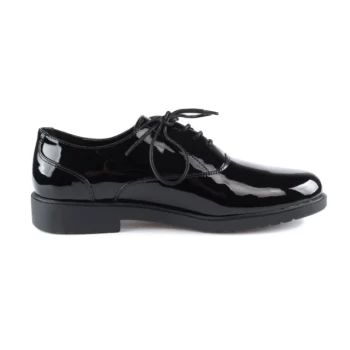
- If your primary focus is maximum formality (black-tie or boardrooms): A whole-cut or plain-toe Oxford in black patent leather offers the cleanest and most elegant silhouette.
- If your primary focus is standard business wear: The cap-toe Oxford is the quintessential choice, perfectly balancing timeless style with professional decorum.
- If your primary focus is business casual or adding flair: A wingtip or brogued Oxford introduces decorative detail that pairs well with sport coats and trousers.
Ultimately, the Oxford's closed construction is the key to its enduring status as the foundation of classic formal footwear.
Summary Table:
| Key Component | Role in Construction |
|---|---|
| Closed Lacing | Quarters stitched under the vamp for a seamless, sleek profile. |
| Vamp | The top front section, stitched on top of the quarters. |
| Quarters | The rear/side sections, forming the lacing system. |
| Concealed Tongue | Lies flat under the laces for clean lines. |
| Result | A snug fit and the most formal dress shoe silhouette. |
Ready to offer your customers the timeless elegance of the Oxford shoe?
As a large-scale manufacturer, 3515 produces a comprehensive range of footwear for distributors, brand owners, and bulk clients. Our production capabilities encompass all types of shoes and boots, including expertly crafted Oxfords in various styles like cap-toe, plain-toe, and whole-cut.
We provide the quality, consistency, and volume to meet your business needs. Let's discuss how we can become your trusted manufacturing partner.
Contact us today to request a catalog and discuss your requirements!
Visual Guide
Related Products
- Wholesale Patent Oxford Dress Shoes | Custom & Bulk Manufacturing
- Classic Leather Derby Dress Shoes Wholesale & Custom Manufacturing
- Wholesale Leather Derby Shoes Manufacturer | Customizable Business & Dress Footwear
- Wholesale Perforated Comfort Dress Shoes | Custom Derby Shoe Manufacturer
- Wholesale Breathable Perforated Leather Derby Dress Shoes for Custom Brands
People Also Ask
- What are the key characteristics of Oxford dress shoes? A Guide to Timeless Formal Footwear
- How do Oxfords and Derbies differ in terms of lacing and formality? A Guide to Choosing the Right Shoe
- What is the origin of the Oxford shoe? From 1800s University Boots to Modern Elegance
- How do Oxford Shoes differ from other casual shoes? The Ultimate Guide to Lacing & Formality
- What makes Oxford shoes suitable for business casual settings? Master the Art of Professional Style