
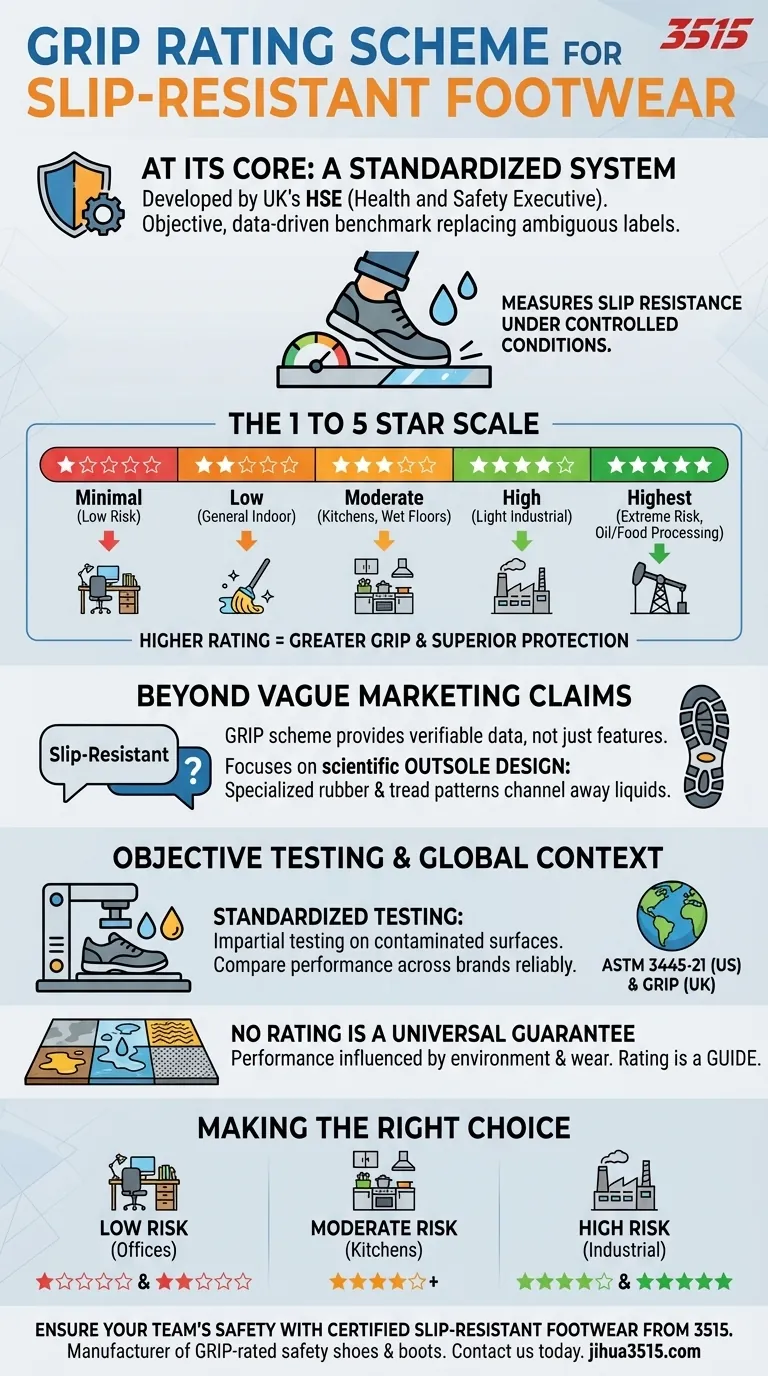
At its core, the GRIP rating scheme is a standardized system developed by the UK's Health and Safety Executive (HSE) to objectively measure the slip resistance of footwear. It assigns a simple one to five-star rating based on rigorous testing, allowing safety managers and employees to make informed decisions without relying on vague manufacturer claims.
The central purpose of the GRIP rating is to replace ambiguous labels like "slip-resistant" with a clear, data-driven benchmark. A higher star rating signifies a greater level of grip, making it easier to match footwear to the specific slip hazards of a work environment.
How the GRIP Rating System Works
The GRIP scheme was designed to bring clarity and consistency to footwear safety. It provides a simple, at-a-glance understanding of a shoe's performance under controlled, repeatable conditions.
The 1 to 5 Star Scale
The rating is straightforward: one star offers a minimal level of slip resistance, while five stars indicate the highest level of performance.
Footwear with a higher rating, particularly four or five stars, is designed and proven to provide superior protection in the most challenging environments where slips are a common and significant risk.
Developed for Objectivity
The scheme was created by the Health and Safety Executive (HSE), a respected government agency. This origin is crucial, as it ensures the testing and ratings are impartial and not influenced by marketing departments.
The goal is to provide a universal standard that cuts through advertising noise and focuses purely on safety performance.
The Power of Standardized Testing
Before GRIP, choosing footwear was often a guess. The scheme introduces a standardized test that measures the coefficient of friction on surfaces contaminated with water or oil.
This ensures that a 4-star shoe from one brand has met the same performance criteria as a 4-star shoe from another, creating a reliable basis for comparison.
Beyond Vague Marketing Claims
For decades, the term "slip-resistant" has been used loosely. The GRIP scheme and similar international standards aim to hold these claims accountable with verifiable data.
The Problem with "Slip-Resistant"
Without a standard, "slip-resistant" is simply a feature, not a guarantee of performance. It doesn't tell you how resistant the shoe is or under what specific conditions it performs best.
This ambiguity can lead to a false sense of security and improper footwear selection for high-risk jobs.
The Science of a Good Outsole
True slip resistance comes from sophisticated outsole design. This involves using specialized rubber compounds and tread patterns engineered to channel away liquids like water and oil.
These features work together to maximize the surface area of the outsole that is in direct contact with the floor, thereby increasing grip.
Understanding the Broader Context
While the GRIP rating is an excellent tool, it's part of a global movement towards standardized footwear safety. Understanding this context helps in making the most informed decisions.
GRIP vs. Other International Standards
The GRIP scheme is a leading example of regional safety standards. In the United States, a similar effort is represented by ASTM 3445-21.
This ASTM standard also sets a universal specification for slip resistance, providing a benchmark for testing. The existence of multiple, robust standards signals a worldwide commitment to reducing workplace falls.
No Rating is a Universal Guarantee
A high GRIP rating indicates excellent performance under the specific test conditions. However, workplace environments are incredibly diverse.
Factors like floor texture, the specific contaminant (e.g., grease vs. hydraulic fluid), and the level of wear on the shoe's outsole will always influence real-world performance. The rating is a powerful guide, not an absolute promise.
Making the Right Choice for Your Environment
Use the GRIP rating as a critical tool to match the level of protection to the level of risk present in your specific workplace.
- If your primary focus is low-risk areas (e.g., dry offices, retail floors): Lower-rated footwear may be sufficient, but selecting any rated shoe is a step up from unrated ones.
- If your primary focus is moderate-risk areas (e.g., commercial kitchens, frequently wet floors): You should set a minimum standard of a three-star rating or higher.
- If your primary focus is high-risk environments (e.g., industrial settings with oil, food processing plants): Insist on footwear with a four or five-star rating to ensure maximum protection.
Ultimately, using a clear rating system like GRIP empowers you to make an evidence-based safety decision that protects your team from preventable harm.
Summary Table:
| GRIP Rating | Slip Resistance Level | Recommended Use Case |
|---|---|---|
| ★☆☆☆☆ | Minimal | Low-risk, dry environments (e.g., offices) |
| ★★☆☆☆ | Low | General indoor areas |
| ★★★☆☆ | Moderate | Moderate-risk areas (e.g., kitchens, wet floors) |
| ★★★★☆ | High | High-risk environments (e.g., light industrial) |
| ★★★★★ | Highest | Extreme-risk settings (e.g., oil, food processing) |
Ensure your team's safety with certified slip-resistant footwear from 3515.
As a large-scale manufacturer, we produce a comprehensive range of GRIP-rated safety shoes and boots for distributors, brand owners, and bulk clients. Our production capabilities encompass all types of occupational footwear, designed to meet rigorous safety standards and reduce workplace accidents.
Contact us today to discuss your specific needs and discover how our footwear solutions can enhance your safety protocols.
Visual Guide
Related Products
- Premium Suede Sport Safety Shoes for Wholesale & Bulk Orders
- Heavy-Duty Waterproof Nubuck Safety Boots Safety Shoes for Bulk Supply
- Advanced KPU Athletic Safety Shoe with Steel Toe Cap Anti-Slip Rotary Lacing System
- Wholesale Durable 6-Inch Work Boots | Custom & Private Label Manufacturer
- Durable Leather Moc Toe Work Boots for Wholesale & Custom Manufacturing
People Also Ask
- What industries have specific OSHA footwear requirements? Ensure Compliance & Protect Your Workforce
- What are the primary functions of professional safety shoes? Maximize Safety in Water Supply Confined Spaces
- What role do specialized safety shoes play in preventing falls? Engineering Stability in Industrial Environments
- How do I choose the best safety shoes? Match Certified Features to Your Hazards
- How Specialized Footwear Impacts Side-Cutting Performance and Injury Risk Assessment
















