
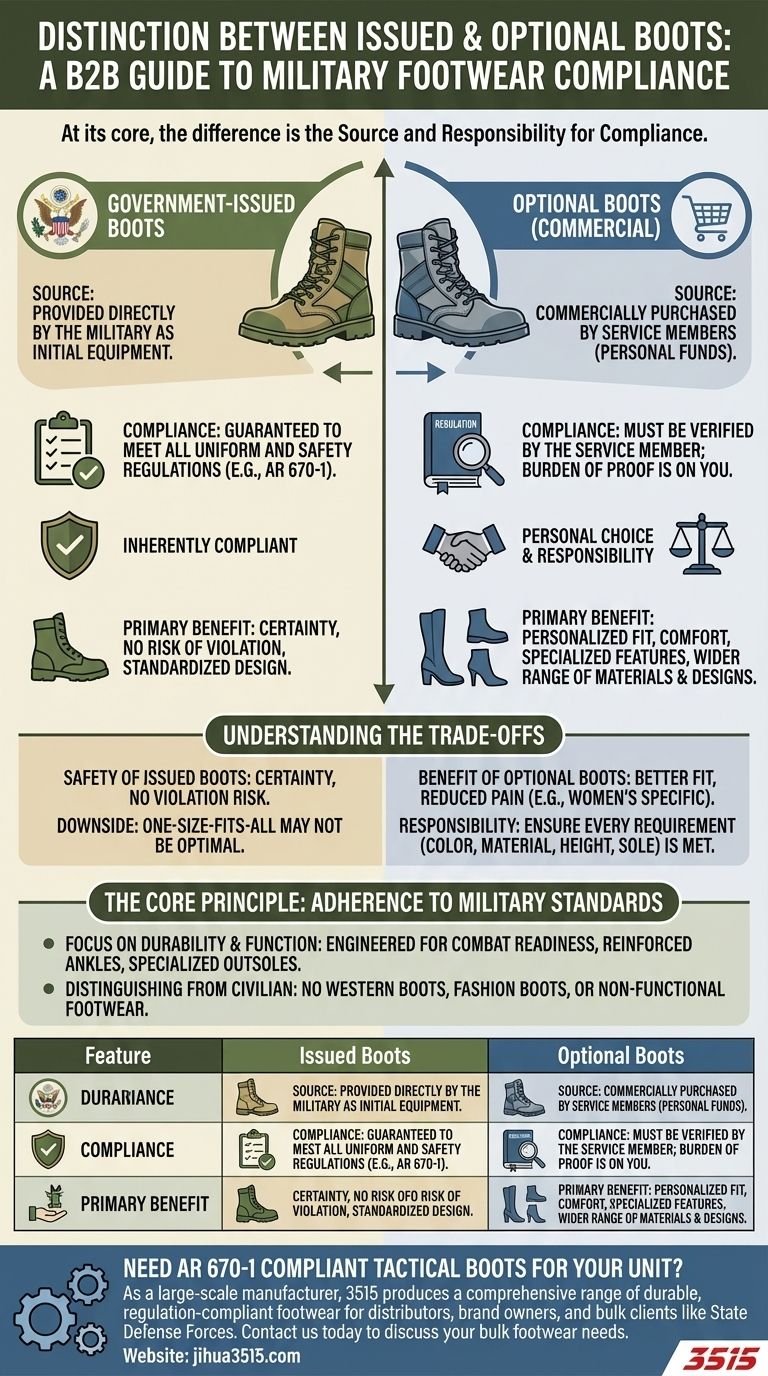
At its core, the distinction is simple: issued boots are provided directly by the military, while optional boots are commercially purchased by service members. However, these optional boots are only authorized for wear if they strictly adhere to military regulations, such as the U.S. Army's AR 670-1.
The key difference isn't just the source of the boots, but where the responsibility for compliance lies. Issued boots are inherently compliant, whereas choosing an optional boot gives you personal choice in fit and features but places the burden of meeting regulations squarely on you.
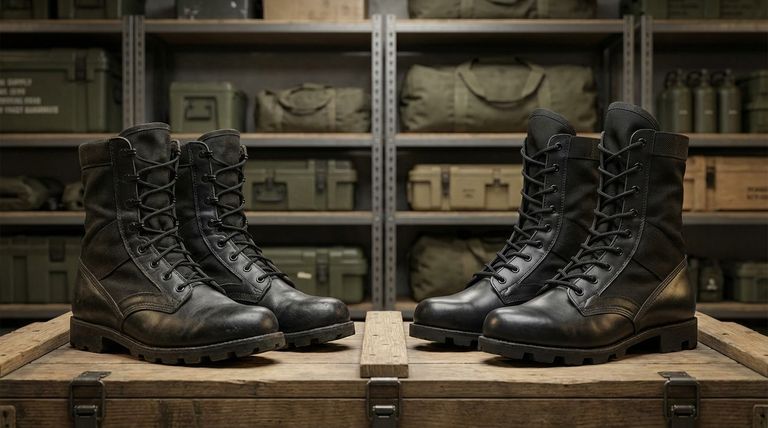
Issued vs. Optional: The Fundamental Difference
The primary distinction between these two categories comes down to procurement and guaranteed compliance. Each serves a purpose within the uniform regulations of military branches.
Government-Issued Boots
Issued boots are the standard footwear provided to all soldiers as part of their initial equipment. They are manufactured to meet exact military specifications, guaranteeing they are fully compliant with all uniform and safety regulations.
Optional Boots (Commercial)
Optional boots are any commercially available boots that a service member chooses to purchase with their own funds. These boots offer a wider range of fits, materials, and designs, but they are only authorized if they meet the stringent requirements outlined in regulations like AR 670-1.
This option is particularly relevant for personnel in units like the State Defense Force, who often rely on compliant commercial boots to meet their uniform standards.
The Core Principle: Adherence to Military Standards
Simply being a "military-style" boot is not enough. Optional boots are authorized based on specific functional criteria designed for durability, safety, and uniformity, not style.
Focus on Durability and Function
Military and tactical boots are engineered for combat readiness and challenging conditions. Regulations ensure that any optional boot maintains this focus, often requiring features like reinforced ankles, specialized outsoles for traction, and durable, non-exotic materials.
Distinguishing from Civilian Boots
The regulations create a clear line between acceptable boots and other types. For example, Western boots with their pointed toes and ornate stitching, or standard work boots that may lack specific military features, would not be compliant.
Similarly, specialized footwear like snow boots or field boots designed for equestrian activities do not meet the functional requirements for military duty wear.
Understanding the Trade-offs
Choosing between issued and optional boots involves balancing guaranteed compliance against personalized comfort and performance.
The Safety of Issued Boots
The primary advantage of issued boots is certainty. There is no risk of choosing a non-compliant boot, saving you from a wasted purchase and a potential uniform violation. The potential downside is a one-size-fits-all design that may not be optimal for every individual's foot.
The Benefit of Optional Boots
The main reason service members seek optional boots is to find a better fit and enhanced comfort. Commercial manufacturers offer boots designed for specific foot shapes, such as women's boots which typically feature a narrower heel and higher arch support. This can significantly reduce the risk of blisters and pain.
The Responsibility of Choice
When you select an optional boot, the responsibility to verify its compliance is entirely yours. You must ensure it meets every specific requirement for color, material, height, and sole design before wearing it in uniform.
Making the Right Choice for Your Goal
- If your primary focus is guaranteed compliance: Stick with your standard-issue boots, as they are the approved baseline and require no additional verification.
- If your primary focus is personalized comfort and fit: Carefully research AR 670-1 compliant optional boots to find a brand and model that best suits your foot shape and operational needs.
- If you need a lightweight, versatile option: Look for tactical boots from reputable brands that explicitly state they are AR 670-1 compliant, as these are often lighter than standard-issue models.
Ultimately, selecting the right boot is about ensuring you are comfortable, safe, and always in compliance with regulations.
Summary Table:
| Feature | Issued Boots | Optional Boots |
|---|---|---|
| Source | Provided by the military | Commercially purchased |
| Compliance | Guaranteed to meet regulations | Must be verified by the service member |
| Primary Benefit | Guaranteed adherence to standards | Personalized fit, comfort, and features |
| Responsibility | None - inherently compliant | On the individual to ensure compliance |
Need AR 670-1 Compliant Tactical Boots for Your Unit?
As a large-scale manufacturer, 3515 produces a comprehensive range of durable, regulation-compliant footwear for distributors, brand owners, and bulk clients like State Defense Forces. Our production capabilities encompass all types of military and tactical boots, ensuring your personnel have access to reliable, high-performance footwear that meets strict standards.
Contact us today to discuss your bulk footwear needs and ensure your team is equipped for any mission.
Visual Guide
Related Products
- Durable Military Combat Boots with Water Drainage for Wholesale & OEM
- High-Traction Suede Tactical Boots Wholesale & Custom Manufacturing
- Durable High-Ankle Tactical Boots for Wholesale & Custom Manufacturing
- Durable Mid-Cut Tactical Boots for Wholesale & Private Label
- Wholesale Waterproof Tactical Boots Custom Suede & High-Traction Soles
People Also Ask
- Why must gait validation for military applications be conducted in combat boots? Ensure Data Accuracy for Soldiers
- What are the common types of combat boots? Find the Right Boot for Your Mission
- What factors should be considered when choosing military boots for hiking? Durability vs. Weight for Your Terrain
- What are the key considerations when choosing military boots? Prioritize Compliance, Environment & Fit
- How should the midfoot and heel fit in military boots? Achieve a Snug, Secure Fit for Blister Prevention


















