
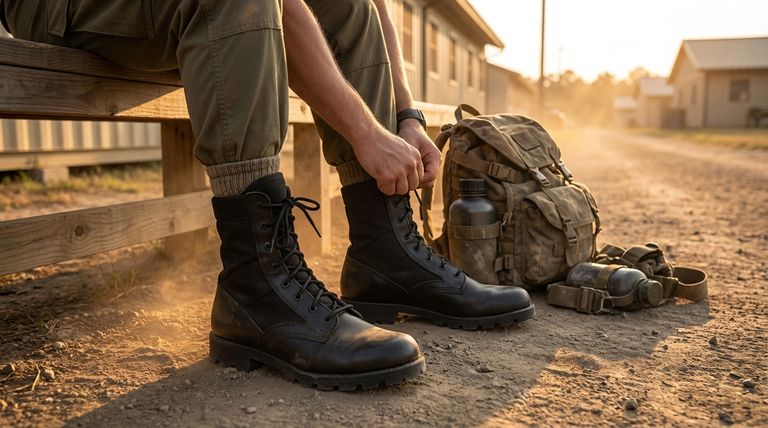
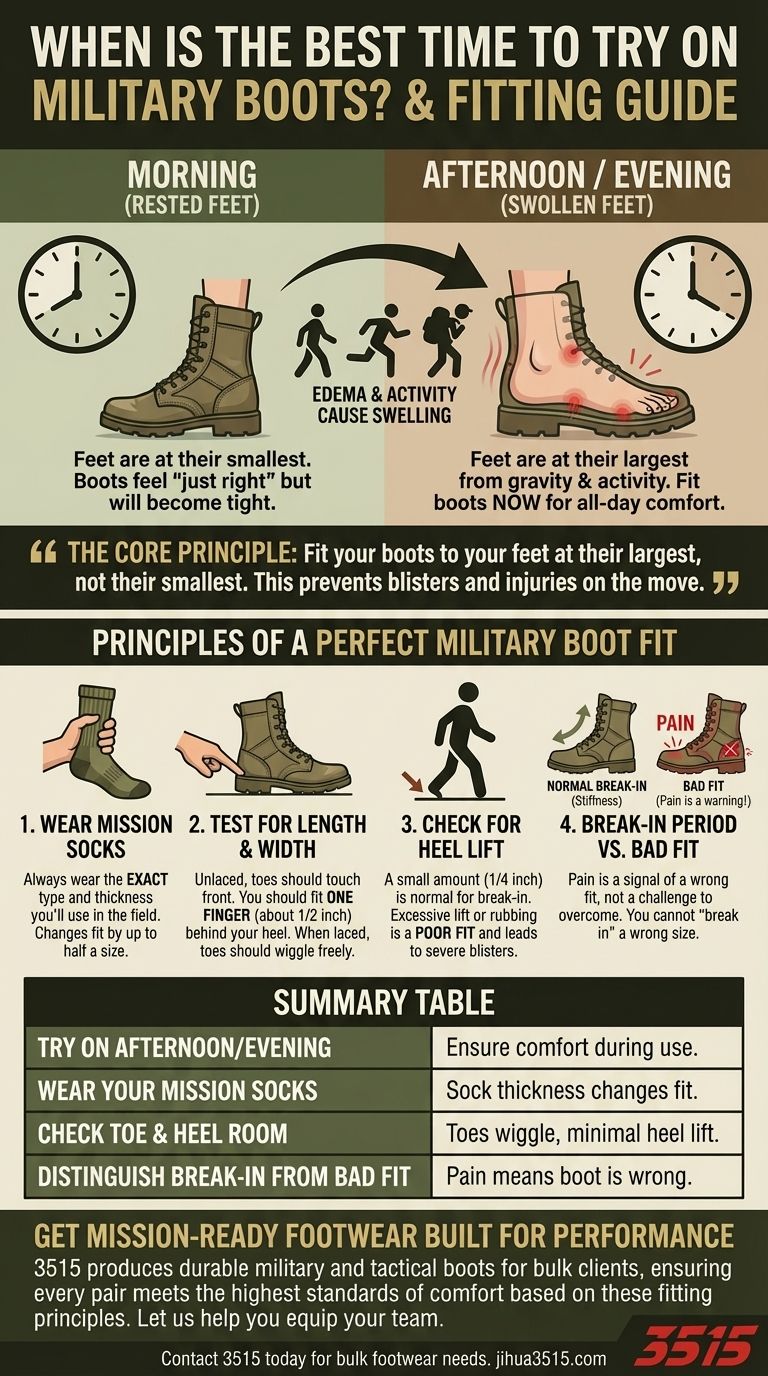
The best time of day to try on military boots is in the afternoon or evening. Your feet naturally swell from the effects of gravity and activity throughout the day, reaching their largest size later in the day. Fitting your boots during this time ensures they will remain comfortable and not become too tight during long marches or extended field use.
The core principle is simple: fit your boots to your feet at their largest, not their smallest. This single decision prevents a cascade of problems, from pressure points and blisters to more serious foot injuries when you’re on the move.
Why Timing is Critical: The Science of Foot Swell
Getting the right fit for a military boot is about more than just your shoe size; it's about accommodating the dynamic nature of your feet. A boot that feels perfect in the morning can become an instrument of torture by the end of the day.
How Your Feet Change During the Day
Throughout the day, factors like heat, humidity, and simple gravity cause fluid to pool in your lower extremities. This process, known as edema, causes your feet to swell slightly in both length and width.
This swelling is significantly amplified by demanding physical activity like walking, running, or carrying a load, all of which are standard in a military context.
The Consequences of a Morning Fitting
Trying on boots first thing in the morning is a common and critical mistake. A boot that feels "snug" or "just right" on a rested, unswollen foot will become painfully tight later on.
This constriction creates pressure points, restricts circulation, and dramatically increases the friction that leads to blisters and hot spots. You are essentially buying a boot that is guaranteed to be too small when you need it most.
Beyond Timing: Principles of a Perfect Military Boot Fit
While timing is crucial, it's only one piece of the puzzle. A truly mission-ready fit requires a more comprehensive approach.
Wear the Right Socks
The thickness of your socks can change the fit of a boot by up to half a size. Always try on boots while wearing the exact type and thickness of sock you plan to use in the field. A thin athletic sock will give you a completely different feel than a thick, cushioned wool or synthetic boot sock.
Test for Length and Width
With the boot unlaced, slide your foot forward until your toes touch the front. You should be able to comfortably slip one finger (about a half-inch) between your heel and the back of the boot.
When laced up, your foot should feel secure, but your toes should have enough room to wiggle freely. Your foot should not spill over the sides of the insole.
Check for Heel Lift
Walk around in the boots. A small amount of heel lift (about a quarter-inch) is normal and acceptable as the boot breaks in.
However, if your heel is lifting excessively or rubbing aggressively with each step, it's a sign of a poor fit. This constant friction is a primary cause of severe heel blisters.
Understanding the Trade-offs: Break-in Period vs. Bad Fit
It's vital to distinguish between the normal stiffness of a new boot and a fundamentally poor fit.
The Myth of "Breaking In" a Bad Fit
A quality leather or synthetic boot requires a break-in period for the stiff materials to flex and conform to your foot's shape. This is normal.
However, you cannot "break in" a boot that is the wrong size or shape for your foot. If the boot feels painfully tight, pinches your toes, or crushes the sides of your foot, no amount of wear will fix it. Pain is a signal of a bad fit, not a challenge to overcome.
How to Properly Test New Boots
Once you've purchased boots that feel right in the store, don't immediately take them on a 12-mile ruck march.
Wear them around the house for a few hours. If they still feel good, test them on shorter walks or light hikes. This allows you to identify potential issues before you are fully committed and miles away from a solution.
Making the Right Choice for Your Mission
Your final check should align the boot's fit with its intended purpose.
- If your primary focus is rucking or long marches: Ensure there is ample room in the toe box to prevent your toes from jamming into the front of the boot on declines, and confirm your heel is securely locked in place.
- If your primary focus is garrison or light duty: You may have slightly more leeway, but never compromise on correct length and width, as you may be on your feet for an entire duty day.
A few minutes of thoughtful evaluation in the store will save you weeks of pain and recovery down the road.
Summary Table:
| Key Fitting Principle | Why It Matters |
|---|---|
| Try on in the Afternoon/Evening | Feet swell during the day; fitting then ensures comfort during use. |
| Wear Your Mission Socks | Sock thickness changes fit by up to half a size. |
| Check Toe and Heel Room | Toes should wiggle freely; heel lift should be minimal. |
| Distinguish Break-in from Bad Fit | Pain means the boot is wrong, not just stiff. |
Get Mission-Ready Footwear Built for Performance
As a large-scale manufacturer, 3515 produces a comprehensive range of durable military and tactical boots for distributors, brand owners, and bulk clients. Our production capabilities ensure every pair meets the highest standards of comfort and durability, designed based on the precise fitting principles outlined above.
Let us help you equip your team with footwear that performs under pressure.
Contact 3515 today for your bulk footwear needs and get a perfect fit for any mission.
Visual Guide
Related Products
- Durable Military Combat Boots with Water Drainage for Wholesale & OEM
- High-Traction Suede Tactical Boots Wholesale & Custom Manufacturing
- Durable High-Ankle Tactical Boots for Wholesale & Custom Manufacturing
- Durable Mid-Cut Tactical Boots for Wholesale & Private Label
- Wholesale Waterproof Tactical Boots Custom Suede & High-Traction Soles
People Also Ask
- Why must gait validation for military applications be conducted in combat boots? Ensure Data Accuracy for Soldiers
- What are the common types of combat boots? Find the Right Boot for Your Mission
- What factors should be considered when choosing military boots for hiking? Durability vs. Weight for Your Terrain
- What are the key considerations when choosing military boots? Prioritize Compliance, Environment & Fit
- How should the midfoot and heel fit in military boots? Achieve a Snug, Secure Fit for Blister Prevention


















