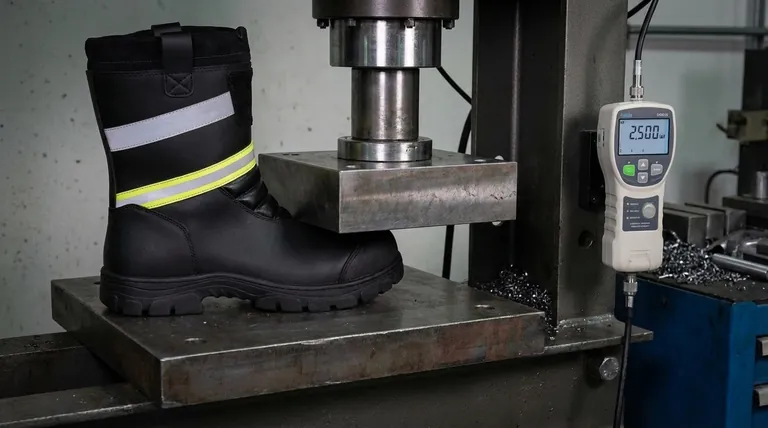
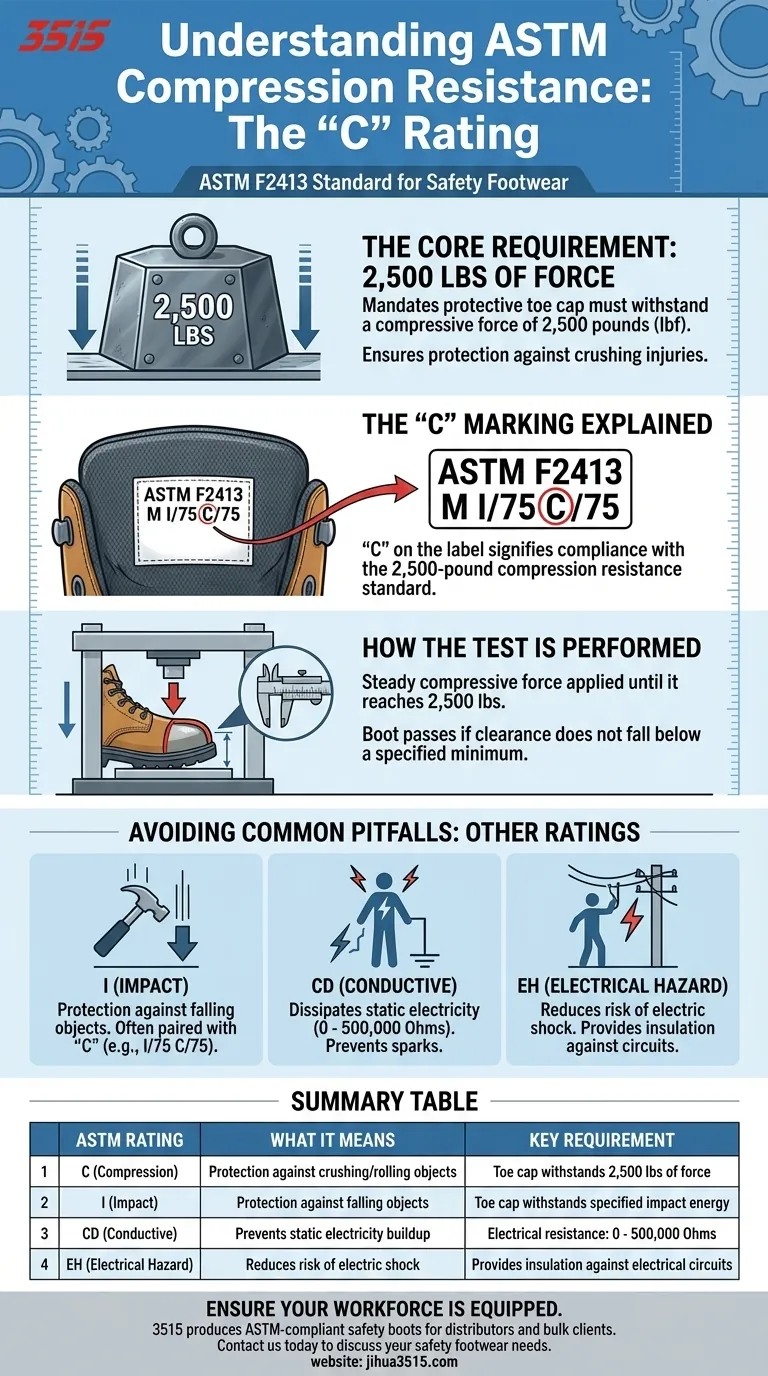
At its core, the ASTM F2413 standard for safety footwear mandates that the protective toe cap must withstand a compressive force of 2,500 pounds (lbf). This ensures the toe area provides a minimum, testable level of protection against crushing injuries in the workplace.
The "C" on a safety boot's label directly signifies its compliance with the ASTM's 2,500-pound compression resistance standard, a critical benchmark for protecting against crushing hazards.
Deconstructing the ASTM Compression Standard
To properly select and trust your safety footwear, it's essential to understand what this specific rating means and how it's identified. It's a measure of static crush protection, distinct from other safety features.
The Core Requirement: 2,500 Pounds of Force
The standard requires the safety toe cap to resist a compressive load of 2,500 pounds-force (lbf) before the cap critically deforms.
This test simulates the force of a very heavy object slowly rolling onto or pressing down on the toe area of the boot.
The "C" Marking Explained
Footwear that successfully passes this compression test is marked with a "C" on its ASTM label, which is typically found sewn onto the boot's tongue.
This simple letter provides a clear, immediate confirmation that the boot meets the required level of protection against crushing forces.
How the Test is Performed
During certification, a steady compressive force is applied to the toe cap at a slow, controlled rate until it reaches 2,500 pounds.
The test measures the amount of clearance remaining inside the toe cap at maximum force. The boot passes if the clearance does not fall below a specified minimum, ensuring the wearer's toes would be safe.
Avoiding Common Pitfalls: Other Safety Ratings
The "C" for compression is just one part of a boot's overall safety rating. It is a common mistake to confuse it with other critical, but separate, standards.
Impact Resistance ("I")
Nearly all boots with a "C" rating also carry an "I" rating for impact. This tests the toe cap's ability to withstand a heavy object being dropped on it, simulating a falling tool or material. The two ratings together (e.g., I/75 C/75) offer comprehensive toe protection.
Electrical Ratings ("CD", "EH")
The "C" for compression has no connection to a boot's electrical properties. For instance, Conductive ("CD") footwear is designed to dissipate static electricity to prevent sparks, requiring a resistance of 0 to 500,000 Ohms.
Confusing these labels can lead to selecting the wrong boot for your specific hazard, creating a serious safety risk. Always verify each rating independently based on your work environment's needs.
Making the Right Choice for Your Goal
Selecting the correct boot means matching its certified ratings to the specific hazards you face.
- If your primary focus is protection from rolling objects or crushing: Look for the "C" marking on the ASTM label as your non-negotiable requirement.
- If you work around falling tools or materials: Ensure the boot has both an "I" (Impact) and "C" (Compression) rating.
- If you work in an environment with explosive materials: You must look for the "CD" (Conductive) rating to prevent static discharge, in addition to any other required physical protections.
Understanding these distinct labels empowers you to make an informed decision that ensures your safety on the job.
Summary Table:
| ASTM Rating | What It Means | Key Requirement |
|---|---|---|
| C (Compression) | Protection against crushing/rolling objects | Toe cap withstands 2,500 lbs of force |
| I (Impact) | Protection against falling objects | Toe cap withstands a specified impact energy |
| CD (Conductive) | Prevents static electricity buildup | Electrical resistance: 0 - 500,000 Ohms |
| EH (Electrical Hazard) | Reduces risk of electric shock | Provides insulation against electrical circuits |
Ensure your workforce is equipped with the right safety footwear. As a large-scale manufacturer, 3515 produces a comprehensive range of ASTM-compliant safety boots and shoes for distributors, brand owners, and bulk clients. Our production capabilities encompass all types of protective footwear, ensuring quality and compliance for every hazard. Contact us today to discuss your safety footwear needs and get a quote.
Visual Guide
Related Products
- Puncture-Resistant Velcro Safety Boots for Wholesale & Custom Manufacturing
- Wholesale Durable Safety Boots | Custom Steel Toe & Puncture-Resistant Manufacturing
- Premium Grain Leather Safety Boots for Bulk Supply
- Heavy-Duty Waterproof Nubuck Safety Boots Safety Shoes for Bulk Supply
- Premium High-Cut Waterproof Safety Boots Manufacturing & Wholesale Solutions
People Also Ask
- Why are industrial safety boots with steel toes necessary for machine operators? Essential Foot Protection for Safety
- What are the characteristics of steel toe safety boots? Maximum Protection, Key Trade-offs
- Is it true that steel toes can cause toes to get cut off? Debunking the Dangerous Myth
- What are the primary safety functions of safety boots with steel-toe designs? Essential Protection for Industry
- What are the different types of safety toe boots available? Choose the Right Protection for Your Job