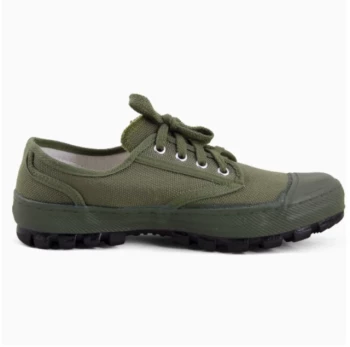
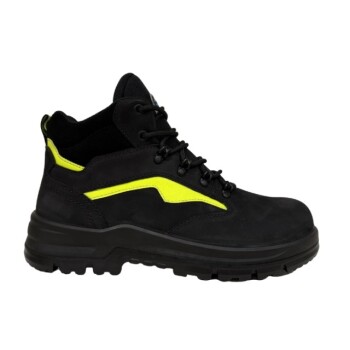
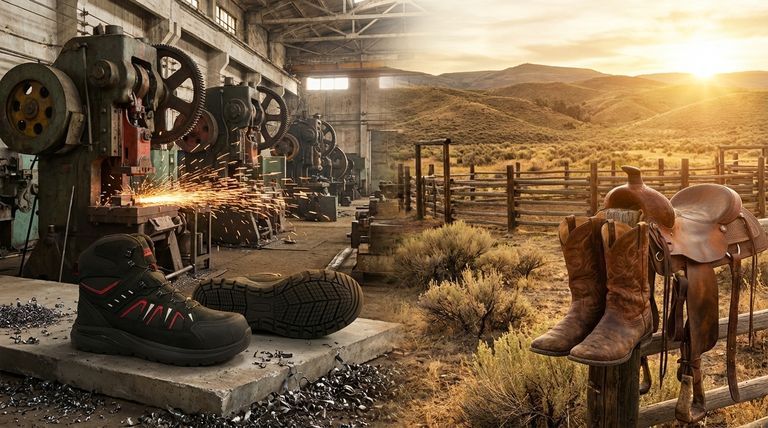
In short, the American Industrial Revolution and the expansion of the US frontier were the pivotal historical forces that shaped the development of work boots and western boots, respectively. Work boots were born from the necessity of protecting laborers in new industrial environments like factories and mines, while western boots were functionally designed for the specific needs of cowherds and ranchers on the open range.
The core takeaway is that these iconic footwear styles are not arbitrary designs; they are direct, functional responses to their historical environments. One is a product of the machine age, built for safety, while the other is a tool of the frontier, built for the saddle.
The Rise of the Work Boot: A Product of Industrialization
The modern work boot is a direct descendant of the Industrial Revolution in the United States. As the nation shifted to factory work, mining, and large-scale construction, a new type of footwear became an absolute necessity.
The Demands of the Factory Floor
Traditional shoes were no match for the hazards of industrial job sites. Workers faced constant threats from heavy machinery, falling objects, and treacherous surfaces, demanding a boot built purely for protection.
Safety Becomes Standard
In response to these dangers, key innovations were integrated into boot design. Features like steel toes to guard against impact and compression, and thick, slip-resistant rubber soles to ensure stability, became defining characteristics.
Function Over Form
The design philosophy was ruthlessly practical. Work boots evolved with heavy-duty, often puncture-resistant materials, with every element focused on durability and the safety of the wearer. Aesthetics were a distant, if non-existent, concern.
The Western Boot: Forged on the American Frontier
Simultaneously, a different evolution was taking place in the American West. The western, or "cowboy," boot emerged as an essential tool for ranchers and cowherds navigating the rugged frontier.
The Needs of the Cowherd
Life on the range presented a unique set of challenges centered around horsemanship. A rider needed a boot that was safe, durable, and perfectly suited for long hours in the saddle.
Anatomy of a Frontier Tool
Each element of the western boot served a specific purpose. The high top protected the rider's leg from brush and snakebites, the pointed toe helped guide the foot into a stirrup, and the angled "walking" heel secured the foot within the stirrup to prevent slipping.
From Utility to Identity
While born from function, the western boot quickly became a powerful symbol of rugged individualism and the frontier spirit. This cultural status led to the addition of stylistic elements like ornate stitching and polished leathers, blending its practical origins with a distinct identity.
Understanding the Divergence
The distinct paths of these two boots highlight a fundamental difference in their core purpose. One was designed to protect a person from their environment, while the other was designed to help a person master it.
Design Philosophy: General Safety vs. Specific Task
Work boots are generalist tools designed for a wide range of industrial hazards. In contrast, western boots are specialist tools, with every feature optimized for the single, critical task of riding a horse.
Materials and Construction
This divergence is clear in their construction. Work boots utilize heavy-duty, modern materials focused on impact and puncture resistance. Western boots traditionally rely on leather, balancing durability with the form required for their specific function and cultural aesthetic.
Cultural Symbolism
Ultimately, each boot came to represent the environment that created it. The work boot stands as a symbol of industrial labor and the working class, while the western boot endures as an icon of American independence and the frontier.
How Function Defines Form
Understanding the origin of these boots provides a clear framework for their modern application. Their historical purpose is still embedded in their design.
- If your primary focus is uncompromising protection in hazardous environments: The work boot's legacy of industrial safety is the clear and correct choice.
- If your primary focus is a tool designed for equestrian life and rugged terrain: The western boot's frontier-driven design remains the functional standard.
- If your primary focus is cultural expression and iconic style: Both boots carry a powerful heritage, one rooted in industry and the other in individualism.
Knowing the history behind a design reveals its true and intended purpose.
Summary Table:
| Boot Type | Key Historical Influence | Primary Design Purpose | Key Functional Features |
|---|---|---|---|
| Work Boot | American Industrial Revolution | Protection from industrial hazards (factories, mines) | Steel toe, slip-resistant sole, heavy-duty materials |
| Western Boot | Expansion of the US Frontier | Mastery of the saddle and rugged terrain | High top, pointed toe, angled heel for stirrups |
Need Durable, Historically-Inspired Footwear for Your Business?
As a large-scale manufacturer, 3515 produces a comprehensive range of footwear rooted in this legacy of functional design. Whether you're a distributor, brand owner, or bulk client needing the protective qualities of industrial work boots or the specialized design of western boots, our production capabilities encompass all types of shoes and boots.
Let us help you supply footwear built for purpose.
Contact us today to discuss your manufacturing needs.
Visual Guide

Related Products
- Durable Leather Work Boots for Wholesale & Custom Manufacturing
- Durable Leather Work Boots for Wholesale & Custom OEM Manufacturing
- Durable Leather Work Boots Wholesale Manufacturer & Custom Factory
- Durable Leather Moc Toe Work Boots for Wholesale & Custom Manufacturing
- Wholesale Durable 6-Inch Work Boots | Custom & Private Label Manufacturer
People Also Ask
- What is the difference between full-grain and top-grain leather? Premium Material Guide for Boot Manufacturers
- What are the common workplace hazards that can be mitigated with the right work boots? Protect Your Workforce
- What are the common foot issues workers face due to uncomfortable work boots? Prevent Pain & Deformities
- What are the advantages of leather versus synthetic work boots? A Guide to Choosing the Right Material
- What are the key components of modern work boots? Engineered for Ultimate Durability and Comfort