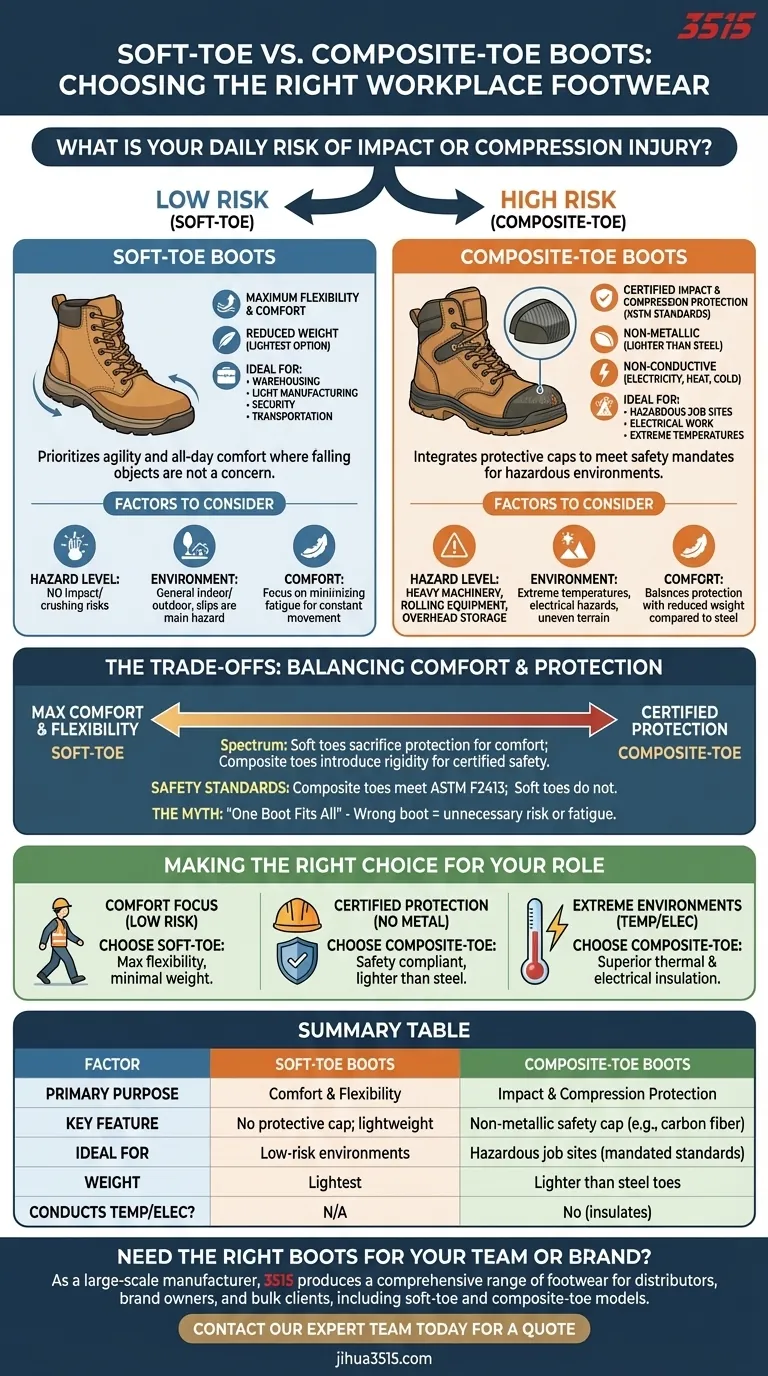
Choosing between soft-toe and composite-toe boots hinges on a single, critical question: what is your daily risk of impact or compression injury to your feet? Soft-toe boots are built for flexibility and comfort in low-risk environments where falling objects are not a concern. Composite-toe boots, however, integrate non-metallic protective caps to meet certified safety standards, making them essential for hazardous job sites.
Your decision should be guided by your workplace safety requirements, not just personal comfort. Composite toes are for mandated protection against impact and compression, while soft toes are for roles where agility and reduced weight are the priority and impact risks are minimal.
Deconstructing the Boot: Soft Toe vs. Composite Toe
Understanding the fundamental purpose behind each design is the first step in making an informed choice. Each type is engineered for a distinctly different environment and set of daily tasks.
The Case for Soft-Toe Boots
A soft-toe boot is exactly what its name implies—a boot with no reinforced protective cap over the toes. This design prioritizes comfort, flexibility, and reduced weight above all else.
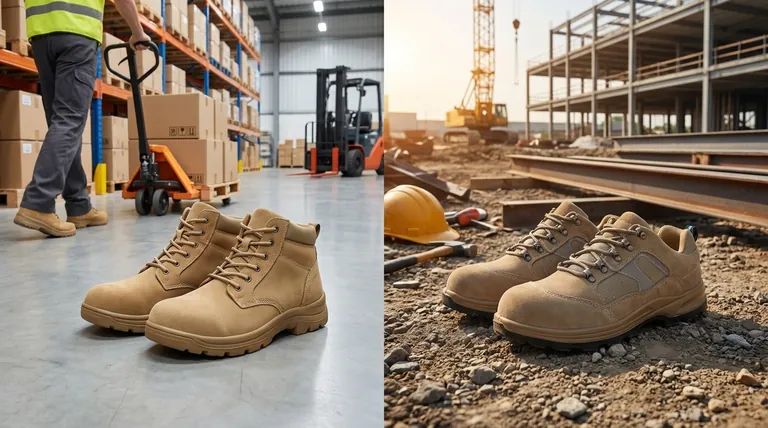
These boots are the ideal choice for jobs where the primary hazards are slips or uneven terrain, not falling objects. They are common in fields like warehousing, light manufacturing, security, and transportation, where all-day comfort reduces fatigue.
The Power of Composite-Toe Boots
A composite-toe boot features a safety cap made from non-metallic materials like carbon fiber, Kevlar, plastic, or fiberglass. These materials are engineered to be strong enough to meet the same ASTM safety standards for impact and compression as steel-toe boots.
The primary advantage of composite materials is that they are significantly lighter than steel, reducing foot fatigue over a long shift. Furthermore, they do not conduct electricity, heat, or cold, making them the superior choice for electricians or anyone working in extreme temperature conditions.
How to Assess Your True Workplace Needs
A boot is a tool. To choose the right one, you must first perform a clear-eyed assessment of the job it needs to do.
Identify Your Hazard Level
Start with a simple risk assessment. Do you work around heavy machinery, rolling equipment like forklifts, or in environments where materials are stored overhead?
If the answer is yes, a safety toe is non-negotiable. Your employer's safety policy or OSHA requirements will likely mandate a certified protective toe. If there is no risk of objects falling on or crushing your feet, a soft toe may be sufficient.
Consider Environmental Factors
The climate and ground conditions play a crucial role. Composite toes will not transfer cold to your feet in a freezing environment or heat in a hot one, offering a significant comfort advantage over metal.
Also, consider underfoot conditions. While both boot types can feature slip-resistant outsoles, the rigidity of a composite-toe boot can sometimes provide more stability on uneven or rocky surfaces.
Factor in All-Day Comfort and Weight
For workers who walk several miles a day, boot weight is a major factor in end-of-day fatigue.
Soft-toe boots are the undisputed winner for lightness and flexibility. If your job requires constant movement without impact risk, a soft toe will maximize your comfort.
Composite-toe boots offer the perfect compromise between protection and weight. They provide certified safety while being noticeably lighter than traditional steel-toe boots, making them a popular choice for modern work sites.
Understanding the Trade-offs
Choosing footwear is always a balance of competing factors. Being aware of the inherent compromises ensures you won't be surprised by your boot's performance.
The Comfort vs. Protection Spectrum
This is the core trade-off. Soft toes maximize comfort and flexibility by sacrificing impact protection. Composite toes deliver certified protection but introduce rigidity and a bit more weight compared to a soft toe.
Safety Standards and Compliance
Composite-toe boots are built to meet specific safety standards (like ASTM F2413). If your job requires this compliance, a soft-toe boot is not an option. Always verify the required standard for your work site.
The Myth of "One Boot Fits All"
Using the wrong boot for the job creates unnecessary risk. Wearing a soft-toe boot in a hazardous area is a critical safety failure. Conversely, wearing a heavy safety-toe boot when it's not needed can cause unnecessary fatigue and discomfort over time.
Making the Right Choice for Your Role
Filter your decision through the lens of your primary daily requirement to select the boot that will serve you best.
- If your primary focus is comfort in a low-risk environment: A soft-toe boot is your best option, offering maximum flexibility and minimal weight for long hours on your feet.
- If you require certified impact protection without metal: A composite-toe boot provides the necessary safety while being lighter than steel and fully compliant with workplace standards.
- If you work in extreme temperatures or around electrical hazards: The thermal and electrical insulating properties of a composite toe make it the safest and most comfortable choice.
By accurately assessing your daily risks and environmental conditions, you can confidently select a boot that provides the perfect balance of protection and performance.
Summary Table:
| Factor | Soft-Toe Boots | Composite-Toe Boots |
|---|---|---|
| Primary Purpose | Comfort & Flexibility | Impact & Compression Protection |
| Key Feature | No protective cap; lightweight | Non-metallic safety cap (e.g., carbon fiber) |
| Ideal For | Low-risk environments (e.g., warehousing) | Hazardous job sites (mandated safety standards) |
| Weight | Lightest | Lighter than steel toes |
| Conducts Temp/Electricity? | N/A | No (insulates against heat, cold, electricity) |
Need the Right Boots for Your Team or Brand?
As a large-scale manufacturer, 3515 produces a comprehensive range of footwear for distributors, brand owners, and bulk clients. Our production capabilities encompass all types of safety and work boots, including both soft-toe and composite-toe models, ensuring your workforce has the perfect balance of protection, comfort, and compliance.
Let's discuss your specific needs: Contact our expert team today to get a quote or learn more about our manufacturing solutions.
Visual Guide
Related Products
- Wholesale Durable Safety Boots Manufacturer Customizable Steel Toe Work Boots
- Durable Leather Moc Toe Work Boots for Wholesale & Custom Manufacturing
- Durable Moc-Toe Wedge Work Boots | Wholesale Manufacturing for Brands
- Wholesale Mesh Steel Toe Safety Shoes with Dial Closure Factory Production
- Wholesale Durable Breathable Safety Boots Custom OEM Manufacturer
People Also Ask
- What are the pros and cons of steel toe work boots? A Guide to Maximum Protection vs. Comfort
- What are the different types of steel toe work boots? Choose the Right Boot for Your Job
- What is the history of steel toe work boots? From German Invention to Modern Safety Standard
- How much weight can steel toe work boots withstand? Unpacking the 3,372 lb. Safety Standard
- What are some common myths about steel toe work boots? Debunked for Modern Workers