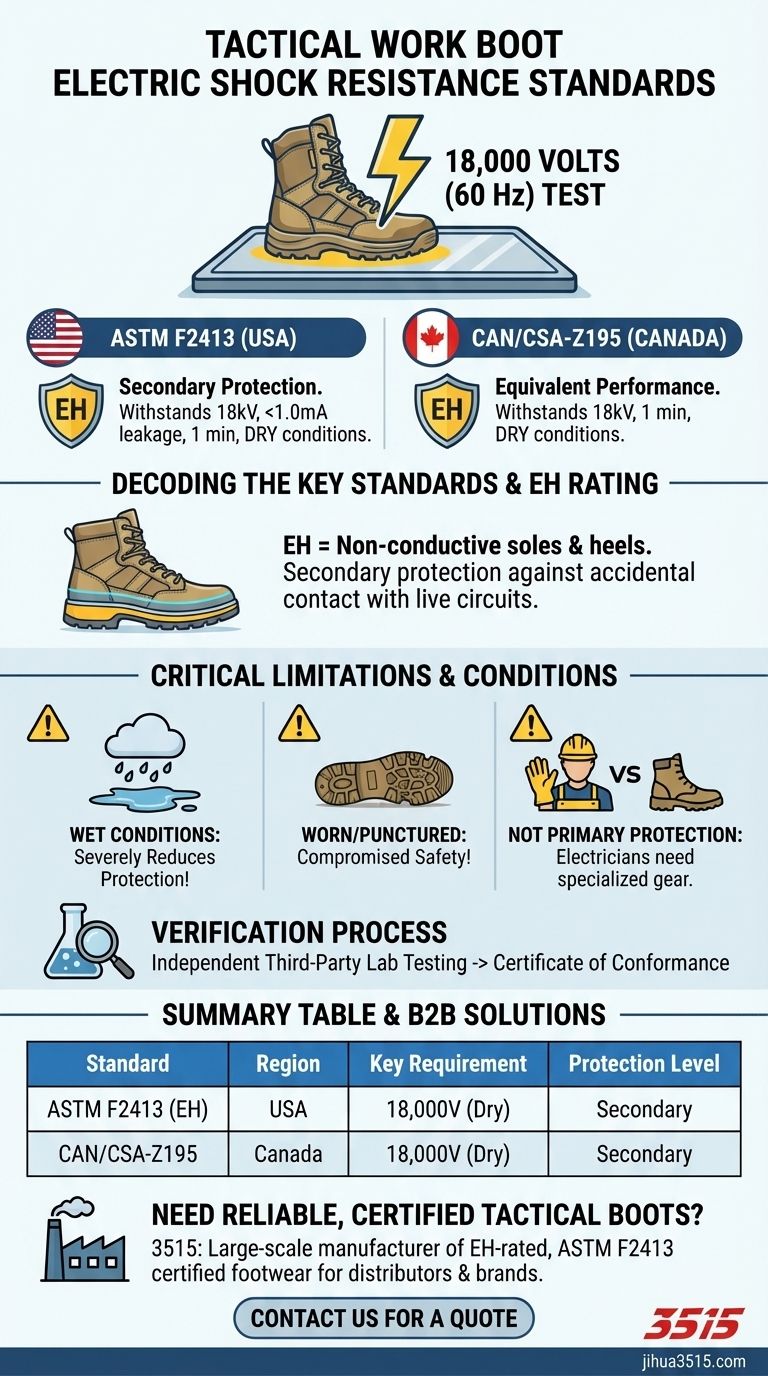
Tactical work boots certified for electrical hazard protection primarily adhere to the ASTM F2413 standard in the United States or the CAN/CSA-Z195 standard in Canada. These standards specify that the footwear must be capable of withstanding the application of 18,000 volts at 60 Hz for one minute with no current flow or leakage current in excess of 1.0 milliampere under dry conditions.
The "EH" rating on a boot is your critical indicator for electrical safety. It signifies compliance with the ASTM F2413 standard, but this protection is designed for secondary, accidental contact and is significantly compromised in wet or worn-down conditions.
Decoding the Key Standards
To make an informed decision, you must understand what these certifications mean in practice. The standards are not just labels; they represent specific performance benchmarks achieved through rigorous testing.
The Primary US Standard: ASTM F2413
The foundational standard for safety footwear in the United States is ASTM F2413. This is a broad specification that covers multiple types of protection.
Work boots are certified to this standard to guarantee they meet performance requirements for safety, including but not limited to electrical hazards.
The "EH" Rating Explained
Within the ASTM F2413 standard, the specific designation for Electrical Hazard protection is "EH".
Boots with an EH rating are constructed with non-conductive, electric shock-resistant soles and heels. Their purpose is to provide a secondary source of protection against accidental contact with live electrical circuits.
The Canadian Standard: CAN/CSA-Z195
In Canada, the equivalent standard is CAN/CSA-Z195. It serves a similar function to the ASTM standard.
Like its US counterpart, it also requires boots to be tested for resistance to 18,000 volts to ensure they provide adequate protection.
How Certification is Verified
Reputable brands do not self-certify their footwear. To receive a valid ASTM certification, the boots must be tested by an independent, third-party laboratory.
This lab issues a Certificate of Conformance, which verifies that the specific boot model meets or exceeds the performance requirements outlined in the standard.
Common Pitfalls and Limitations
An EH rating provides a crucial layer of safety, but it is not absolute. Understanding its limitations is as important as knowing the standard itself.
Primary vs. Secondary Protection
EH-rated boots are designed as a secondary source of protection. They are intended for environments where accidental contact with energized equipment is a risk.
They are not designed for primary protection, such as for electricians or linemen who work directly with live circuits. Those roles require specialized, primary-level protective gear.
The Critical Impact of Conditions
The 18,000-volt resistance rating is based on tests performed in dry conditions.
The protective qualities of EH footwear are severely reduced when the boots are wet, if the sole is punctured, or once the tread becomes excessively worn.
Confusing Other Safety Ratings
It is easy to confuse different safety features. An ASTM F2413-certified boot can have many ratings, but they are not interchangeable.
For example, Mt/75 refers to metatarsal protection against impact, and ASTM F3445 certifies slip resistance. These are separate from the EH rating for electrical shock.
Making the Right Choice for Your Task
Your specific work environment and the hazards you face should dictate your choice.
- If your primary focus is general industrial work with potential electrical hazards: Look for boots explicitly marked "EH" and certified to the current ASTM F2413 standard.
- If your primary focus is compliance with Canadian safety regulations: Ensure the boots are certified to the CAN/CSA-Z195 standard, often indicated by a green Omega symbol on the footwear.
- If you are a professional electrician or lineman: Recognize that EH-rated boots are insufficient for your tasks and you must use specialized primary protective equipment.
Ultimately, understanding these standards empowers you to select footwear that provides a true layer of defense, not a false sense of security.
Summary Table:
| Standard | Region | Key Requirement | Protection Level |
|---|---|---|---|
| ASTM F2413 (EH) | United States | Withstand 18,000 volts (dry) | Secondary protection against accidental contact |
| CAN/CSA-Z195 | Canada | Withstand 18,000 volts (dry) | Secondary protection against accidental contact |
Need Reliable, Certified Tactical Work Boots for Your Team?
As a large-scale manufacturer, 3515 produces a comprehensive range of EH-rated and other safety-certified footwear for distributors, brand owners, and bulk clients. We ensure every pair meets rigorous standards like ASTM F2413, providing your customers with dependable protection.
Let's discuss your specific requirements: Contact 3515 today to request a quote or schedule a consultation.
Visual Guide
Related Products
- Wholesale Tactical Boots High-Traction & Reflective for Bulk & Brand Orders
- High-Traction Suede Tactical Boots Wholesale & Custom Manufacturing
- Durable High-Ankle Tactical Boots Wholesale Manufacturer for Custom & Bulk Orders
- Durable Leather High-Ankle Tactical Boots for Wholesale & Custom Manufacturing
- Durable High-Ankle Tactical Boots for Wholesale & Custom Manufacturing
People Also Ask
- How do tactical boots protect against injuries? Discover the Integrated Safety System
- What are the different types of tactical boots available? Find the Right Boot for Your Mission
- What is the role of professional 3D medical imaging software in optimizing tactical boot design and performance?
- What factors should be considered when choosing tactical boots for different terrains? Match Your Boot to the Mission.
- How do manufacturing processes for electronic textiles balance durability with wearing comfort? Innovation in Footwear