The single most effective daily practice to extend the life of your Goodyear welted shoes is to give them a thorough brushing at the end of the day. This simple, two-minute habit removes the abrasive dirt and grime that accumulate on the leather uppers and, most critically, in the channel of the welt stitching.
While a daily brushing is the foundational habit, true longevity is achieved by treating your shoes as a long-term investment. This requires a system of care focused on allowing the leather to rest, dry, and recover its structural integrity between wears.

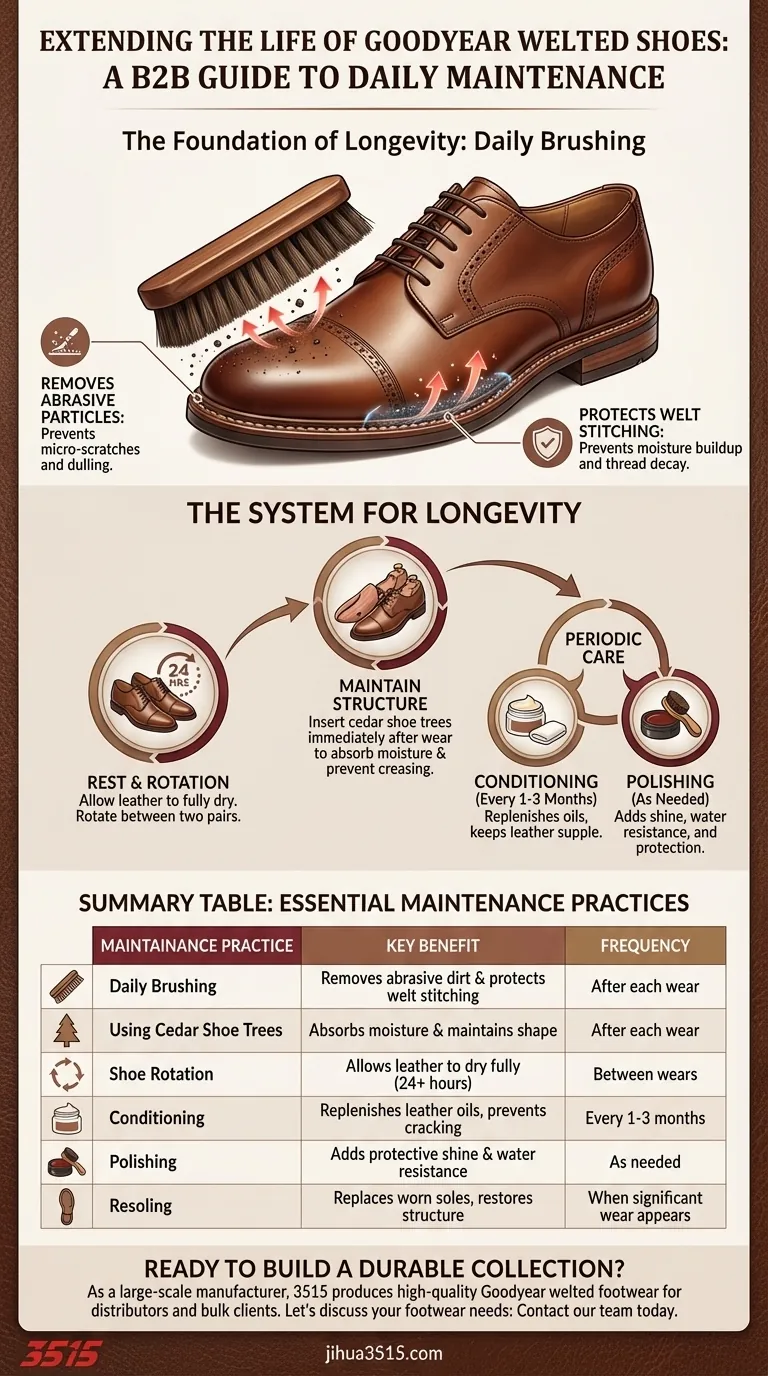
The "Why" Behind the Daily Brush
Brushing isn't just about appearance; it's a preventative measure that addresses the two primary enemies of fine footwear: abrasion and moisture buildup in critical areas.
Removing Abrasive Particles
Throughout the day, fine dust and grit settle on your shoes. These particles act like sandpaper, slowly creating micro-scratches that dull the finish and weaken the leather's surface over time. A quick brush-down with a horsehair brush lifts and removes these damaging particles before they can be ground into the leather.
Protecting the Welt Stitching
The Goodyear welt is the structural core of your shoe, and the exposed stitching is its most vulnerable point. Dirt and grime collect in this channel, holding moisture against the thread and accelerating its decay. Brushing this area clean ensures the stitching stays dry and strong, preserving the shoe's fundamental structure.
The System for Longevity
A daily habit is the start, but a complete care routine is what allows a Goodyear welted shoe to last for decades. This involves giving the shoe what it needs to recover after being subjected to the stress, heat, and moisture of a full day's wear.
The Critical Role of Rest and Rotation
Leather is a natural skin that absorbs moisture from your feet. It needs a full 24 hours to completely dry and release this moisture. Wearing the same pair of shoes every day prevents this process, leading to a breakdown of the leather fibers and lining. Rotating between at least two pairs is essential.
Maintaining Structure with Shoe Trees
As soon as you take your shoes off, you should insert a pair of unfinished cedar shoe trees. This is non-negotiable for long-term care. The trees absorb residual moisture, help the shoe retain its proper shape as it dries, and prevent the leather from curling or cracking.
Periodic Conditioning vs. Polishing
It's important to understand the difference between conditioning and polishing. They are not the same.
Conditioning with a shoe cream replenishes the natural oils in the leather, keeping it supple and preventing it from drying out and cracking. Think of it as moisturizing the skin of the shoe.
Polishing with a wax polish creates a protective barrier on the surface. It guards against scuffs and water while providing shine. Polishing without conditioning first is like painting over dry, cracked wood—it only hides the underlying problem.
Common Pitfalls to Avoid
Many well-intentioned owners shorten the life of their shoes by making a few common mistakes. Understanding these helps you protect your investment.
Forgetting the Shoehorn
Forcing your foot into a shoe collapses the heel counter, which is the rigid structural support at the back of the shoe. Once this structure is broken, it cannot be repaired. A shoehorn is a simple tool that completely prevents this damage.
Neglecting the Soles
The leather sole will wear down with use. Don't wait until you've worn a hole through it. Once the sole or heel shows significant wear, take your shoes to a reputable cobbler for replacement. This is the primary benefit of the Goodyear welt construction.
Improper Storage
When not in use, shoes should be stored in a cool, dry place away from direct sunlight or heat vents. Extreme temperatures can dry out and damage the leather. Storing them with shoe trees inside is always the best practice.
How to Apply This to Your Goal
Your maintenance routine can be tailored to your primary objective.
- If your primary focus is maximum longevity: Prioritize rotating your shoes and using cedar shoe trees after every single wear.
- If your primary focus is pristine appearance: Master a routine of brushing daily, conditioning monthly, and polishing as needed to maintain shine and protection.
- If your primary focus is simplicity: The two most impactful actions are brushing after each wear and always using shoe trees.
Ultimately, consistent care is the key to unlocking the true value of your Goodyear welted footwear.
Summary Table:
| Maintenance Practice | Key Benefit | Frequency |
|---|---|---|
| Daily Brushing | Removes abrasive dirt & protects welt stitching | After each wear |
| Using Cedar Shoe Trees | Absorbs moisture & maintains shape | After each wear |
| Shoe Rotation | Allows leather to dry fully (24+ hours) | Between wears |
| Conditioning | Replenishes leather oils, prevents cracking | Every 1-3 months |
| Polishing | Adds protective shine & water resistance | As needed |
| Resoling | Replaces worn soles, restores structure | When significant wear appears |
Ready to build a durable footwear collection that lasts?
As a large-scale manufacturer, 3515 produces a comprehensive range of high-quality Goodyear welted and other footwear for distributors, brand owners, and bulk clients. Our production capabilities encompass all types of durable shoes and boots built to withstand the test of time with proper care.
Let's discuss your footwear needs: Contact our team today to explore our catalog and manufacturing solutions.
Visual Guide
Related Products
- Durable Goodyear Welt Leather Work Boots for Wholesale & Private Label
- Wholesale Durable Leather Work Boots | 8-Inch Goodyear Welt Manufacturer
- Wholesale Durable & Breathable Training Shoes for Custom Brands
- Wholesale Breathable Training Shoes Custom Athletic Footwear Manufacturer
- Custom OEM Training Shoes Wholesale Manufacturer Durable & Breathable
People Also Ask
- What is the difference between full-grain and top-grain leather? Premium Material Guide for Boot Manufacturers
- What are the advantages of leather as an upper material for work boots? Unmatched Durability & Custom Comfort
- Why is it important to waterproof leather work boots? Protect Your Investment and Performance
- How should new leather work boots be broken in? A Guide to Comfort and Durability
- What are the advantages of leather uppers in work boots? Unmatched Durability & Protection