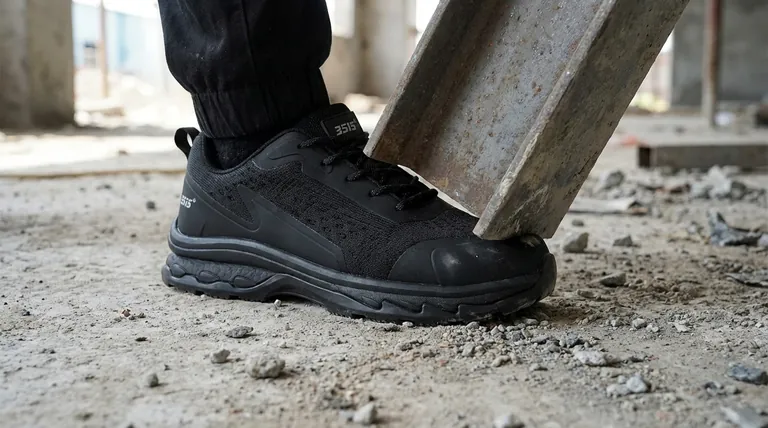
The most persistent myth about steel toe caps is the fear that a severe impact could cause the metal cap to bend or curl downwards, amputating the wearer's toes. This idea has been thoroughly and repeatedly debunked. Safety footwear is engineered specifically to prevent this type of failure, protecting the foot from compression and impact.
The fear of a steel toe cap causing amputation is a widespread urban legend. In reality, safety footwear is designed to withstand forces far greater than those that would cause catastrophic injury to an unprotected foot, making the cap a vital shield, not a potential liability.
Deconstructing the Amputation Myth
To understand why this myth is false, we need to look at the engineering and physics behind a safety toe cap. The fear comes from an intuitive, yet incorrect, understanding of how the component behaves under stress.
The Origin of the Fear
The myth imagines a heavy object striking the very edge of the steel cap, leveraging it downwards like a blade. This visual is powerful but does not reflect how the forces are distributed in a real-world impact.
The Reality of Impact Physics
A steel toe cap is a dome-shaped structure, one of the strongest shapes for resisting compression. When an object strikes the boot, the force is distributed across the entire cap. The steel is designed to dent, deform, or flatten under extreme load, but not to curl into a sharp, cutting edge.
What Safety Standards Mandate
Safety boots are not simply shoes with a piece of metal inserted. They must meet rigorous safety standards (like those from ASTM International) that specify minimum requirements for impact and compression resistance. These tests ensure the cap can withstand tremendous force without the type of catastrophic failure the myth describes.
How Steel Toe Caps Actually Behave Under Extreme Force
While the amputation scenario is a myth, it's fair to ask what happens when a force exceeds the boot's safety rating. The failure mode is predictable and still far safer than wearing no protection.
Failure by Compression, Not Amputation
If an object is heavy enough to overcome the boot's structural integrity, the steel cap will collapse. This would result in a severe crushing injury. However, the same force applied to an unprotected foot would cause an even more devastating and immediate crushing injury.
The Overwhelming Protective Advantage
The myth distracts from the primary function of safety footwear: protecting you from common workplace hazards. For the vast majority of incidents—like dropped tools, falling construction materials, or rolling carts—the steel toe cap prevents injury entirely. It absorbs and deflects forces that would easily break bones in an unprotected foot.
Common Misconceptions to Avoid
The durability of this myth often stems from a lack of trust in the engineering behind personal protective equipment (PPE). Understanding the reality helps in making informed decisions about safety.
Focusing on an Impossible Scenario
Worrying about the amputation myth is like refusing to wear a seatbelt for fear it might trap you in a burning car. While incredibly rare entrapment scenarios exist, the daily, proven benefit of preventing ejection in a crash far outweighs the negligible risk. The same logic applies to steel toe caps.
Confusing Steel with Other Materials
Modern safety footwear also includes composite toe caps (made from materials like carbon fiber, plastic, or Kevlar). While these also meet safety standards, they have different properties. They are lighter and don't conduct electricity or temperature, but steel generally offers the highest absolute protection against extreme impact and compression. The amputation myth, however, is equally false for both types.
Making the Right Choice for Your Safety
Your choice of safety footwear should be based on the specific hazards of your environment, not on unfounded fears.
- If your primary focus is maximum impact resistance: Trust in the proven engineering of certified steel toe boots, which are designed to withstand tremendous forces.
- If you are worried about the amputation myth: Understand that this fear is not supported by evidence. The cap is designed to deform safely under loads that would otherwise guarantee severe injury.
- If you work in environments with electrical hazards or extreme temperatures: Consider certified composite toe boots, which provide robust protection without the conductivity of metal.
Ultimately, certified safety footwear is a critical piece of equipment engineered to prevent the very injuries that myths claim it can cause.
Summary Table:
| Myth vs. Reality | Key Takeaway |
|---|---|
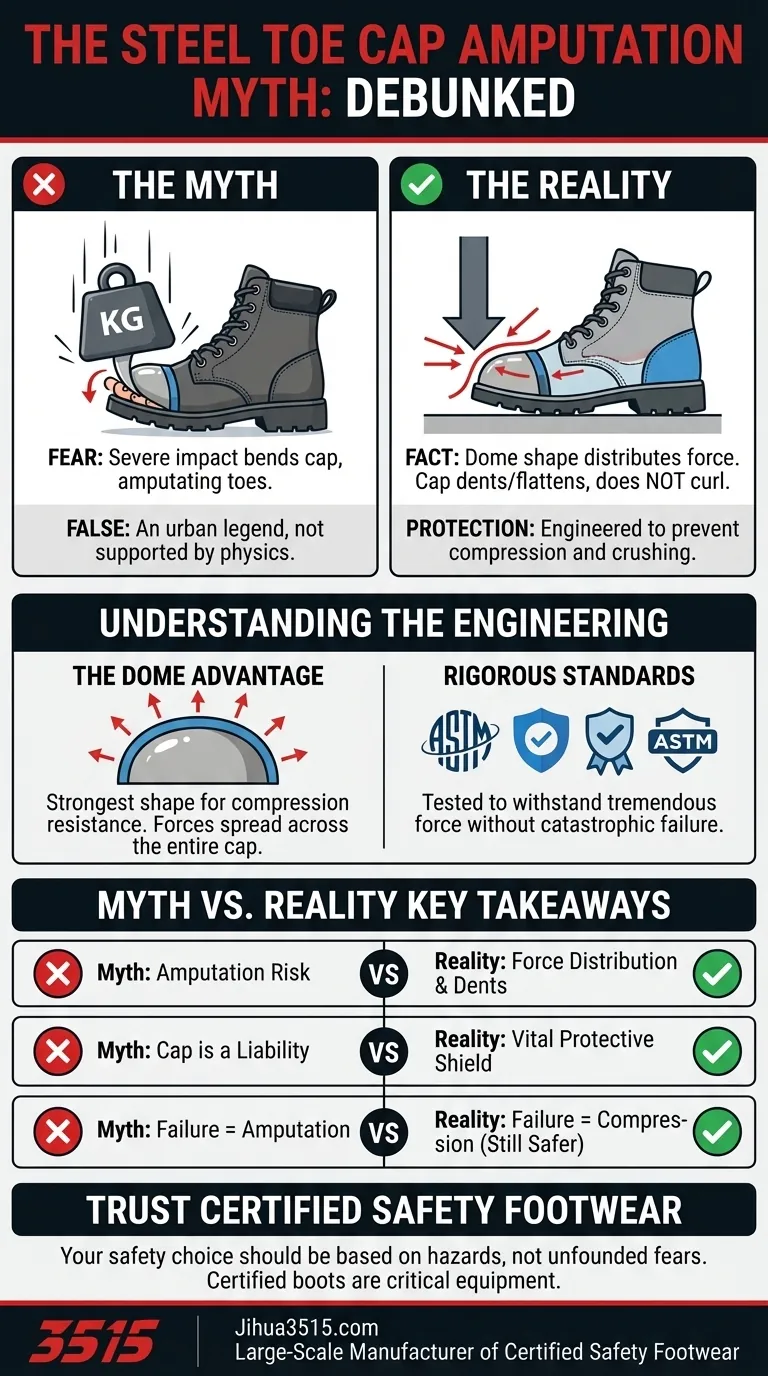
| Myth: A severe impact can bend the cap, amputating toes. | Reality: The cap's dome shape distributes force, causing it to dent or flatten, not curl. |
| Myth: The steel cap is a liability. | Reality: It's a vital shield, tested to withstand forces far greater than an unprotected foot can endure. |
| Myth: Failure leads to amputation. | Reality: Failure results in compression, which is still safer than no protection at all. |
Need Reliable, Certified Safety Footwear? Partner with 3515, a Large-Scale Manufacturer.
As a leading manufacturer, 3515 produces a comprehensive range of certified safety boots and shoes for distributors, brand owners, and bulk clients. Our production capabilities encompass all types of industrial footwear, engineered to meet rigorous international safety standards and protect workers from real-world hazards.
We ensure maximum impact resistance and durability, so you can provide your customers with confidence. Contact 3515 today to discuss your safety footwear needs and benefit from our large-scale manufacturing expertise.
Visual Guide
Related Products
- Premium Suede Sport Safety Shoes for Wholesale & Bulk Orders
- Premium Lightweight Safety Shoes for Wholesale & Bulk Orders
- Wholesale Anti-Smash & Puncture-Proof Safety Shoes Custom Manufacturing for Brands
- Premium KPU Injection Athletic Style Safety Shoes
- Premium Safety Shoes with Rotating Buckle Safety Sneakers
People Also Ask
- What industries have specific OSHA footwear requirements? Ensure Compliance & Protect Your Workforce
- What are the primary functions of professional safety shoes? Maximize Safety in Water Supply Confined Spaces
- What role do specialized safety shoes play in preventing falls? Engineering Stability in Industrial Environments
- What are the main safety features of S1-S5 shoes? The 3 Essential Protections Explained
- What core functions do professional safety shoes serve? Enhance Construction & Industrial Safety Standards