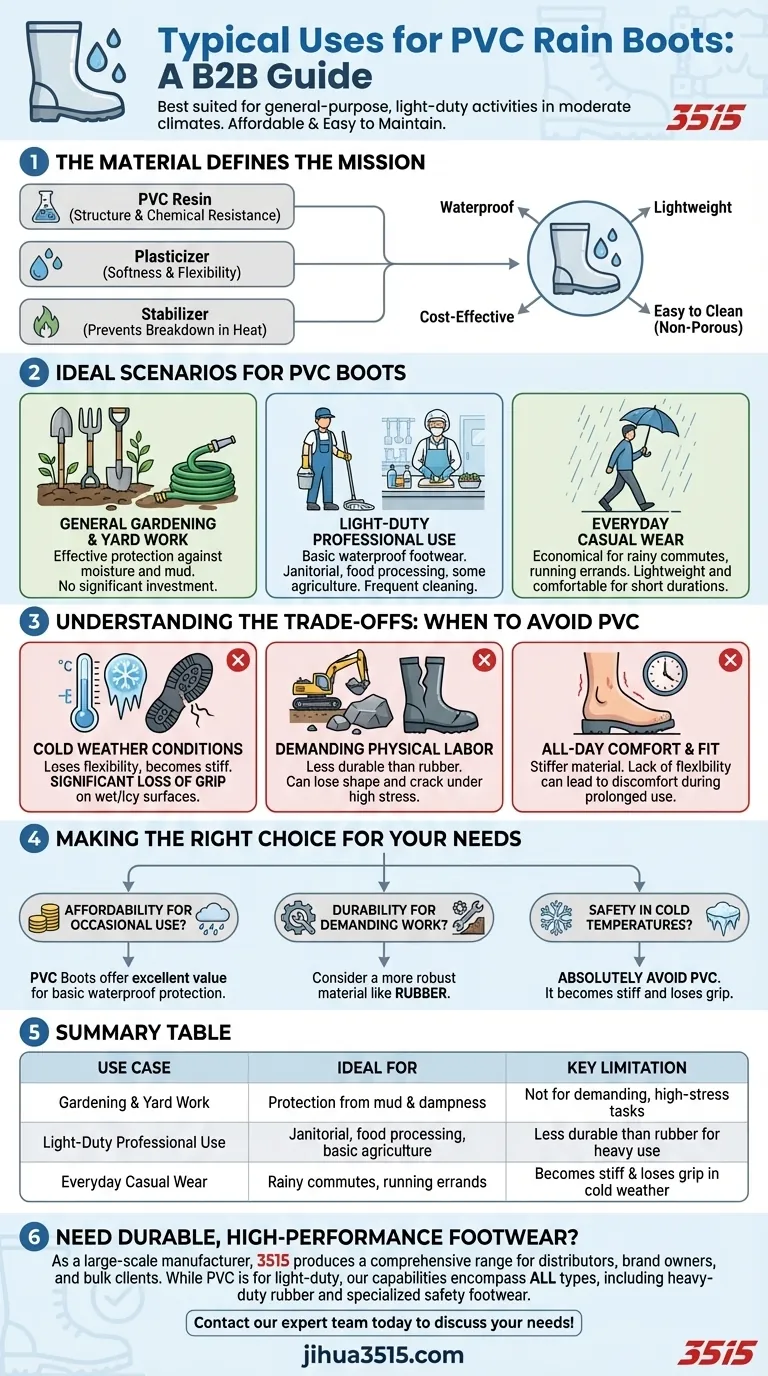
The definitive answer is that PVC rain boots are best suited for general-purpose, light-duty activities in moderate climates where basic, affordable waterproof protection is the primary goal. Their use is defined as much by their strengths—low cost and ease of maintenance—as by their limitations in cold weather and demanding environments.
While PVC boots provide an excellent economical and lightweight waterproof solution, their ideal use case is dictated by their material limitations. Understanding these trade-offs is crucial for avoiding poor performance in cold or high-stress conditions.
The Material Defines the Mission
To understand why PVC boots are used for specific tasks, we must first look at their composition. They are not simply "plastic" but a carefully formulated material with distinct properties.
The Core Components
PVC boots are primarily made from polyvinyl chloride (PVC) resin, which provides the fundamental structure and chemical resistance.
This resin is mixed with a plasticizer to increase softness and flexibility, along with a stabilizer to prevent the material from breaking down during the high-heat manufacturing process.
Other additives, like colorants or fillers, can be included to meet specific design requirements.
The Resulting Characteristics
This formulation results in a boot that is inherently waterproof, lightweight, and cost-effective to produce.
Because the material is non-porous and smooth, PVC boots are also exceptionally easy to clean and maintain, making them a practical choice.
Ideal Scenarios for PVC Boots
The properties of PVC make it a perfect fit for a clear set of applications where its benefits shine and its weaknesses are not a factor.
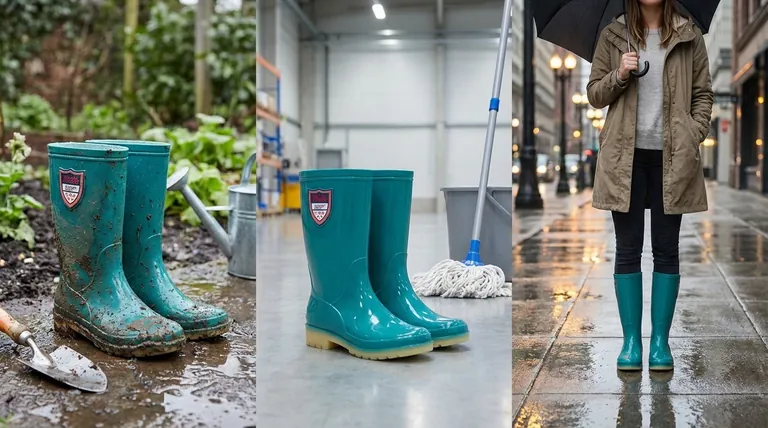
General Gardening and Yard Work
For tasks like working in a damp garden, mowing a wet lawn, or washing a car, PVC boots provide effective protection against moisture and mud without a significant investment.
Light-Duty Professional Use
They are a common choice in jobs requiring basic waterproof footwear but not extreme durability. This includes certain agricultural tasks, janitorial work, and food processing environments where frequent cleaning is necessary.
Everyday Casual Wear
As an economical option for rainy day commutes or running errands, PVC boots keep your feet dry for short durations. Their lightweight nature makes them more comfortable for casual walking than heavier, more rugged boots.
Understanding the Trade-offs: When to Avoid PVC
The same material properties that make PVC boots ideal for some situations make them unsuitable for others. This is not a failure of the boot, but a limitation of the material itself.
Cold Weather Conditions
The most significant limitation of PVC is its performance in the cold. As temperatures drop, the material loses flexibility and becomes stiff, which can be uncomfortable and restrictive.
Crucially, the sole also hardens, leading to a significant loss of grip on wet or icy surfaces, creating a potential safety hazard.
Demanding Physical Labor
While suitable for light work, standard PVC boots are less durable than rubber counterparts. Over time and with heavy use, they can lose their original shape and are more prone to cracking or splitting under high stress.
All-Day Comfort and Fit
PVC is generally a stiffer material than rubber. For individuals on their feet all day, this lack of flexibility can lead to less comfort compared to boots made from more pliable materials that conform better to the foot.
Making the Right Choice for Your Needs
Selecting the right boot requires matching the tool to the task. PVC's value is in its practicality for specific, non-demanding environments.
- If your primary focus is affordability for occasional use: PVC boots offer excellent value for basic waterproof protection in moderate weather.
- If your primary focus is durability for demanding work: You should consider a more robust and flexible material like rubber, as PVC can lose shape and break down under stress.
- If your primary focus is safety in cold temperatures: Absolutely avoid PVC, as it becomes stiff and loses its grip, making it unsuitable for snow or ice.
Ultimately, choosing the right boot means matching the material's inherent properties to the demands of your specific environment.
Summary Table:
| Use Case | Ideal For | Key Limitation |
|---|---|---|
| Gardening & Yard Work | Protection from mud and dampness | Not for demanding, high-stress tasks |
| Light-Duty Professional Use | Janitorial, food processing, basic agriculture | Less durable than rubber for heavy use |
| Everyday Casual Wear | Rainy commutes, running errands | Becomes stiff and loses grip in cold weather |
Need Durable, High-Performance Footwear for Your Business?
As a large-scale manufacturer, 3515 produces a comprehensive range of footwear for distributors, brand owners, and bulk clients. While PVC boots are perfect for light-duty applications, our production capabilities encompass all types of shoes and boots, including heavy-duty rubber and specialized safety footwear designed for demanding environments and extreme conditions.
Let us help you find or create the perfect footwear solution for your market. Contact our expert team today to discuss your needs!
Visual Guide
Related Products
- Durable Waterproof Rain Boots | Custom Manufacturer for Wholesale & Brands
- Factory Direct Wholesale Rain Boots Durable Waterproof & Fully Customizable
- Premium Wholesale Waterproof Safety Boots High Performance Protection for Industrial Markets
- High Performance Fire-Retardant Waterproof Safety Boots
- Wholesale Waterproof Tactical Boots Custom Suede & High-Traction Soles
People Also Ask
- What are the main materials for waterproof rain boots? Choose the Right Material for Durability & Comfort
- What is the overall recommendation for choosing rain boot materials? A Guide to Rubber vs. PVC
- How does boot height affect waterproofing? Choose the Right Height for Ultimate Protection
- Why are rain boots more flexible and comfortable than snow boots? The Key Differences Explained
- What are the best types of shoes for different gardening conditions? Find Your Perfect Match.