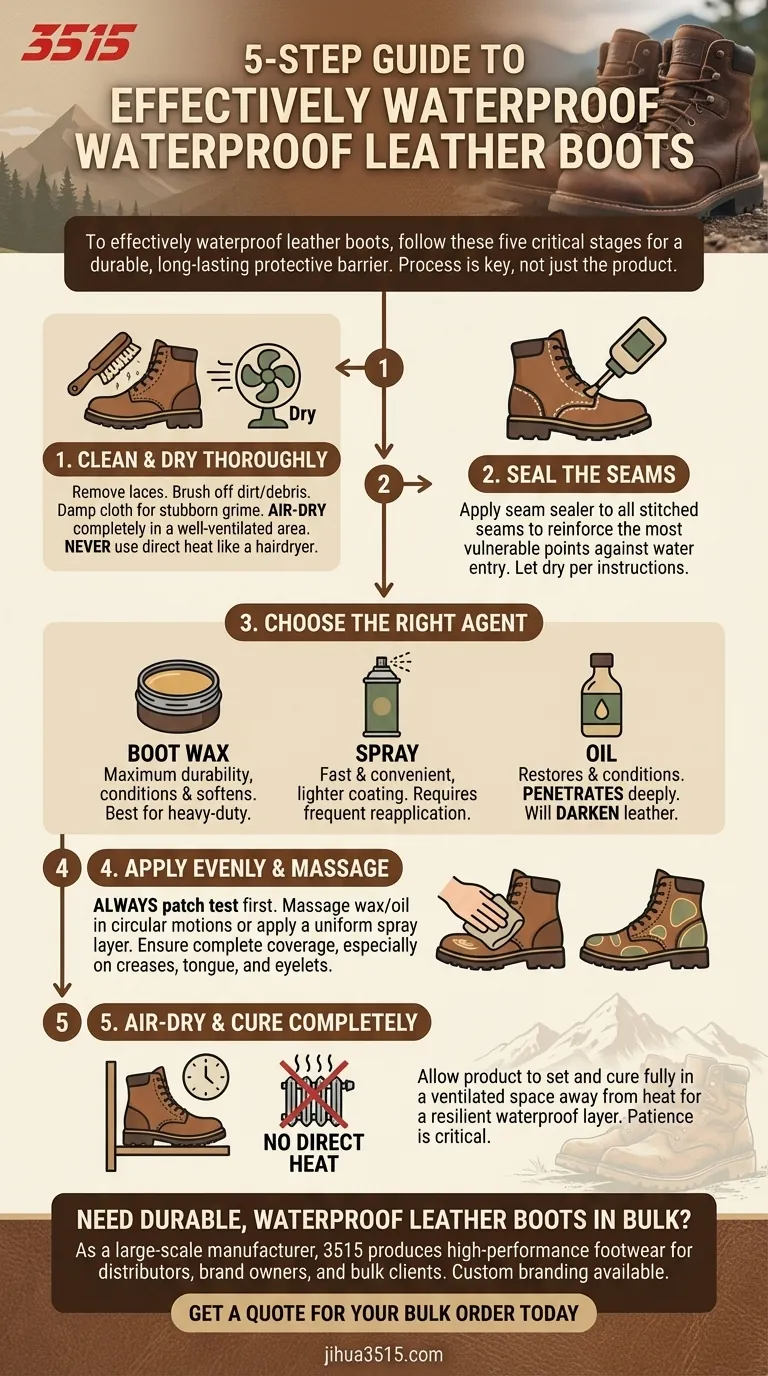
To effectively waterproof leather boots, the process involves five critical stages: thoroughly cleaning and drying the boots, sealing the seams, applying the appropriate waterproofing agent evenly across all surfaces, and allowing the boots to cure completely without direct heat. This systematic approach ensures the treatment penetrates the leather and forms a durable, protective barrier.
The key to truly waterproof boots isn't a single magic product, but a methodical process. Proper preparation of the leather and correct application of the right agent are far more important than the brand you choose.
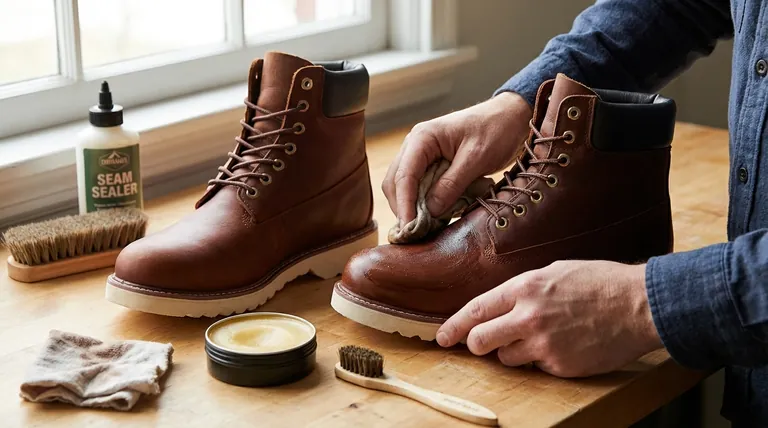
The Foundational Step: Preparation is Non-Negotiable
Before you apply any waterproofing product, the leather must be in the ideal state to receive it. Skipping this stage is the most common reason for treatment failure.
Start with a Thorough Cleaning
First, remove the laces to ensure you can access the entire boot, including the tongue.
Use a brush to knock off any loose dirt, mud, or debris. For more stubborn grime, a damp cloth may be necessary, but avoid soaking the leather.
Ensure the Boots are Completely Dry
Applying a waterproofing agent to damp leather will trap moisture inside, which can lead to material degradation and odor.
Allow the boots to air-dry completely in a warm, well-ventilated area. You can use a fan to speed up the process, but never use a direct heating element like a hairdryer or radiator, as this can cause the leather to crack and become brittle.
Choosing Your Waterproofing Agent
The right product depends on your needs for durability, convenience, and leather conditioning. Each type offers distinct advantages.
Boot Wax for Maximum Durability
Wax provides a robust, long-lasting physical barrier against moisture. It also conditions and softens the leather, preventing the stiffness and cracking that can occur over time. This is the best choice for heavy-duty work or hiking boots.
Sprays for Convenience
Spray-on treatments are the fastest and easiest to apply. However, they create a lighter, less durable coating that will require more frequent reapplication compared to wax.
Oils for Conditioning and Protection
Oils are excellent for restoring and protecting leather, as they penetrate deeply to condition the fibers. Be aware that oils will almost always darken the leather, so a patch test is essential.
Seam Sealer for Reinforcing Weak Points
The stitched seams are often the most vulnerable points for water entry. A dedicated seam sealer can be applied to these specific areas to reinforce them against leaks.
The Application Process: A Step-by-Step Guide
With your boots prepared and your product selected, a careful and methodical application will yield the best results.
Always Perform a Patch Test
Before covering your entire boot, apply a small amount of the product to an inconspicuous area, like the inner side of the ankle. This ensures it won't cause any undesirable discoloration.
Apply Seam Sealer First
If you are using a seam sealer, apply it now along all stitched seams. This creates a primary waterproof barrier at the boot's weakest points. Let it dry according to the product instructions.
Apply the Main Waterproofing Product
Using a clean rag, apply the wax or oil in a circular motion, massaging it into the leather. Work in small sections to ensure you get a consistent, even coat. For sprays, hold the can at the recommended distance and apply a uniform layer.
Ensure Complete and Even Coverage
Pay special attention to high-flex areas, creases, the tongue, and around the eyelets. It's common to apply one to two coats for full protection, but always check the product's specific instructions.
Allow for Proper Curing
Let the boots dry and cure completely in a well-ventilated space, away from direct heat. This allows the product to set properly, forming a resilient waterproof layer. Patience here is critical for longevity.
Understanding the Trade-offs
Choosing a waterproofing method involves balancing protection, effort, and aesthetic impact.
Durability vs. Convenience
Wax-based treatments offer superior durability but require more time and effort to apply. Sprays are fast and easy but offer less protection and require more frequent touch-ups.
Altering the Leather's Appearance
Oils and some waxes will change the look of your boots, typically making the leather darker. If maintaining the original color is a high priority, a silicone-based spray may be a better, albeit less durable, option.
The Risk of Improper Drying
As mentioned, using direct heat to dry your boots is the fastest way to ruin them. High heat breaks down the leather's natural oils, leading to a stiff, brittle material that is prone to cracking.
Making the Right Choice for Your Boots
Select your method based on how you use your boots and the level of protection you need.
- If your primary focus is maximum protection for rugged use: Use a combination of seam sealer followed by a high-quality boot wax for the most durable barrier.
- If your primary focus is quick maintenance for casual wear: A spray-on treatment is a suitable choice, but be prepared for frequent reapplication to maintain protection.
- If your primary focus is conditioning older, dry leather: A conditioning oil is an excellent option, but only if you are comfortable with it darkening the material.
Properly treating your boots transforms them from a simple purchase into a long-term, reliable investment in comfort and protection.
Summary Table:
| Step | Key Action | Purpose |
|---|---|---|
| 1. Preparation | Clean & Dry Boots Thoroughly | Creates an ideal surface for the waterproofing agent to adhere. |
| 2. Seam Sealing | Apply Seam Sealer to Stitches | Reinforces the boot's most vulnerable points against water entry. |
| 3. Product Selection | Choose Wax, Spray, or Oil | Matches the protection level to your boot's use and your needs. |
| 4. Application | Apply Evenly, Massage In | Ensures complete coverage and deep penetration into the leather. |
| 5. Curing | Air-Dry Completely | Allows the product to set properly for a durable, resilient barrier. |
Need to Source Durable, Waterproof Leather Boots in Bulk?
As a large-scale manufacturer, 3515 produces a comprehensive range of high-performance footwear for distributors, brand owners, and bulk clients. Our production capabilities encompass all types of durable boots, ready for your custom branding.
Let us help you provide your customers with superior quality: Get a Quote for Your Bulk Order Today
Visual Guide
Related Products
- Premium Oil Wax Leather Safety Boots for Bulk Purchase
- Premium Wholesale Waterproof Safety Boots High Performance Protection for Industrial Markets
- Premium Waterproof Nubuck Safety Boots for Wholesale
- Wholesale Premium Waterproof Nubuck Safety Shoes Boots
- Wholesale Waterproof Tactical Boots Custom Suede & High-Traction Soles
People Also Ask
- What materials are commonly used for outsoles in safety boots? A Guide to Durability, Grip, and Comfort
- How do safety boots reduce cutting hazards? Essential Protection for Your Workforce
- What are the common types of safety boots and their primary uses? A Guide to Industrial Footwear
- Which organizations develop safety standards for work boots? Ensure Compliance & Worker Safety
- What primary protective functions do professional safety boots provide in urban solid waste recovery and waste picking processes? Discover Dual-Layer Protection.