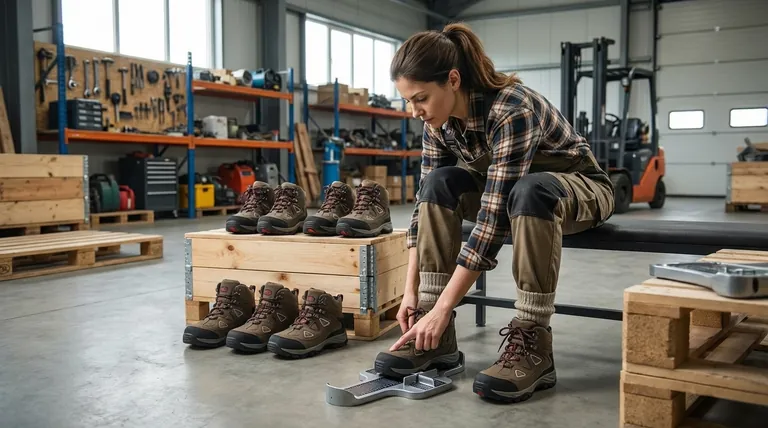
Finding the correct fit for a women's work boot is a matter of safety, not just comfort. To get an accurate fit, you must measure your feet at the end of the day when they are most swollen. When trying on boots, wear the exact socks you use for work, ensure there is about a centimeter of space between your longest toe and the end of the boot, and confirm your heel is locked in place without slipping or rubbing.
A properly fitting work boot goes beyond standard shoe sizing. It requires a systematic check for toe space, heel lock, and arch alignment, all while considering the specific demands of your job to prevent injury and ensure day-long support.
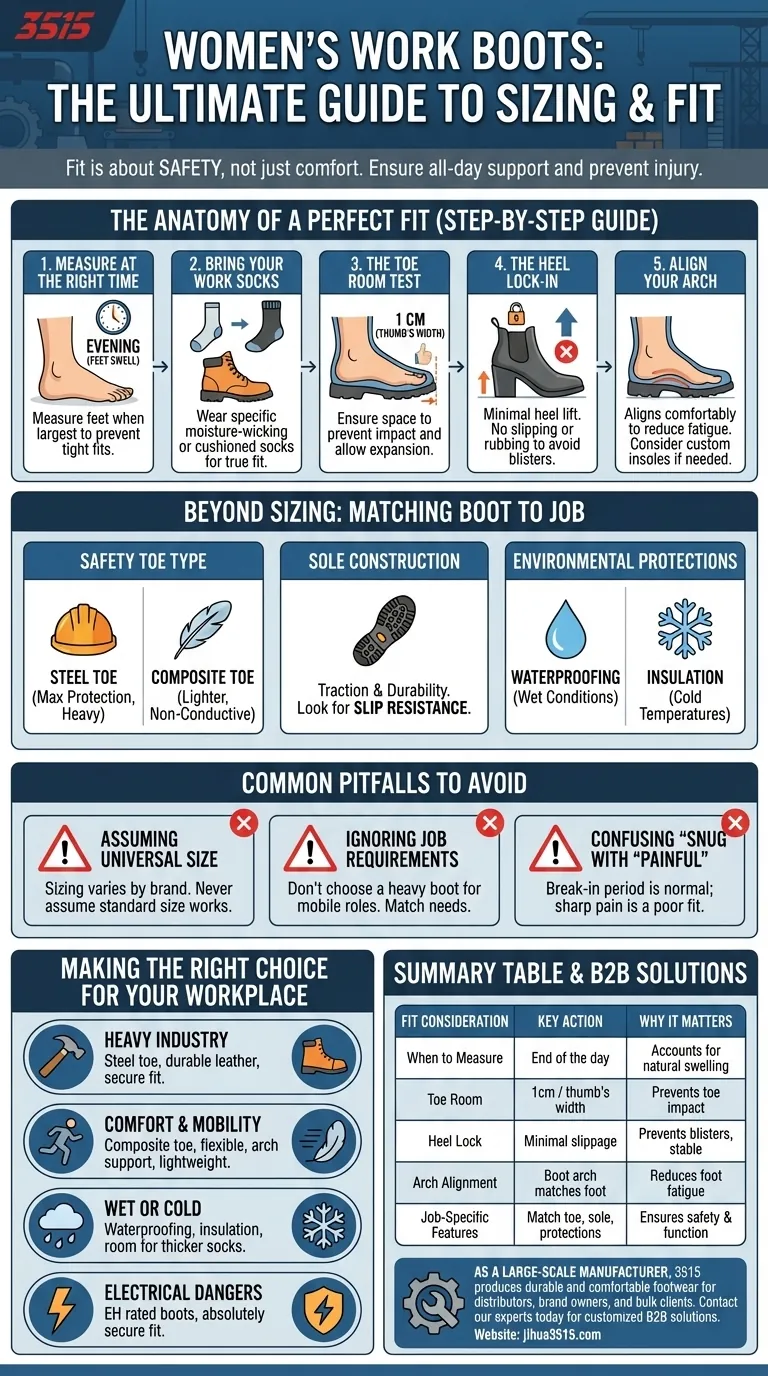
The Anatomy of a Perfect Fit: A Step-by-Step Guide
Achieving the right fit is a methodical process. Each step ensures that the boot will support you correctly through long hours, varied terrain, and demanding tasks.
Measure at the Right Time
Your feet naturally swell throughout the day due to activity and gravity. Measuring them in the evening ensures you are fitting for their largest size, preventing a fit that becomes painfully tight by the afternoon.
Bring Your Work Socks
The thickness of your socks directly impacts the boot's internal volume. Always try on boots with the specific moisture-wicking or cushioned socks you will be wearing on the job to get a true-to-life fit.
The Toe Room Test
You should have about a centimeter (roughly a thumb's width) of space between your longest toe and the front of the boot. This prevents your toes from hitting the end of the boot, especially when walking downhill, and accommodates natural foot expansion.
The Heel Lock-In
When you walk, your heel should not lift or slide up and down excessively. A small amount of movement is normal, but significant heel slip is a primary cause of blisters and instability. A secure heel is critical for support.
Align Your Arch
The arch of the boot should align comfortably with the natural arch of your foot. Improper arch support is a leading cause of foot fatigue and pain. If the built-in support is inadequate, consider using custom insoles.
Beyond Sizing: Matching the Boot to the Job
A perfect fit is meaningless if the boot's features don't match your work environment. Sizing and function are two halves of the same whole.
Safety Toe Type
Your choice of safety toe balances protection and weight. Steel toes offer maximum protection for heavy industry, while composite toes are lighter and don't conduct cold, making them ideal for jobs requiring more mobility or outdoor work.
Sole Construction
The sole determines your boot's traction and durability. Look for features like slip resistance for slick surfaces and durable construction that can withstand the specific hazards of your workplace.
Environmental Protections
Consider the conditions you face daily. Waterproofing is essential for wet environments, while insulation is critical for cold temperatures. These features protect you from the elements and keep you comfortable and productive.
Common Pitfalls to Avoid
Even with the right information, common mistakes can lead to a poor choice. Being aware of these pitfalls is crucial for making a confident investment in your safety.
Assuming Your Size is Universal
Work boot sizing can vary dramatically between brands. Never assume your standard shoe size will translate directly. Always try on the specific boot you intend to buy.
Ignoring Your Specific Job Requirements
Don't choose a heavy-duty boot designed for construction if you work in a role that requires constant walking and flexibility. The right boot provides the necessary protection without adding unnecessary weight or restricting motion.
Confusing "Snug" with "Painful"
A new boot, especially one made of leather, will have a break-in period. It should feel snug and secure, but it should never cause sharp pain or create significant pressure points right out of the box. Pain is a sign of a poor fit, not a boot that needs breaking in.
Making the Right Choice for Your Workplace
Your final decision should be guided by the primary demands of your role.
- If your primary focus is maximum protection in heavy industry: Prioritize a steel toe and durable leather construction, ensuring a snug fit with no internal movement.
- If your primary focus is all-day comfort and mobility: Look for composite toes and flexible materials, paying close attention to arch support and lightweight construction.
- If your primary focus is working in wet or cold conditions: Make waterproofing and proper insulation your top criteria, ensuring there's still enough room for thicker socks without cramping your toes.
- If your primary focus is protection from electrical dangers: Select boots explicitly rated for Electrical Hazard (EH) and verify the fit is absolutely secure.
Ultimately, the right work boot becomes an extension of your body, providing the confidence and protection you need to focus on the task at hand.
Summary Table:
| Fit Consideration | Key Action | Why It Matters |
|---|---|---|
| When to Measure | Measure feet at the end of the day. | Accounts for natural swelling for a comfortable all-day fit. |
| Toe Room | Ensure a thumb's width of space. | Prevents toe impact and accommodates foot expansion. |
| Heel Lock | Check for minimal heel slippage. | Prevents blisters and ensures stability. |
| Arch Alignment | Boot arch should align with your foot's arch. | Reduces foot fatigue and provides proper support. |
| Job-Specific Features | Match safety toe, sole, and protections to your work. | Ensures the boot provides necessary safety and functionality. |
Ready to find the perfect-fitting work boot for your team?
As a large-scale manufacturer, 3515 produces a comprehensive range of durable and comfortable footwear for distributors, brand owners, and bulk clients. Our production capabilities encompass all types of safety boots and shoes, ensuring you get the right fit and features for any job requirement.
We can help you equip your workforce with boots that provide superior safety, all-day comfort, and job-specific performance. Contact our experts today to discuss your bulk order needs and receive a customized solution.
Visual Guide
Related Products
- Wholesale Leather Work Boots with Customizable Wedge Sole for Brands
- Durable Leather Work Boots for Wholesale & Custom Manufacturing
- Durable Leather Moc Toe Work Boots for Wholesale & Custom Manufacturing
- Durable Leather Work Boots for Wholesale & Custom OEM Manufacturing
- Durable Moc-Toe Wedge Work Boots | Wholesale Manufacturing for Brands
People Also Ask
- What is the difference between full-grain and top-grain leather? Premium Material Guide for Boot Manufacturers
- What are the advantages of leather as an upper material for work boots? Unmatched Durability & Custom Comfort
- How can leather work boots be protected from environmental elements? A 3-Step Guide to Lasting Durability
- What is the complete process for deep cleaning leather work boots? A Step-by-Step Guide to Preserve Your Investment
- What are the key qualities of leather for work boots? Superior Durability, Breathability & Custom Fit