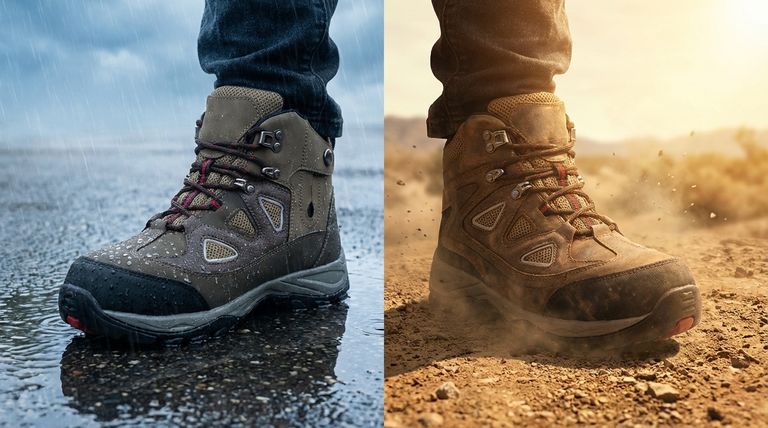
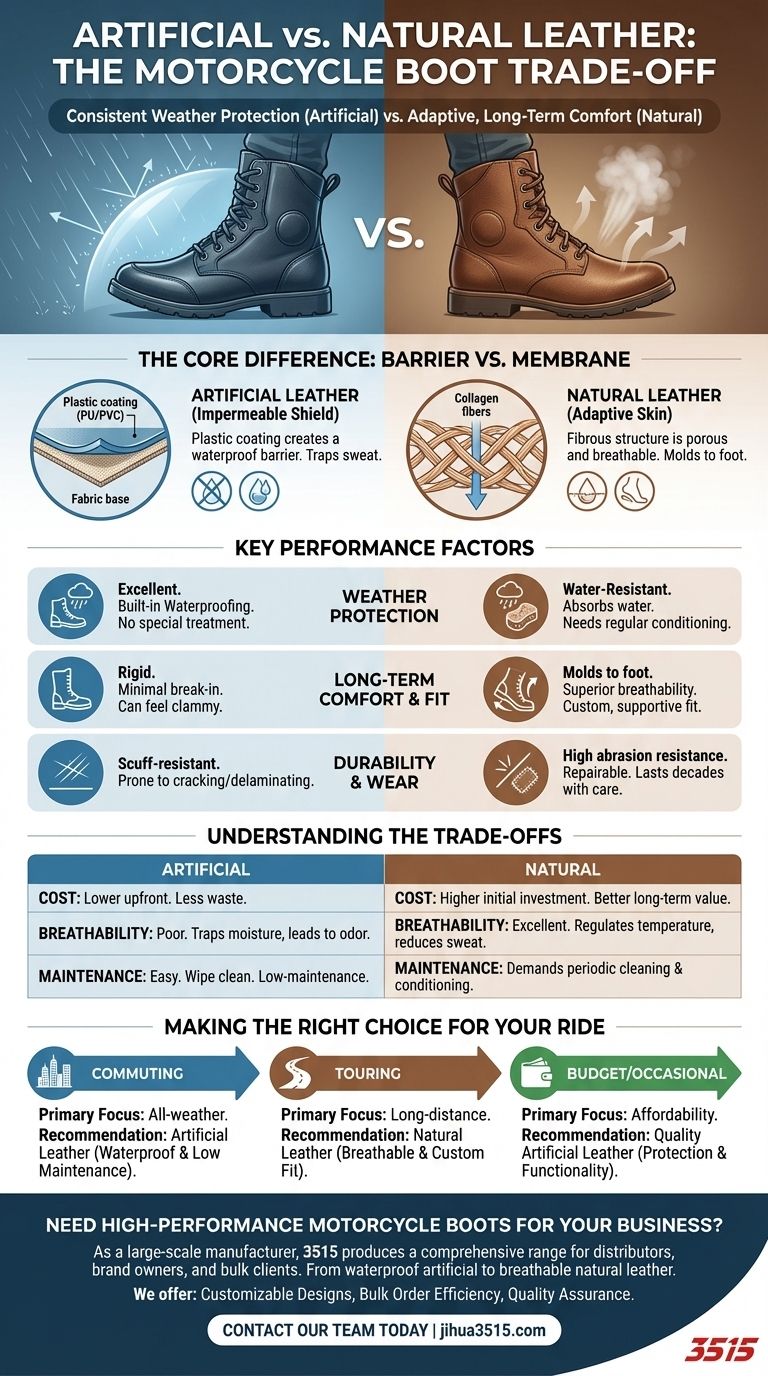
Choosing between artificial and real leather for motorcycle boots involves a direct trade-off between consistent weather protection and long-term, adaptive comfort. Artificial leather excels with its lower cost and inherent waterproof qualities, making it a practical choice for many riders. However, this comes at the significant cost of breathability, which can lead to discomfort and odor on longer or warmer rides.
The core decision hinges on a simple principle: artificial leather acts as a non-breathable barrier, while real leather functions as a breathable, adaptive skin. Understanding this fundamental difference is the key to selecting the right boot for your specific riding needs.
The Core Material Difference: Barrier vs. Membrane
To make an informed choice, you must first understand how each material functions at a microscopic level. Their properties are not arbitrary; they are a direct result of their composition.
Artificial Leather: The Impermeable Shield
Artificial leather is a synthetic product, typically a fabric base coated with a layer of plastic like polyurethane (PU) or polyvinyl chloride (PVC).
This plastic coating creates an impermeable barrier. It effectively seals the boot from external moisture, which is why it provides excellent, out-of-the-box water resistance.
However, this barrier works both ways. It also prevents moisture vapor (sweat) from escaping, trapping it inside the boot.
Natural Leather: The Adaptive Skin
Natural leather is processed animal hide, a biological material composed of a complex web of collagen fibers.
This fibrous structure is naturally porous, allowing it to function like a breathable membrane. It allows water vapor to pass through, keeping your foot drier and more comfortable.
Over time, heat and pressure cause these fibers to shift and mold, allowing the boot to conform perfectly to the unique shape of your foot.
Key Performance Factors for Riders
How do these material properties translate to performance on the road? The answer depends entirely on the conditions you face.
Weather Protection
For riders who frequently encounter rain, artificial leather offers a clear advantage. Its waterproof nature is built-in and requires no special treatment.
Natural leather, by contrast, is water-resistant but not waterproof. It will absorb water unless it is regularly treated with conditioning oils or waxes, which adds a maintenance requirement.
Long-Term Comfort and Fit
This is where natural leather excels, particularly for touring or all-day riding. Its ability to breathe is critical for regulating temperature and managing sweat, preventing the clammy, uncomfortable feeling common with synthetic boots.
Furthermore, leather's ability to break in and conform to your foot provides a customized, supportive fit that simply cannot be replicated by rigid plastic materials.
Durability and Wear
Both materials are marketed as durable, but they degrade differently. Natural leather is renowned for its high abrasion resistance and, if cared for, can last for decades. It can also be repaired by a cobbler.
Artificial leather is highly resistant to scuffs and flexing, but it can be prone to cracking or delaminating over time, especially with exposure to sun and heat. Once the plastic layer is compromised, it is very difficult to repair effectively.
Understanding the Trade-offs
Neither material is perfect. Acknowledging their inherent limitations is crucial for avoiding buyer's remorse.
The Cost Equation
Artificial leather is significantly cheaper to produce. The raw materials are less expensive, and manufacturing processes result in less material waste (5-15% for real leather). This makes synthetic boots the clear winner for upfront affordability.
However, a high-quality, well-maintained pair of leather boots can outlast several pairs of synthetic ones, potentially offering better value over the long term.
The Breathability Problem
The single greatest drawback of artificial leather is its lack of breathability. For short trips or commutes, this may be a non-issue.
For long tours, rides in hot climates, or for riders whose feet tend to sweat, this can become a major source of discomfort, blisters, and odor.
Maintenance and Care
Artificial leather is praised for its ease of care—simply wipe it clean. This is a significant advantage for riders who want a low-maintenance solution.
Natural leather demands periodic cleaning and conditioning to keep it supple and water-resistant. Neglecting this care will cause it to dry out, crack, and lose its protective qualities.
Making the Right Choice for Your Ride
Your ideal boot material depends entirely on your riding style, climate, and priorities.
- If your primary focus is all-weather commuting: Artificial leather's built-in waterproofing and low maintenance make it the most practical choice.
- If your primary focus is long-distance touring: Natural leather's superior breathability and ability to mold to your foot will provide unmatched comfort over many hours and miles.
- If your primary focus is budget and occasional riding: A quality artificial leather boot offers excellent protection and functionality without the high initial investment.
Ultimately, the best boot is not defined by its material alone, but by how well that material's inherent properties align with the demands of your specific journey.
Summary Table:
| Factor | Artificial Leather | Natural Leather |
|---|---|---|
| Weather Protection | Excellent, built-in waterproofing | Water-resistant, requires maintenance |
| Breathability | Poor, traps moisture | Excellent, allows sweat to escape |
| Long-Term Comfort | Rigid, minimal break-in | Molds to foot for a custom fit |
| Durability | Resists scuffs, may crack/delaminate | High abrasion resistance, can be repaired |
| Cost & Maintenance | Lower upfront cost, easy to wipe clean | Higher initial cost, requires conditioning |
Need High-Performance Motorcycle Boots for Your Business?
As a large-scale manufacturer, 3515 produces a comprehensive range of footwear for distributors, brand owners, and bulk clients. Our production capabilities encompass all types of motorcycle boots, allowing you to source the perfect product—whether your customers prioritize the waterproof reliability of artificial leather or the breathable comfort of natural leather.
We offer:
- Customizable Designs: Tailor boots to your brand's specifications.
- Bulk Order Efficiency: Benefit from our large-scale manufacturing expertise.
- Quality Assurance: Durable construction built to meet rider demands.
Let's discuss your specific needs and how we can deliver the right boots for your market. Contact our team today for a consultation!
Visual Guide
Related Products
- High Performance Fire-Retardant Waterproof Safety Boots
- Premium High-Cut Waterproof Safety Boots Manufacturing & Wholesale Solutions
- Wholesale Tactical Boots High-Traction & Reflective for Bulk & Brand Orders
- Durable Goodyear Welt Leather Work Boots for Wholesale & Private Label
- Wholesale High-Traction Camo Boots - Custom Manufacturer for Brands
People Also Ask
- Why are waterproof safety boots recommended for certain work environments? Essential Protection for Wet & Hazardous Jobs
- What roles do 3D vision systems and industrial robots play in the manufacturing of fire safety boots? Smart Automation
- What is the advantage of one-piece construction in waterproof boots? Unbeatable Seamless Protection
- What materials make waterproof boots durable? The Ultimate Guide to Long-Lasting Footwear
- What is the difference between waterproof, water-resistant, and water-repellent boots? Choose the Right Protection for Your Feet