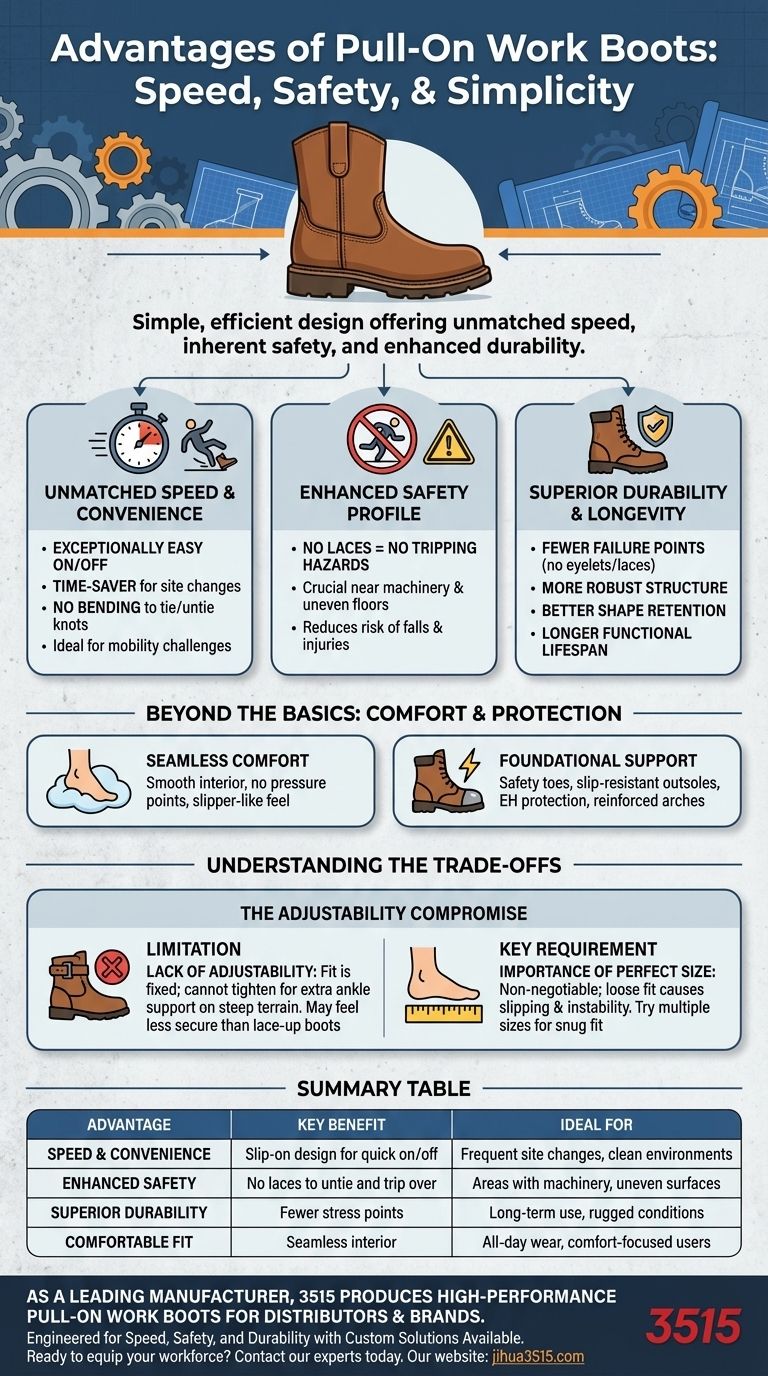
The primary advantages of pull-on work boots are rooted in their simple, efficient design. They offer unmatched speed for putting on and taking off, an inherent safety benefit by eliminating laces that can become tripping hazards, and enhanced durability due to fewer stress points like eyelets that can wear out over time.
Choosing pull-on work boots is a decision to prioritize speed, safety, and structural simplicity. While they offer unmatched convenience, this comes at the cost of the fine-tuned, adjustable ankle support that only lace-up boots can provide.

The Core Benefits of a Laceless Design
The defining characteristic of a pull-on boot is the absence of laces. This single design choice creates several distinct advantages for workers in specific environments.
Unmatched Convenience and Speed
Pull-on boots are exceptionally easy to put on and take off. This slip-on functionality is a significant time-saver, especially for professionals who frequently move between job sites and clean indoor environments.
There is no need to bend down to tie or untie knots, which is also a benefit for individuals with mobility challenges.
Enhanced Safety Profile
The lack of laces completely removes the risk of them coming untied and creating a dangerous tripping hazard. This is particularly important in workplaces with moving machinery, uneven surfaces, or cluttered floors where a fall could lead to serious injury.
Superior Durability and Longevity
Laces and eyelets are common points of failure on work boots. Over time, laces fray and break, and eyelets can tear out from the leather under high tension.
By eliminating these components, pull-on boots have a more streamlined and robust structure. This often results in better shape retention and a longer functional lifespan.
Beyond the Basics: Comfort and Protection
While the laceless design defines them, modern pull-on boots do not compromise on the features expected from any high-quality piece of safety footwear.
A Seamless, Comfortable Fit
The interior of a pull-on boot offers a smooth, seamless fit without the pressure points that laces can create across the top of the foot. Many users describe this as a more comfortable, slipper-like feel for all-day wear.
Foundational Support Features
High-quality pull-on boots are built with the same protective technologies as their lace-up counterparts.
These essential features include safety toes (steel or composite), oil- and slip-resistant outsoles, electrical hazard (EH) protection, and reinforced arches for support when climbing ladders. Their high-cut shafts also provide excellent protection against abrasions.
Understanding the Trade-offs
To make an informed decision, you must recognize the inherent compromises that come with a laceless design. The primary trade-off is the relationship between convenience and fit.
The Lack of Adjustability
The fit you get out of the box is the fit you will always have. You cannot tighten the boot for extra ankle support when navigating steep inclines or highly uneven terrain.
This lack of adjustability means the boot may not feel as secure as a tightly cinched lace-up boot during certain tasks.
The Importance of a Perfect Size
Because you cannot adjust the fit, selecting the exact right size is non-negotiable. A boot that is too loose will allow your heel to slip, causing friction and instability.
You may need to try on several sizes to find a snug fit that properly secures your foot and ankle. Using a shoehorn can help ease your foot in without damaging the boot's heel structure.
Making the Right Choice for Your Work
Choosing between pull-on and lace-up boots depends entirely on the realities of your job and your personal priorities.
- If your primary focus is speed and convenience: Pull-on boots are the undisputed winner, especially if you frequently enter and exit clean environments.
- If your primary focus is maximum ankle support on uneven terrain: A lace-up boot is the superior choice for its ability to be cinched tight and secure your foot.
- If your primary focus is durability and minimizing failure points: The simpler, laceless construction of pull-on boots gives them a distinct advantage for long-term structural integrity.
Ultimately, the right boot is the one that best matches the specific demands of your workday.
Summary Table:
| Advantage | Key Benefit | Ideal For |
|---|---|---|
| Speed & Convenience | Slip-on design for quick on/off | Frequent site changes, clean environments |
| Enhanced Safety | No laces to untie and trip over | Areas with machinery, uneven surfaces |
| Superior Durability | Fewer stress points (no eyelets/laces) | Long-term use, rugged conditions |
| Comfortable Fit | Seamless interior, no pressure points | All-day wear, comfort-focused users |
As a leading manufacturer, 3515 produces a comprehensive range of high-performance pull-on work boots for distributors, brand owners, and bulk clients.
Our boots are engineered to deliver the speed, safety, and durability your customers need. We offer custom solutions with essential features like safety toes, slip-resistant outsoles, and EH protection.
Ready to equip your workforce with reliable footwear? Contact our experts today to discuss your specific requirements and explore our full production capabilities for all types of shoes and boots.
Visual Guide
Related Products
- Wholesale Leather Work Boots with Customizable Wedge Sole for Brands
- Durable Leather Moc Toe Work Boots for Wholesale & Custom Manufacturing
- Durable Moc-Toe Wedge Work Boots | Wholesale Manufacturing for Brands
- Durable Goodyear Welt Leather Work Boots for Wholesale & Private Label
- Durable Leather Work Boots for Wholesale & Custom Manufacturing
People Also Ask
- What is the difference between full-grain and top-grain leather? Premium Material Guide for Boot Manufacturers
- What are the advantages of leather as an upper material for work boots? Unmatched Durability & Custom Comfort
- How can leather work boots be protected from environmental elements? A 3-Step Guide to Lasting Durability
- What is the complete process for deep cleaning leather work boots? A Step-by-Step Guide to Preserve Your Investment
- What are the key qualities of leather for work boots? Superior Durability, Breathability & Custom Fit