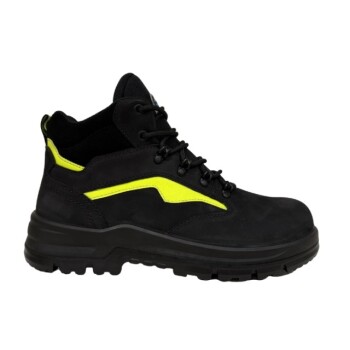
Ultimately, investing in high-quality work boots is a financial and health strategy, not just a purchase. The long-term benefits extend far beyond simple durability, directly impacting your total cost of ownership, your physical well-being, and your ability to earn an income by preventing injuries and chronic strain.
While the upfront cost is higher, premium work boots are a smarter long-term investment. Their superior durability, repairability, and protective features lead to lower overall costs and prevent the significant financial and physical price of workplace injuries.

The Financial Case for Quality Boots
Many professionals focus on the initial price tag, but the true cost of footwear is measured over years of use. High-quality boots are designed to deliver value over this extended timeline.
Beyond the Initial Price Tag
Cheaper boots require frequent replacement. A $70 boot replaced twice a year costs more over three years than a single $300 pair that lasts the entire period. This concept of amortized cost, or cost-per-wear, almost always favors the higher-quality option.
The Power of Repair and Resoling
Premium boots are often constructed in a way that allows them to be repaired. A technique like a Goodyear welt means a worn-out sole can be replaced by a cobbler, drastically extending the boot's life for a fraction of the cost of a new pair.
Consistent Performance Over Time
Quality materials like full-grain leather and robust sole compounds do not degrade as quickly. This ensures the boot provides consistent support and protection for years, unlike cheaper alternatives that lose their structural integrity rapidly.
The Critical Link Between Boots and Your Health
Your boots are the primary line of defense for your feet and a critical component of your overall physical health. Investing in them is a form of preventative care.
Preventing Costly Injuries
Superior protection—such as reinforced safety toes, puncture-resistant plates, and slip-resistant outsoles—directly prevents accidents. A single avoided injury can save you thousands in medical bills and emergency care.
Reducing Chronic Physical Strain
Proper arch support, cushioning, and an ergonomic fit reduce the daily impact on your feet, ankles, knees, and back. This helps prevent chronic conditions like plantar fasciitis or joint pain that can develop over a career.
The Hidden Cost of Lost Income
The most significant expense from an injury is often not the medical bill, but the lost income from being unable to work. Quality boots are a tool that keeps you safe, healthy, and on the job.
Understanding the Trade-offs
While the benefits are clear, it is crucial to acknowledge the practical considerations of investing in high-end work boots.
The Upfront Investment
The primary hurdle is the initial cost. A high price tag can be a significant barrier, especially for those just starting in a trade.
The Break-in Period
Durable materials, particularly thick leather, often require a break-in period. This can involve some initial discomfort as the boots mold to your feet, which is not typically an issue with softer, less durable boots.
Maintenance Is Required
To achieve maximum lifespan, quality boots require care. Regular cleaning, conditioning, and proper storage are necessary to maintain the materials and construction, which represents a time commitment.
Making the Right Investment for Your Work
Choosing the right boot depends on balancing your budget with the demands of your job and your long-term goals.
- If your primary focus is minimizing long-term costs: Choose a boot from a reputable brand known for durability and repairable construction, as this will deliver the lowest cost-per-wear.
- If your primary focus is personal safety and health: Prioritize boots with certified protection features and superior ergonomic support to prevent both immediate injuries and chronic physical strain.
- If your primary focus is a tight immediate budget: Seek out entry-level models from trusted brands, which offer a baseline of quality and safety that is superior to generic, low-cost alternatives.
Investing in your boots is a direct investment in the foundation of your career, your health, and your financial security.
Summary Table:
| Benefit Category | Key Long-Term Advantages |
|---|---|
| Financial | Lower cost-per-wear, repairable construction (e.g., Goodyear welt), consistent performance |
| Health & Safety | Prevents costly injuries, reduces chronic physical strain, protects against lost income |
| Overall Value | A direct investment in career longevity, health, and financial security |
Ready to invest in boots that protect your workforce and your bottom line?
As a large-scale manufacturer, 3515 produces a comprehensive range of high-quality, durable work boots and safety footwear for distributors, brand owners, and bulk clients. Our production capabilities ensure you get the protective features, ergonomic support, and long-lasting construction your business depends on.
Contact 3515 today to discuss your specific needs and discover how our footwear solutions can become a strategic asset for your operation.
Visual Guide

Related Products
- Durable Leather Work Boots for Wholesale & Custom Manufacturing
- Durable Leather Moc Toe Work Boots for Wholesale & Custom Manufacturing
- Durable Leather Work Boots for Wholesale & Custom OEM Manufacturing
- Durable Leather Work Boots Wholesale Manufacturer & Custom Factory
- Durable Goodyear Welt Leather Work Boots for Wholesale & Private Label
People Also Ask
- What is the difference between full-grain and top-grain leather? Premium Material Guide for Boot Manufacturers
- What are the common workplace hazards that can be mitigated with the right work boots? Protect Your Workforce
- What are the common foot issues workers face due to uncomfortable work boots? Prevent Pain & Deformities
- What are the advantages of leather versus synthetic work boots? A Guide to Choosing the Right Material
- What are the key components of modern work boots? Engineered for Ultimate Durability and Comfort